
Child IQ Testing in Palmdale, CA

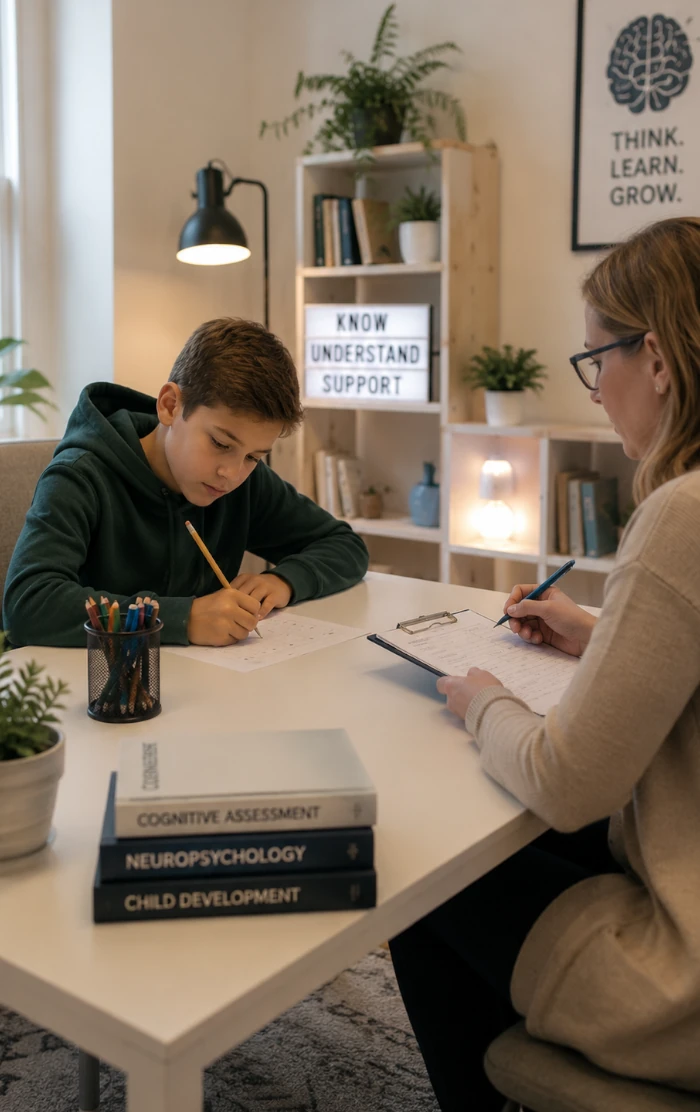
Professional child IQ testing in Palmdale, CA – whether you need an assessment for school placement, gifted program eligibility, or to understand your child's learning profile, we connect you with licensed psychologists in the Palmdale, CA area.
Last Updated: September 2026
Gifted Testing
Identify giftedness for school placement, enrichment, and talent programs using WISC-V or Stanford-Binet 5.
WISC-V Test
Wechsler Intelligence Scale for Children® Fifth Edition – the gold standard for child IQ testing.
Stanford-Binet 5
Stanford-Binet Intelligence Scales Fifth Edition – comprehensive cognitive assessment for all ages.
Full Evaluation
Combined assessment with detailed report and recommendations. Includes WISC-V or Stanford-Binet 5.
School Placement Testing
Testing for private school admission and gifted program eligibility using WISC-V or Stanford-Binet 5.
Schedule Child IQ Testing
Book your WISC-V & Stanford-Binet 5 for ages 6–16. Gifted identification, learning profiles, etc. with a licensed psychologist in Palmdale, CA today.
Child IQ Testing in Palmdale, CA: city context
Palmdale is a young, diverse High Desert city in northern Los Angeles County. The U.S. Census Bureau estimated 161,845 residents on July 1, 2025, compared with a 2020 Census population of 169,450, across approximately 106.06 square miles of land. About 29.5% of residents are under age 18, making school referral, developmental assessment, gifted identification, and learning-support questions especially relevant to local families.
Current Census context includes a population that is approximately 50.6% female, 63.5% Hispanic or Latino, and 25.4% foreign born. About 53.9% of residents age five and older speak a language other than English at home. These figures describe community context—not intelligence—and they make careful review of language development, quality and continuity of instruction, immigration or migration history, disability, culture, and test-language fit essential.
Families seek child cognitive assessment for gifted identification, learning differences, attention concerns, developmental or diagnostic clarification, disability and accommodation documentation, school placement, twice-exceptionality, and private educational planning. Palmdale’s long commutes and movement between local schools, charter programs, the Antelope Valley, and other parts of Los Angeles County can also complicate record continuity and appointment scheduling.
Modern intelligence tests are normed so broad male and female averages are similar, although individual profiles can differ across verbal comprehension, visual-spatial reasoning, fluid reasoning, working memory, and processing speed. There is no authoritative city dataset establishing separate Palmdale IQ averages by gender, race, ethnicity, neighborhood, income, or home language.
- White alone: 23.4%; Black alone: 13.1%; Asian alone: 4.8%; American Indian or Alaska Native alone: 1.6%; Native Hawaiian or Other Pacific Islander alone: 0.1%.
- Two or more races: 21.7%; Hispanic or Latino: 63.5%; White alone, not Hispanic or Latino: 15.5%.
- Educational context: 77.2% of adults age 25 and older are high-school graduates or higher, and 17.1% hold a bachelor’s degree or higher.
- Economic context: median household income is $81,770, per-capita income is $29,441, and 15.7% of residents are in poverty in 2020–2024 estimates.
These percentages must never be used as proxies for cognitive potential. A qualified examiner combines developmental, educational, medical, linguistic, cultural, and family history with behavioral observations, multiple test scores, and validity considerations. A private score does not by itself establish school eligibility, and no child should be judged from a single number.
Palmdale School District and Gifted Programs
Palmdale School District primarily serves elementary and middle-grade students and maintains Gifted and Talented Education activities, including family information and parent meetings at participating schools. Identification procedures, grade levels, referral windows, screening measures, service models, and appeal processes can change, so parents should obtain current written guidance directly from the district rather than relying on a prior year’s webpage or another district’s rules.
High-school students generally transition to the Antelope Valley Union High School District. Palmdale-area campuses—including Palmdale, Highland, Knight, and specialized or charter options—provide combinations of Advanced Placement, honors-level study, career academies, technical pathways, dual enrollment, engineering, health careers, public service, robotics, computer science, unmanned-aircraft programs, arts, and other college-and-career opportunities. Availability and prerequisites differ by campus and year.
Gifted identification, special-education evaluation, English-learner services, Section 504 accommodations, course placement, acceleration, and AP enrollment are separate processes with different standards. Families should preserve prior evaluations, IEPs, 504 plans, achievement reports, intervention records, teacher observations, and language-development information when changing schools or districts.
Private IQ results may add useful information, but they do not automatically establish district GATE eligibility, special-education eligibility, acceleration, class placement, or accommodations. School teams retain decision-making authority under district policy and applicable California and federal law.
Palmdale, CA Private Schools Requiring IQ Testing
There is no reliable citywide list showing that Palmdale private, charter, or magnet schools universally require an individually administered IQ test. Many schools rely on prior records, achievement data, interviews, portfolios, readiness measures, or their own placement procedures. The Palmdale Aerospace Academy and other charter options have their own admissions and educational policies; charter enrollment rules are not the same as private-school admissions.
Before arranging private testing, request the school’s written policy identifying the accepted instrument, edition, age range, minimum score if any, report recency, examiner credentials, and whether achievement or adaptive measures are also required. This prevents families from purchasing a report that the school will not use.
Palmdale, CA Gifted Identification Statistics
Palmdale School District does not provide a single current public statistic that can be interpreted as the percentage of all Palmdale children who are gifted. Enrollment and identification counts can vary by year, school, grade, referral access, language, disability, educational opportunity, and the district’s current definition and criteria.
- Multiple evidence sources: School review may consider ability or achievement measures, classroom performance, work samples, teacher and parent input, creativity, motivation, and other district-approved evidence.
- Multilingual learners: More than half of Palmdale residents age five and older speak a language other than English at home; language proficiency and opportunity to learn must be distinguished from reasoning ability.
- Twice-exceptionality: ADHD, dyslexia, autism, language disorder, anxiety, or another disability can coexist with advanced reasoning and may mask strengths or create uneven scores.
- Equitable referral: Students who are economically disadvantaged, mobile, disabled, or less likely to be nominated may be under-identified unless schools use broad and fair referral practices.
- Outside reports: Private evaluations may inform review but do not replace district procedures or committee decisions.
National percentile expectations and “top two percent” descriptions should not be treated as local enrollment guarantees. Families should request the district’s current criteria, timelines, appeal procedures, and program data directly.
The child IQ testing process: step by step
Understanding the testing process can help parents prepare their child and reduce anxiety. Here's what to expect:
- Initial consultation (15–20 minutes): A brief phone or video call with the psychologist to discuss your child's background, concerns, and goals. This helps determine the right test and approach.
- Testing session (60–90 minutes): The child meets one-on-one with a licensed psychologist in a quiet, comfortable room. The psychologist administers the WISC-V or Stanford-Binet 5, which includes a series of subtests measuring verbal comprehension, visual-spatial reasoning, fluid reasoning, working memory, and processing speed. Breaks are offered as needed.
- Scoring and interpretation (1–2 days): The psychologist scores the test and analyzes the results. They consider the child's age, background, and any relevant medical or educational history.
- Feedback session (45–60 minutes): The psychologist meets with the parents (and the child, if appropriate) to explain the results. They discuss the Full-Scale IQ, index scores, strengths, and areas for growth. They also provide tailored recommendations for home, school, and extracurriculars.
- Comprehensive written report (5–7 days): You receive a detailed report with all scores, normative comparisons, and actionable next steps. This report can be shared with schools, doctors, or other professionals.
The full process includes intake, records review, testing, scoring, feedback, and report preparation. Timing varies with provider availability and referral complexity, so confirm deadlines before scheduling. The testing itself is non-invasive and designed to be engaging for children.
What is the WISC-V test?
The WISC-V (Wechsler Intelligence Scale for Children® – Fifth Edition) is the most widely used IQ test for children aged 6:0–16:11. It provides a Full-Scale IQ and five primary index scores: Verbal Comprehension, Visual-Spatial, Fluid Reasoning, Working Memory, and Processing Speed. The test is administered one-on-one by a trained psychologist and takes about 60–90 minutes.
The WISC-V is normed on a large, representative sample of U.S. children and is updated regularly to ensure accuracy. It is the gold standard for gifted identification, learning disability diagnosis, and school placement.
Why test your child's IQ?
IQ testing provides valuable insights into your child's cognitive strengths and weaknesses. It can help:
- Identify giftedness: For admission to gifted programs, private schools, or enrichment opportunities.
- Diagnose learning disabilities: Such as dyslexia, dyscalculia, or ADHD, which can be masked by high intelligence.
- Guide educational planning: Tailor instruction to your child's unique learning profile.
- Provide reassurance: Understand why your child is different from peers and how to support them.
Palmdale, CA Gifted Testing Timeline
- Clarify the purpose: District GATE referral, private-school review, acceleration, enrichment planning, twice-exceptional evaluation, or another clinical question.
- Obtain current dates: Referral, consent, screening, committee, placement, and appeal windows may change each school year and by grade.
- Gather records: Report cards, achievement data, prior gifted decisions, IEP or 504 documents, intervention history, teacher observations, developmental information, and language background.
- Plan language access: Tell the examiner about bilingual development, English-learning history, interpreters, and the languages used at home and school before selecting an instrument.
- Schedule with enough lead time: Allow for intake, testing, scoring, feedback, report completion, school review, illness, travel, and possible follow-up questions.
- Avoid unnecessary retesting: Practice effects, test-security rules, and receiving-agency standards may limit how soon a measure can be repeated.
- Plan services—not only a score: Discuss differentiation, advanced coursework, acceleration, enrichment, peer fit, emotional needs, and twice-exceptional support.
Private evaluation schedules depend on provider availability and referral complexity. Ask for realistic timing instead of assuming a fixed one- or two-week turnaround.
Palmdale, CA Gifted Programs by Age Group
- Preschool and early childhood: Focus on developmental observation, language exposure, play, and readiness; very early scores can be less stable.
- Elementary and middle grades: Palmdale School District GATE activities, differentiated instruction, enrichment, and school-based services depend on current district procedures.
- High school: AVUHSD students can pursue Advanced Placement, honors-level work, dual enrollment, engineering, health careers, public service, robotics, computer science, and other career pathways at Palmdale-area campuses.
- Community enrichment: Palmdale City Library, parks and recreation, museums and aerospace resources in the wider Antelope Valley, clubs, arts, coding, and college programs can supplement school services.
Program fit should consider motivation, emotional maturity, interests, workload, transportation, and social needs—not only an IQ score.
Palmdale, CA Child ADHD and Learning Disability Assessment
A child who is bright may still have ADHD, dyslexia, dysgraphia, dyscalculia, language disorder, autism, anxiety, trauma-related symptoms, hearing or vision problems, sleep disruption, or another condition affecting school performance. A full evaluation can combine cognitive, achievement, attention, language, executive-function, adaptive, behavioral, developmental, and social-emotional information as appropriate.
Families can request a school evaluation in writing when a disability is suspected. Palmdale School District and AVUHSD maintain their own Child Find, special-education, Section 504, intervention, and related-service procedures. A private evaluation may provide additional detail but does not replace the school team’s legal process, while a school evaluation is not automatically equivalent to a broad clinical diagnosis.
Because many Palmdale children are bilingual or multilingual, the examiner should distinguish limited exposure to academic English from a disorder and use interpreters, bilingual assessment practices, nonverbal measures, or additional language data when appropriate. Parents should retain complete copies of reports, score tables where lawfully available, IEPs, 504 plans, progress monitoring, and accommodation records when students transfer.
Palmdale, CA Summer Programs for Gifted Children
Summer options change annually and may include Palmdale City Library activities, City of Palmdale recreation and arts programs, Antelope Valley College youth or community offerings, school-district enrichment, robotics and coding programs, aerospace-related learning, camps, and regional museum or university activities.
Programs differ in age range, cost, supervision, transportation, language support, disability access, application requirements, and whether they are enrichment rather than formal gifted services. Many strong programs use interest, grade level, a portfolio, or teacher recommendation rather than an IQ score.
Families should also consider heat, travel distance, scheduling, workload, and the child’s social and emotional fit. A child does not need a clinical IQ label to benefit from challenging, interest-based activities, independent projects, reading groups, arts, science, or community learning.
Palmdale, CA Child Testing Costs by District
When Palmdale School District, AVUHSD, or another public school evaluates a student under applicable special-education law, eligible school-based assessment is provided through the public process rather than billed as a private clinical service. Gifted screening, special-education evaluation, and privately requested IQ testing follow different rules and serve different purposes.
- Focused cognitive assessment: Usually costs less than a comprehensive evaluation but may not answer learning, ADHD, autism, language, emotional, or accommodation questions.
- Comprehensive evaluation: Costs more because it may include interviews, records, several test batteries, scoring, interpretation, feedback, and a detailed written report.
- Insurance: Coverage depends on medical necessity, diagnosis, network status, exclusions, authorization, and whether the plan considers testing educational.
- School acceptance: A family can pay privately and still find that a district or program requires different instruments, recency, examiner credentials, or its own evaluation.
- Additional services: Interpreter time, travel, expedited reports, school meetings, record review, or added testing may be billed separately.
Request a written estimate identifying instruments, professional time, records review, feedback, report, cancellation terms, and possible added charges. Confirm the receiving school’s outside-report policy before paying.
Areas we serve
We support all areas of Palmdale, CA.
Frequently Asked Questions
Both are excellent tests. WISC-V is more commonly used for school-age children, while Stanford-Binet 5 can be used for ages 2–85. We often recommend WISC-V for gifted identification.
The testing session often takes about 60–90 minutes for a focused measure, but broader batteries take longer. Intake, records review, scoring, feedback, and report timing vary by provider and referral complexity.
Referral requirements vary. Contact the psychologist directly and ask whether self-referral is accepted; insurance, school, or agency funding may require authorization or a formal referral.
A private report may be reviewed as one source of information, but Palmdale School District and each private program apply their own current eligibility, score, recency, instrument, and documentation rules. Obtain those requirements before testing; no private report guarantees admission or placement.
Some plans cover cognitive assessments when there is a clinical indication. Check with your provider.
Get a good night's sleep, eat a healthy meal, and arrive relaxed. No specific preparation is needed.
You'll receive a comprehensive report with your child's scores and tailored recommendations.
Some interview and feedback components may be available remotely, but many standardized cognitive tests require in-person administration. Confirm with the psychologist and the organization receiving the report.