
Gifted Testing in Palm Bay

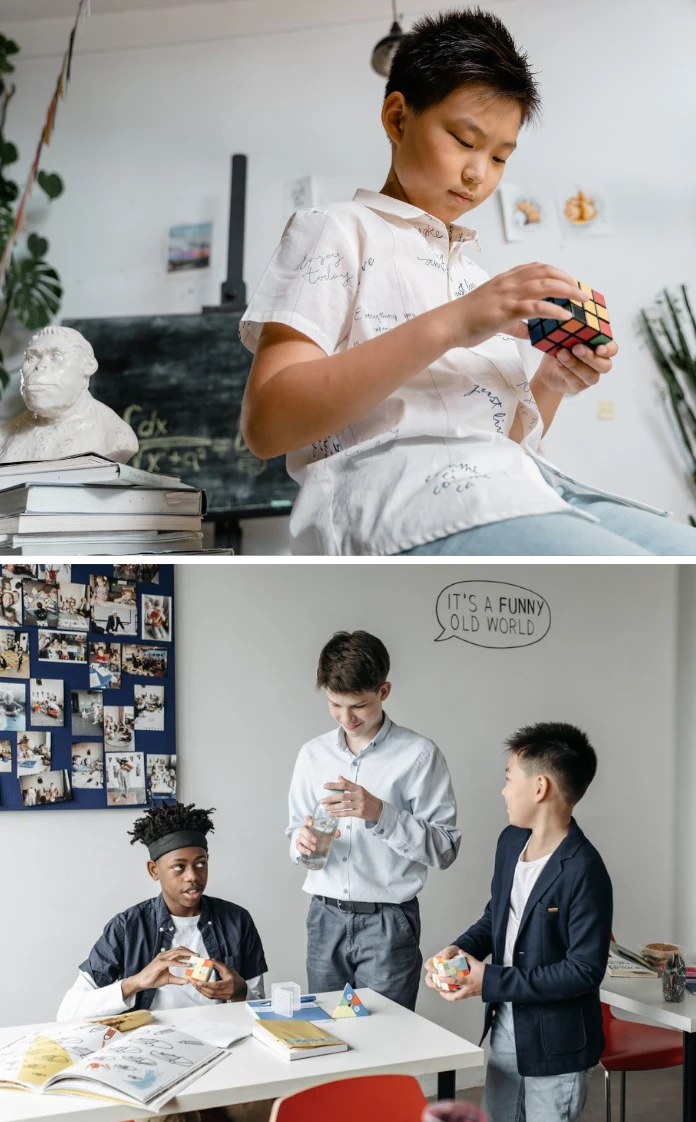
Professional gifted testing in Palm Bay – whether your child needs identification for school placement, enrichment programs, or you're an adult seeking Mensa admission, we connect you with licensed psychologists who specialize in gifted assessment.
Last Updated: September 2026
Child Gifted Testing
WISC-V & Stanford-Binet 5 for ages 6–16. Gifted identification, school placement.
Adult Gifted Testing
WAIS-IV & WAIS-5 available. Comprehensive assessments for adults seeking Mensa or career guidance.
WISC-V Test
Wechsler Intelligence Scale for Children® Fifth Edition – the gold standard for child gifted identification.
Stanford-Binet 5
Stanford-Binet Intelligence Scales Fifth Edition – comprehensive cognitive assessment for all ages, often used for gifted identification.
Mensa Testing
Mensa admission testing and preparation for the high-IQ society. Accepts WAIS-IV, WAIS-5, and Stanford-Binet 5 scores.
School Placement Testing
Testing for private school admission and gifted program eligibility using WISC-V or Stanford-Binet 5.
Gifted Testing in Palm Bay: city context
Gifted assessment in Palm Bay may support Brevard Public Schools referral, private-school planning, acceleration discussions, twice-exceptional evaluation, or a clearer understanding of advanced and uneven development. The receiving program's rules should be obtained before private testing.
Florida gifted eligibility considers multiple areas of evidence. A private IQ score can be informative, but it does not automatically create public-school eligibility, placement, or services.
IQ by gender & ethnicity (child population)
Modern tests are designed so broad male and female averages are similar. No valid Palm Bay dataset ranks children by gender, race, ethnicity, disability, bilingual status, income, school, or neighborhood. Individual identification should integrate opportunity to learn, language, achievement, observations, creativity, motivation, and disability.
- Do not infer ability from race, language, family income, gender, disability, or immigration history.
- Use qualified bilingual or language-informed assessment when English proficiency could affect results.
- Look for twice-exceptional profiles in which high reasoning coexists with ADHD, autism, dyslexia, language disorder, or another disability.
Gifted children in Palm Bay: who are they?
Gifted children are not a single personality type. Palm Bay students may demonstrate advanced reasoning, creativity, leadership, academic achievement, artistic talent, intense interests, rapid learning, or unusual problem solving while still needing support in other areas.
- Some thrive in advanced classes; others need acceleration, mentorship, science, technology, arts, technical, or project-based opportunities.
- High ability may be masked by disability, language development, inconsistent schooling, anxiety, perfectionism, or limited access to enrichment.
- Evaluation should explain the child's pattern and educational implications rather than reducing the child to a percentile.
Schools for gifted children in Palm Bay
Brevard Public Schools provides gifted and advanced pathways under district and Florida rules, while specialty, charter, private, faith-based, and home-study options establish their own criteria. Families should compare service model, course depth, arts and STEM access, disability support, transportation, and social-emotional fit.
- Ask how gifted services are delivered at the assigned school and how often students receive differentiated instruction.
- Verify choice-program and private-school deadlines directly; do not assume an IQ score is required.
- For twice-exceptional students, review both advanced-learning and disability-support capacity.
Advantages of gifted education
- Appropriate pace, depth, complexity, and opportunities for independent inquiry.
- Access to intellectual peers without assuming uniform social or emotional development.
- Support for creativity, leadership, research, art, design, technical work, and problem solving.
- Earlier recognition of twice-exceptional needs and underachievement.
Hobbies and interests of gifted children
Palm Bay offers authentic contexts for history, architecture, preservation, visual art, music, writing, film, coding, engineering, environmental and life sciences, ecology, logistics, and civic learning. Interests should guide enrichment, but hobbies are not diagnostic evidence of giftedness.
What is giftedness?
Giftedness is a complex and multifaceted construct that goes beyond a single IQ score. In the field of psychology, giftedness is typically defined as an IQ score of 130 or above (the 98th percentile), but it also encompasses exceptional creativity, leadership ability, or talent in specific academic or artistic domains.
However, in Palm Bay and across the U.S., the definition of giftedness is evolving. Many psychologists and educators now recognize that giftedness manifests in diverse ways, including:
- Intellectual giftedness: Exceptional reasoning, problem-solving, and abstract thinking.
- Creative giftedness: Unusual originality, imagination, and ability to generate novel ideas.
- Leadership giftedness: Exceptional interpersonal skills, empathy, and ability to inspire others.
- Artistic giftedness: Superior talent in visual arts, music, drama, or dance.
- Twice-exceptional (2E): Gifted individuals who also have a learning disability or neurodivergence such as ADHD or dyslexia.
In Palm Bay, where diversity and inclusion are highly valued, there is a growing movement to identify and support gifted students from all backgrounds, including those who may be underserved by traditional testing methods.
Palm Bay Gifted Identification Statistics
No authoritative source publishes a current gifted-identification rate specifically for children residing inside Palm Bay city limits. Brevard Public Schools reports are countywide, and private programs use different definitions and reporting practices.
- Do not create a city estimate by applying a national gifted percentage to Palm Bay's population.
- Compare referral, evaluation, eligibility, participation, and service figures carefully; they are not interchangeable.
- Representation should be reviewed alongside language, disability, mobility, poverty, and access to advanced instruction.
Palm Bay Gifted Testing Timeline
- School pathway: Ask the assigned school about current nomination, referral, consent, testing, eligibility, and placement dates.
- Private pathway: Allow time for consultation, records, testing, scoring, feedback, and the written report.
- Deadlines: Start before school-choice, acceleration, private-school, summer-program, or accommodation deadlines.
- Acceptance: Confirm the receiving organization's test, edition, score, examiner, and recency rules in writing.
Palm Bay Gifted Programs by Age Group
- Early childhood: Developmental observation, play, language, curiosity, and readiness are important; scores are less stable at very young ages.
- Elementary: District differentiation, gifted services, enrichment, specialty options, and flexible pacing may provide challenge.
- Middle school: Advanced coursework, arts, STEM, competitions, clubs, mentorship, and project-based learning can deepen interests.
- High school: AP, IB, dual enrollment, career academies, arts programs, research, internships, and college planning offer multiple advanced pathways.
Unique challenges and nuances of giftedness
Giftedness is not always a straightforward advantage. Many gifted individuals face unique challenges that can impact their well-being and success:
- Asynchronous development: Gifted children often have intellectual abilities that outpace their social and emotional maturity. This can lead to frustration, social isolation, and difficulty relating to peers.
- Perfectionism: Many gifted individuals set unrealistically high standards for themselves, leading to anxiety, burnout, and avoidance of challenges.
- Underachievement: Gifted students may underperform in school if they are not adequately challenged or if their learning needs are not met.
- Social isolation: Gifted individuals may struggle to find peers who share their interests and intellectual intensity, leading to loneliness and depression.
- Twice-exceptionality (2E): Many gifted individuals also have learning disabilities or neurodivergence, such as ADHD, dyslexia, or autism. This can mask their abilities and make it difficult to receive appropriate support.
- Cultural and ethnic disparities: Giftedness is often under-identified in minority and low-income populations due to cultural biases in testing and limited access to enrichment programs. Palm Bay is actively working to address these disparities through inclusive identification practices.
Gifted testing can help identify these challenges and provide a roadmap for support. A comprehensive evaluation can reveal not only strengths but also areas where intervention is needed.
Mensa and high-IQ societies
- Qualification: Mensa membership requires an accepted score at or above the 98th percentile.
- Children: American Mensa offers youth resources, but parents should review privacy, social fit, and the child's interest before applying.
- Accepted evidence: Requirements depend on test, edition, score, date, and documentation.
- School distinction: Mensa qualification is not the same as Palm Bay-area gifted eligibility, honors placement, or selective-school admission.
- Clinical distinction: A Mensa admission test does not diagnose ADHD, learning disability, autism, or emotional concerns.
- Local community: Palm Bay-area families can use American Mensa's official Florida local-group directory for current events and contacts.
Areas we serve
We support all areas of Palm Bay. Verify the child's assigned school, program requirements, and evaluator's exact office because postal, municipal, county, and attendance-zone boundaries can differ.
Frequently Asked Questions
Both are excellent tests. WISC-V is more commonly used for school-age children, while Stanford-Binet 5 can be used for ages 2–85. We often recommend WISC-V for school placement and Stanford-Binet 5 for highly gifted individuals.
The test itself takes 60–90 minutes. With the consultation, feedback, and report, the entire process is about 1–2 weeks.
Many private psychologists accept self-referrals, but schools, insurers, scholarship programs, and high-IQ societies apply their own evidence and authorization rules. Confirm acceptance before booking.
Potentially. Acceptance depends on the exact test, edition, qualifying score, administration date, examiner credentials, and current Mensa documentation rules. Confirm before testing.
Some plans cover cognitive assessments when there is a clinical indication. Check with your provider.
Get a good night's sleep, eat a healthy meal, and arrive relaxed. No specific preparation is needed.
You'll receive a comprehensive report with your scores and tailored recommendations.
Some interview and feedback components may be available remotely, but many standardized cognitive tests require in-person administration. Confirm with the psychologist and the organization receiving the report.
Not exactly. Smartness is a colloquial term, while giftedness is a clinical construct involving specific cognitive abilities and traits.
Ask for a comprehensive evaluator experienced in both advanced ability and disabilities. Cognitive, achievement, attention, language, developmental, behavioral, and school evidence may all be needed to avoid masking strengths or support needs.