
IQ Testing in Oklahoma City

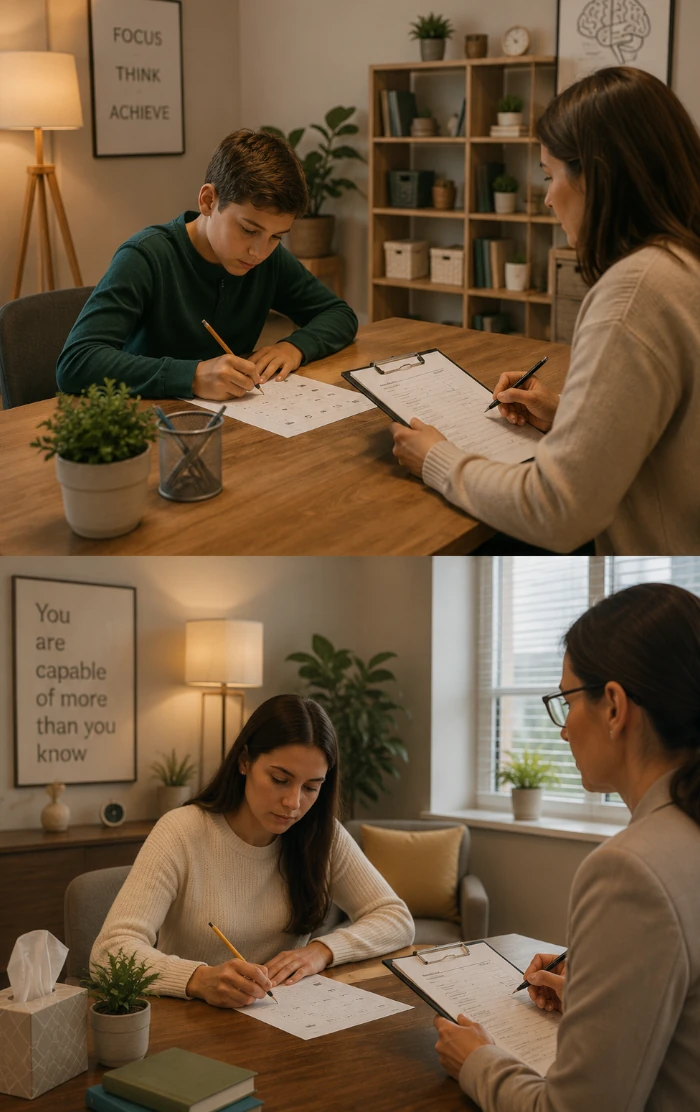
Professional IQ testing in Oklahoma City – whether you need an assessment for school, employment, gifted program eligibility, or personal insight, we connect you with licensed psychologists in the Oklahoma City area.
Last Updated: October 2026
Child IQ Testing
WISC-V & Stanford-Binet for ages 6–16. Gifted identification, learning profiles.
Adult IQ Testing
WAIS-IV & WAIS-5 available. Comprehensive adult cognitive assessments. Clinical & occupational.
WISC-V Test
Wechsler Intelligence Scale for Children® Fifth Edition – the gold standard for child IQ testing.
WAIS-IV & WAIS-5 Tests
Wechsler Adult Intelligence Scale® – Fourth Edition (WAIS-IV) and Fifth Edition (WAIS-5) available for adult IQ testing.
Gifted Testing
Identify giftedness for school placement, enrichment, and talent programs using WISC-V or Stanford-Binet.
Stanford-Binet 5
Stanford-Binet Intelligence Scales Fifth Edition – comprehensive cognitive assessment for all ages.
Mensa Testing
Mensa qualification guidance and testing that may provide accepted prior evidence, subject to current American Mensa rules. American Mensa's published prior-evidence list includes WAIS-IV and Stanford-Binet 5; verify current acceptance of WAIS-5 before testing.
Full Evaluation
Combined assessment with detailed report and recommendations. Includes WISC-V, WAIS-IV, WAIS-5, or Stanford-Binet 5 as appropriate.
IQ Testing in Oklahoma City: city context
Oklahoma City is Oklahoma's capital and largest city, with a U.S. Census Bureau population estimate of approximately 719,849 in 2025. Its 2020 land area was about 606.20 square miles, and the city extends into Oklahoma, Canadian, Cleveland, and Pottawatomie counties.
The area includes Oklahoma City University, the University of Oklahoma Health Sciences Center, Oklahoma State University–Oklahoma City, Oklahoma City Community College, the University of Central Oklahoma in nearby Edmond, OU Health, Oklahoma Children's Hospital OU Health, INTEGRIS Health, the Oklahoma City VA Health Care System, and licensed private practices. These resources support cognitive assessment, educational planning, disability documentation, career guidance, and neuropsychological care.
IQ, gender, and demographic context
Professional IQ tests use age-based national norms. They are not scored against a separate Oklahoma City norm for men, women, racial groups, or ethnic groups. Research generally finds substantial overlap in overall IQ distributions by sex, while individual profiles can differ across verbal, visual-spatial, working-memory, and processing-speed tasks.
Current Oklahoma City Census context:
- Female residents: 50.6% of the city population.
- White alone: 55.5%.
- Black or African American alone: 13.4%.
- American Indian and Alaska Native alone: 3.2%.
- Asian alone: 4.6%.
- Two or more races: 16.8%.
- Hispanic or Latino: 22.1%; Hispanic origin may overlap with race categories.
- Language other than English spoken at home: 21.6% of residents age 5 and older.
No authoritative public dataset establishes valid Oklahoma City IQ averages by gender, race, ethnicity, or neighborhood. A psychologist interprets an individual's results in light of age, education, language, culture, disability, health, effort, and testing conditions rather than assigning ability from demographic membership.
What is professional IQ testing?
Intelligence quotient (IQ) testing is a standardized method to measure human cognitive abilities and intellectual potential. Professional IQ tests are administered by licensed psychologists in a controlled environment to ensure accuracy and reliability. Unlike online quizzes, clinical assessments provide a full-scale IQ score along with detailed breakdowns of verbal comprehension, perceptual reasoning, working memory, and processing speed.
In Oklahoma City, IQ testing is commonly used for gifted program admission, learning disability identification, career guidance, neuropsychological evaluation, and personal development. The results are presented in a comprehensive report that includes normative comparisons, strengths and weaknesses, and actionable recommendations.
Who should get tested?
IQ testing can benefit children, adolescents, and adults in various situations:
- Children: Parents often seek testing for school readiness, gifted placement, or to understand learning challenges.
- Adults: Many adults take IQ tests for career advancement, graduate school applications, or personal curiosity.
- Mensa candidates: High-IQ societies require official test scores for membership.
- Clinical referrals: Psychologists may recommend testing as part of a broader neuropsychological evaluation.
Types of IQ tests
We offer the most recognized and scientifically validated intelligence tests in the field:
- WISC-V (Wechsler Intelligence Scale for Children® – Fifth Edition): The gold standard for children aged 6:0–16:11. It provides a Full-Scale IQ and five primary index scores.
- WAIS-IV (Wechsler Adult Intelligence Scale® – Fourth Edition): The most widely used adult IQ test for ages 16–90. It measures cognitive functioning across four domains.
- Stanford-Binet Intelligence Scales – Fifth Edition: A comprehensive assessment for ages 2–85, often used for gifted identification and clinical evaluations.
- Gifted Testing: Often includes the WISC-V or Stanford-Binet, plus additional creativity and achievement measures.
- Mensa Testing: We provide guidance on Mensa qualification routes and can connect consumers with psychologists whose complete reports may be submitted as prior evidence, subject to current American Mensa rules.
How the testing process works
- Initial consultation: Brief phone or video call to discuss your needs and match you with the right psychologist.
- Testing session: In-person or remote testing (depending on the test) with a licensed psychologist. Most sessions last 1–2 hours.
- Scoring and interpretation: The psychologist scores the test and interprets the results in the context of your background and goals.
- Feedback session: A detailed review of your results, including strengths, weaknesses, and practical recommendations.
- Comprehensive report: You receive a written report with all scores, normative comparisons, and actionable next steps.
How much does IQ testing cost in Oklahoma City?
Fees vary according to the test selected, the referral question, the clinician's credentials, the amount of records review, and whether the service includes only a score summary or a comprehensive written report and feedback session. A stand-alone IQ assessment usually costs less than a full psychoeducational or neuropsychological evaluation.
Request a written estimate covering consultation, testing, scoring, report preparation, feedback, and any additional measures. Insurance is more likely to contribute when testing is medically necessary than when it is requested solely for curiosity, career exploration, school admission, or Mensa documentation.
Oklahoma City's Intellectual History & Educational Legacy
Oklahoma City developed from the Land Run era into the state capital and the center of a large education, government, aerospace, medical, and research region. Its modern intellectual infrastructure is concentrated around the Oklahoma Health Center, the Innovation District, Downtown, the University Research Park, and nearby campuses in Edmond and Norman.
- University of Oklahoma Health Campus and OU Health: More than 4,000 students study in over 70 degree-conferring programs across seven health-professional colleges. The campus combines education, patient care, biomedical research, residency training, and graduate study.
- Oklahoma City University: A private university with more than 2,900 students and programs in psychology, education, business, law, nursing, performing arts, and health professions.
- Oklahoma Medical Research Foundation: An independent biomedical research institute founded in 1946. OMRF reports more than 300 scientific staff working in areas such as immunology, cardiovascular biology, aging, and human disease.
- University of Central Oklahoma: Located in nearby Edmond, UCO offers undergraduate psychology and multiple graduate pathways, including counseling, experimental, forensic, general, and school psychology.
- Oklahoma State University–Oklahoma City and Oklahoma City Community College: Major urban institutions serving traditional students, adult learners, career changers, concurrent high-school students, and workforce-development programs.
- Public learning institutions: Science Museum Oklahoma, the Metropolitan Library System, First Americans Museum, the National Cowboy & Western Heritage Museum, and local arts organizations provide year-round educational programming.
These institutions create sustained demand for psychological assessment, graduate preparation, gifted services, disability documentation, cognitive research, and professional training throughout the Oklahoma City metropolitan area.
Major Oklahoma City Employers and Cognitive Skill Demands
Large Oklahoma City employers hire for jobs requiring different combinations of verbal reasoning, quantitative reasoning, visual-spatial analysis, working memory, processing speed, attention, and executive functioning. Employer procedures vary by position; some roles may involve job-specific aptitude, skills, medical, licensure, security, or psychological screening rather than a clinical IQ test.
- State of Oklahoma: Approximately 32,500 employees in the Greater Oklahoma City employer list. Roles span administration, law, finance, information technology, public safety, engineering, health, and regulatory work.
- Tinker Air Force Base: Approximately 26,000 employees. Aircraft maintenance, engineering, logistics, cybersecurity, program management, and defense positions often demand high technical accuracy and sustained attention.
- INTEGRIS Health: Approximately 10,000 regional employees. Clinical, administrative, technology, laboratory, and leadership roles may require professional credentialing and job-specific assessments.
- FAA Mike Monroney Aeronautical Center: Approximately 5,150 employees. Aviation safety, technical training, air-traffic systems, engineering, and operational roles rely on attention, spatial reasoning, and procedural accuracy.
- University of Oklahoma Health Sciences Center: Approximately 5,000 employees in the regional employer list, supporting health-professional education, research, clinical care, laboratories, and administration.
- City of Oklahoma City: Approximately 4,500 employees across public safety, planning, engineering, transit, utilities, finance, information technology, and community services.
- Paycom: Approximately 3,800 employees. Software, cybersecurity, analytics, payroll technology, sales, implementation, and client-service roles emphasize rapid learning and problem solving.
- The Boeing Company: Approximately 3,740 regional employees. Engineering, sustainment, defense, data, and technical-support roles require strong analytical and visual-spatial skills.
- Other major employers: Mercy, SSM Health, OU Medical Center, Hobby Lobby, Love's Travel Stops, OGE Energy, MidFirst Bank, Devon Energy, Continental Resources, American Fidelity, BancFirst, Amazon, UPS, Dell, and telecommunications firms add substantial healthcare, finance, energy, logistics, and technical employment.
A professional cognitive profile can support career counseling or accommodation planning, but it should never be treated as a substitute for education, experience, practical skills, interests, personality, or direct job performance.
Oklahoma City IQ Testing by Neighborhood and Area
There is no authoritative neighborhood-level IQ database for Oklahoma City, so responsible psychologists do not assign estimated IQ ranges to neighborhoods. The areas below are included to explain access patterns, nearby institutions, family demographics, and common reasons residents seek testing.
- Downtown, Bricktown, Automobile Alley, and Deep Deuce: Central employment, entertainment, government, medical, and professional districts with access to the Oklahoma Health Center, OU Health, downtown offices, and EMBARK transit.
- Midtown, Uptown 23rd, Paseo, and the Plaza District: Mixed residential and commercial areas attracting healthcare workers, educators, artists, entrepreneurs, and young professionals seeking adult assessment, ADHD evaluation, career guidance, or graduate-school documentation.
- Northwest Oklahoma City: A large residential and professional area near hospitals, private practices, schools, Lake Hefner, and major north–south travel corridors. Families commonly seek gifted, learning, ADHD, and school-placement evaluations.
- Nichols Hills and The Village: Established residential communities near private schools, independent practices, and northwest Oklahoma City services. Testing requests often involve educational planning, giftedness, private-school applications, and adult professional questions.
- Bethany and Warr Acres: Communities connected to Putnam City Schools, Southern Nazarene University, and northwest-metro educational resources.
- South Oklahoma City: Includes diverse neighborhoods and access to Oklahoma City Community College, Moore Public Schools, private practices, and major I-35/I-44 corridors.
- Edmond and Deer Creek: Fast-growing northern communities with university access, extensive school systems, gifted services, and many families seeking WISC-V, Stanford-Binet, achievement, and comprehensive evaluations.
- Moore and Norman: Southern metro communities with large public-school systems, the University of Oklahoma, healthcare resources, and access to child, adult, academic, and neuropsychological services.
- Midwest City, Del City, Choctaw, and eastern Oklahoma County: Areas near Tinker Air Force Base, Rose State College, Mid-Del Schools, and military-connected services.
- Yukon and Mustang: Western metro communities in Canadian County with growing school populations and access to testing through west Oklahoma City and local providers.
Oklahoma City Universities and Research Institutions
- University of Oklahoma Health Campus: More than 4,000 students and over 70 degree-conferring programs across Allied Health, Dentistry, Medicine, Nursing, Pharmacy, Public Health, and the Graduate College.
- OU Health: Oklahoma's comprehensive academic health system, integrating advanced clinical care with research, residency training, and health-professional education.
- Oklahoma City University: More than 2,900 students, with programs in psychology, counseling-related disciplines, education, law, business, nursing, and performing arts.
- Oklahoma City Community College: Serves more than 22,000 students of varied ages and backgrounds and offers more than 80 degree and certificate programs, online programs, concurrent enrollment, and workforce education.
- Oklahoma State University–Oklahoma City: An urban, open-access OSU campus serving thousands of students each semester through in-person, hybrid, online, technical, and professional programs.
- University of Central Oklahoma: Nearby Edmond campus offering psychology, school psychology, counseling psychology, forensic psychology, experimental psychology, and other graduate programs.
- Oklahoma Medical Research Foundation: Independent biomedical research institute with more than 300 scientific staff.
- Rose State College: Midwest City institution serving eastern Oklahoma County and military-connected learners near Tinker Air Force Base.
- Oklahoma Christian University, Mid-America Christian University, and Southern Nazarene University: Additional metro institutions offering undergraduate, graduate, adult, and professional pathways.
University research participation is not automatically equivalent to a clinical assessment. Anyone needing a diagnosis, school document, disability report, Mensa evidence, or legal report should confirm that the service includes individualized testing, interpretation, feedback, and an accepted written report.
Oklahoma City Economic Context
- Key industries: Aviation and aerospace, bioscience, healthcare, energy, government, logistics, finance, technology, shared services, education, manufacturing, film, and creative industries.
- Aerospace concentration: Greater Oklahoma City reports more than 290 public- and private-sector aviation and aerospace firms, with Tinker Air Force Base, the FAA, Boeing, and multiple suppliers anchoring the sector.
- Regional workforce: Greater Oklahoma City reports more than 800,000 workers and more than 215,000 students attending area colleges and universities.
- Median household income: $68,656 in 2020–2024 Census estimates.
- Per-capita income: $38,370 in 2020–2024.
- Educational attainment: 88.0% of adults age 25+ have completed high school or higher; 34.7% hold a bachelor's degree or higher.
- Homeownership: 58.6% of occupied housing units are owner-occupied.
- Mean commute: Approximately 22.2 minutes for workers age 16+.
- City scale: Oklahoma City covers approximately 606.2 square miles, making travel time and provider location especially important when scheduling multi-session evaluations.
- Health and social-assistance activity: Census business data report more than $11.4 billion in 2022 healthcare and social-assistance receipts/revenue within the city.
Economic and educational conditions influence access to healthcare, familiarity with testing, language exposure, school opportunity, and preparation. These contextual factors are one reason demographic differences should never be interpreted as fixed differences in innate intelligence.
For Oklahoma City residents who want an informal introduction to reasoning questions, an online IQ test can be a useful starting point, while a licensed psychologist is necessary when formal documentation or diagnosis is required.
Oklahoma City School District and Gifted-Education Context
- Oklahoma City Public Schools: OKCPS universally screens first-grade students, sixth-grade students not already identified, and students new to the district with the NNAT3. Students scoring at or above the 97th percentile may qualify, and a multicriteria route may combine ability, academic, parent, and teacher information.
- OKCPS advanced coursework: The district's strategic guardrails report 18.8% of students in grades 9–12 enrolled in AP, IB, or concurrent coursework in May 2025, with a goal of reaching 22% by May 2028.
- Putnam City Schools: Serves approximately 18,200 students across 27 schools and provides gifted-and-talented services, college-readiness programming, career-tech pathways, and aviation-related opportunities.
- Edmond Public Schools: Uses a gifted-qualification pathway that includes nationally standardized ability testing and a 97th-percentile criterion, together with district procedures and program services.
- Moore Public Schools: Includes 25 elementary schools, six junior highs, and three comprehensive high schools. The district screens second graders with the Cognitive Abilities Test and considers achievement data plus teacher and parent recommendations. Gifted services include differentiated instruction, Saturday academies, field trips, summer camps, honors, pre-AP, and AP courses.
- Mid-Del, Deer Creek, Norman, Yukon, Mustang, Choctaw-Nicoma Park, and other metro districts: Each maintains its own identification calendar, accepted measures, service model, transfer rules, and appeals process.
- Oklahoma statewide framework: State rules recognize students in the top three percent on a nationally standardized intellectual-ability test and students identified through multicriteria evaluation.
- Private and independent schools: Casady School, Heritage Hall, Westminster School, Crossings Christian School, Bishop McGuinness Catholic High School, Mount St. Mary Catholic High School, and others use differing combinations of records, interviews, achievement tests, placement measures, and school-specific admissions procedures.
- School-evaluation distinction: A district gifted screening, special-education evaluation, private-school admission test, and independent clinical IQ evaluation serve different purposes and are not automatically interchangeable.
Local Testing Centers and Psychologists
- OU Health adult neuropsychology and behavioral health: Academic-health resources for neurological, cognitive, psychiatric, and complex diagnostic questions.
- Oklahoma Children's Hospital OU Health: Pediatric specialty care and developmental, neurological, behavioral, and psychological resources for children and adolescents.
- INTEGRIS Health Neuroscience Institute: Neurology, rehabilitation, and related services where neuropsychological assessment may be part of broader medical care.
- Oklahoma City VA Health Care System: Assessment and treatment resources for eligible veterans, including cognitive and mental-health concerns.
- University and training clinics: Psychology, counseling, and health-professional programs may provide supervised services, referrals, or research opportunities; scope and documentation vary.
- School-district evaluation teams: OKCPS and surrounding districts provide evaluations for educational eligibility and school planning when legally appropriate.
- Licensed private psychologists: Independent practices across north, northwest, central, south, and suburban Oklahoma City may offer WISC-V, WAIS, Stanford-Binet, achievement testing, ADHD evaluation, autism assessment, forensic services, or full psychoeducational evaluations.
- Oklahoma Psychological Association: State professional organization offering public information, professional education, and psychologist resources.
Before scheduling, verify the evaluator's Oklahoma license, age range, accepted tests, report format, turnaround, fees, insurance status, and whether the receiving school, employer, court, or organization accepts the evaluation.
Oklahoma City Learning Events and Professional Resources
- Oklahoma Psychological Association Annual Conference and continuing education: Professional programming for psychologists, trainees, practices, and community partners.
- Oklahoma Association for Gifted, Creative & Talented: Statewide annual conference, educator resources, scholarships, awards, and professional learning for gifted education.
- OU Health Campus grand rounds and seminars: Psychiatry, medicine, neuroscience, rehabilitation, and behavioral-health presentations for professionals and trainees.
- Science Museum Oklahoma: Hands-on exhibits, camps, teacher resources, early-childhood programs, teen apprenticeships, field trips, science shows, planetarium programming, and the annual Women in STEAM event.
- Oklahoma Medical Research Foundation: Research news, public education, scientific outreach, and biomedical career opportunities.
- Metropolitan Library System: Learning programs, technology resources, homework support, lectures, and community activities throughout Oklahoma County.
- University research conferences and public lectures: Oklahoma City University, OU Health Campus, UCO, OCCC, OSU-OKC, and nearby OU Norman regularly host academic and professional events.
- District and community enrichment: Gifted parent meetings, STEM programs, academic competitions, summer camps, museum programs, robotics, debate, arts, and career-technology events vary by school year.
Transportation and Accessibility
- Major interstate routes: I-35 runs north–south, I-40 runs east–west, and I-44 connects southwest and northeast Oklahoma City.
- Other major corridors: Kilpatrick Turnpike, Lake Hefner Parkway, Broadway Extension, Northwest Expressway, Airport Road, and major section-line streets shape travel times.
- Public transportation: EMBARK operates fixed-route buses, ADA paratransit, downtown transit services, and the OKC Streetcar.
- Streetcar access: The OKC Streetcar serves Downtown, Bricktown, Automobile Alley, Midtown, and nearby districts, although most suburban testing locations still require a car or rideshare.
- Airport: OKC Will Rogers International Airport serves the metro and is accessible from I-44 and Airport Road.
- Large geographic footprint: Oklahoma City's approximately 606-square-mile land area means two addresses within city limits can be 30–45 minutes apart.
- Regional travel: Edmond, Moore, Norman, Midwest City, Yukon, Mustang, and Choctaw are commonly within 20–45 minutes depending on traffic and the testing location.
- Accessibility questions: Ask about parking, elevators, wheelchair access, sensory accommodations, interpreter arrangements, quiet waiting areas, break policies, and accessible restrooms.
- Remote testing: Teleassessment is limited by test-publisher rules, professional standards, licensing, technology, and the receiving organization's acceptance criteria.
Oklahoma City Weather and Seasonal Considerations
- Spring: Rapid temperature changes, thunderstorms, hail, high winds, tornado watches, and school closures can affect travel and concentration.
- Summer: Prolonged heat, bright sun, dehydration, allergies, and disrupted sleep can affect stamina. Morning appointments may be more comfortable for some examinees.
- Fall: A common period for gifted screening, private-school planning, college accommodation requests, and adult academic evaluations.
- Winter: Cold fronts, occasional snow, freezing rain, and ice can cause cancellations even when accumulation is limited.
- Severe-weather planning: Confirm the clinic's tornado, closure, and rescheduling procedures. Do not travel when public-safety guidance advises against it.
- Health factors: Reschedule when the examinee has fever, acute illness, severe sleep loss, uncontrolled pain, or medication changes likely to invalidate results.
- Typical school-testing cycle: Fall and winter often involve referrals and screening; spring brings placement and end-of-year deadlines; summer is frequently used for private evaluations before the next school year.
- No valid seasonal IQ average: Weather can influence comfort, sleep, and test-day performance, but there is no credible Oklahoma City "average IQ by season."
Areas we serve
We connect consumers with IQ-testing resources serving Oklahoma City and the surrounding metro, including Downtown, Bricktown, Midtown, Automobile Alley, Deep Deuce, Uptown 23rd, Paseo, Plaza District, Northwest Oklahoma City, South Oklahoma City, Nichols Hills, The Village, Warr Acres, Bethany, Edmond, Moore, Norman, Midwest City, Del City, Yukon, Mustang, Choctaw, and nearby communities.
Frequently Asked Questions
WISC-V is for children aged 6–16, while WAIS-IV is for adults aged 16–90. Each is normed for its specific age group.
Most IQ tests take between 60 and 90 minutes, plus a feedback session. Allow 2–3 hours total.
No, you can book directly with our psychologists. We serve both self-referred and professionally referred individuals.
A complete psychologist's report may be submitted as prior evidence if the test, score, administration conditions, and documentation satisfy the receiving organization's current rules. Verify requirements before testing.
Some plans cover cognitive assessments when there is a clinical indication. Check with your provider.
Get a good night's sleep, eat a healthy meal, and arrive relaxed. No specific preparation is needed.
You'll receive a comprehensive report with your scores and tailored recommendations.
Remote administration may be possible only in limited circumstances. The evaluator must confirm publisher guidance, test validity, state licensing, technology requirements, and acceptance by the receiving school or organization.