
Child IQ Testing in Odessa

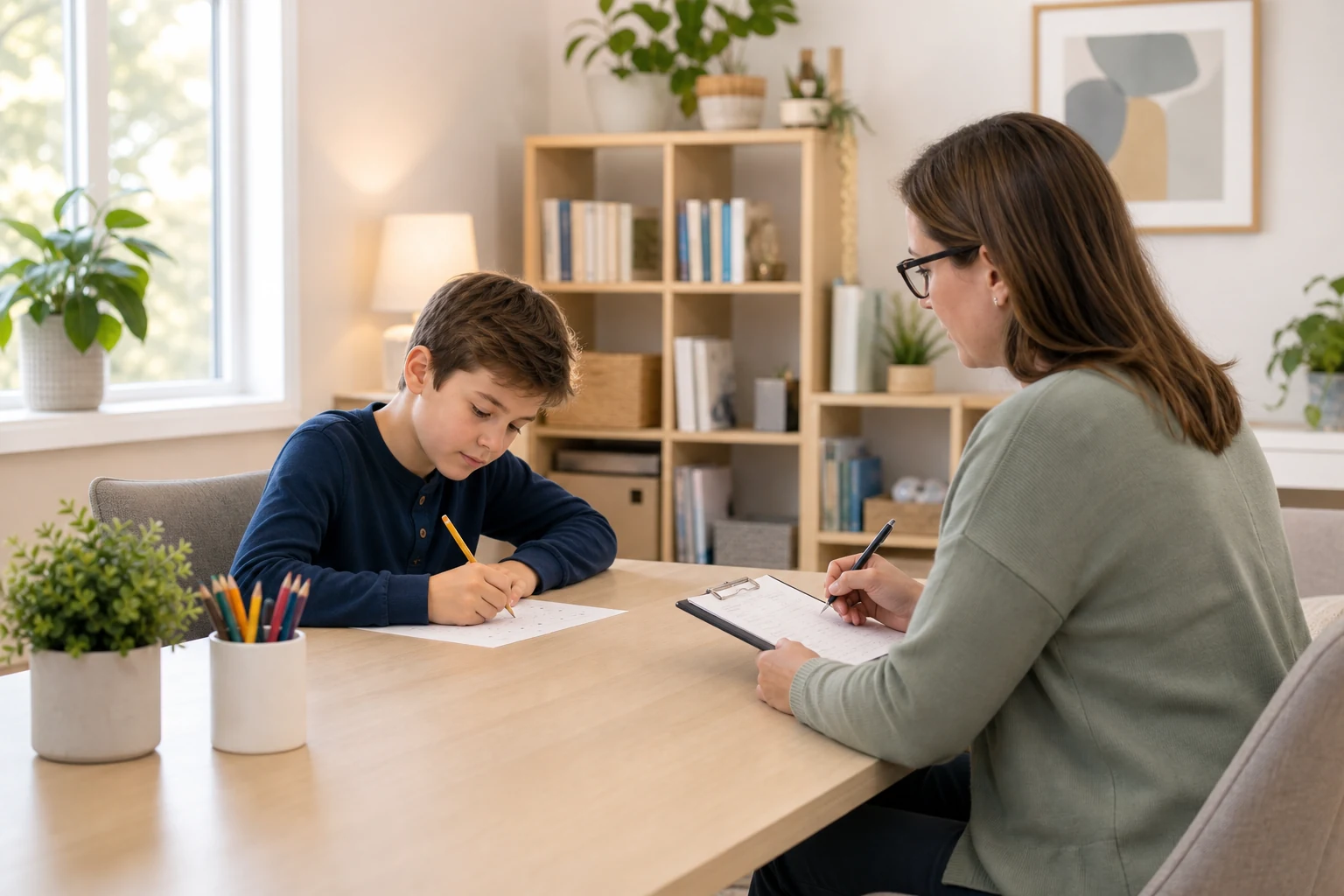
Professional child IQ testing in Odessa – whether you need an assessment for school placement, gifted program eligibility, or to understand your child's learning profile, we connect you with licensed psychologists in the Odessa area.
Last Updated: September 2026
Gifted Testing
Identify giftedness for school placement, enrichment, and talent programs using WISC-V or Stanford-Binet 5.
WISC-V Test
Wechsler Intelligence Scale for Children® Fifth Edition – the gold standard for child IQ testing.
Stanford-Binet 5
Stanford-Binet Intelligence Scales Fifth Edition – comprehensive cognitive assessment for all ages.
Full Evaluation
Combined assessment with detailed report and recommendations. Includes WISC-V or Stanford-Binet 5.
School Placement Testing
Testing for private school admission and gifted program eligibility using WISC-V or Stanford-Binet 5.
Schedule Child IQ Testing
Book your WISC-V & Stanford-Binet 5 for ages 6–16. Gifted identification, learning profiles, etc. with a licensed psychologist in Odessa today.
Child IQ Testing in Odessa: city context
Odessa, TX has approximately 115,322 residents and 51.08 square miles of land. Located in Ector County, the city is part of the Permian Basin and combines energy, oilfield services, healthcare, education.
Local assessment needs include gifted and school placement, learning and attention questions, disability accommodations, graduate education, neuropsychological referrals, and adult career planning. Results should be interpreted in light of language, schooling, culture, health, and the specific referral question.
IQ by gender & ethnicity (child population)
Odessa is approximately 48.7% female, and about 33,864 residents are under age 18. Properly standardized intelligence tests are not intended to rank demographic groups, and no authoritative city dataset establishes IQ averages by sex, race, ethnicity, neighborhood, or language.
Current Odessa demographic context includes:
- Hispanic or Latino residents: 62.7% of the city population.
- Black, non-Hispanic residents: 5.8%.
- Asian, non-Hispanic residents: 1.6%.
- White, non-Hispanic residents: 27.5%.
- Foreign-born residents: 15.6%; language and schooling history can affect test selection and interpretation.
- Language other than English at home: 44.2% of residents age five and older.
- Educational attainment: 81.6% of adults age 25+ are high-school graduates or higher, and 19.0% hold a bachelor’s degree or higher.
These community statistics describe populations, not individual ability. A licensed psychologist considers the person’s complete background and behavioral observations when choosing and interpreting tests.
Odessa School Districts and Gifted Programs
Ector County Independent School District Gifted Education
Gifted identification and services follow Texas law and local district procedures. Referral, screening, eligibility, program design, and appeals should be verified directly with the district for the current school year.
Magnet, Choice, and Advanced Programs
Families should check current honors, Advanced Placement, International Baccalaureate, academy, arts, STEM, career-technical, open-enrollment, and other choice options. Availability and entry criteria vary by grade and school.
Acceleration and Dual Enrollment
Subject acceleration, grade acceleration, compacted curriculum, advanced coursework, and dual enrollment are separate decisions from gifted eligibility and require review of readiness, records, and local policy.
College-Connected Opportunities
The University of Texas Permian Basin, Odessa College, and Midland College and regional Texas programs may support dual enrollment, outreach, camps, transfer, or enrichment according to current institutional programs; no partnership should be assumed without direct confirmation.
Texas Gifted Requirements and Other School Options
Eligibility is not established by an online test. School teams may consider individually administered cognitive data with achievement, classroom performance, creativity, language, development, disability, and opportunity-to-learn evidence. Private and charter school requirements must be checked with each school.
Odessa Private Schools Requiring IQ Testing
There is no single Odessa private-school testing rule. Some schools request achievement tests, readiness measures, interviews, records, or teacher recommendations; many do not require a clinical IQ test.
- Before scheduling: Obtain the current grade-specific checklist and exact deadline from the school.
- Accepted instruments: Ask whether the school names a test, edition, score type, evaluator credential, or administration window.
- Report handling: Confirm whether the psychologist sends results directly and whether observations or achievement data are required.
- Accommodations: Testing supports must be approved in advance and documented without changing the construct being measured.
- Fair interpretation: Language history, prior schooling, disability, illness, anxiety, and opportunity to learn should be considered.
- Decision limits: Admission decisions may include multiple factors and are not controlled by a single score.
Odessa Gifted Identification Statistics
- No dependable city total: Current gifted enrollment should be obtained from Ector County Independent School District or state education reports, not estimated from population.
- Population context: Approximately 33,864 Odessa residents are under age 18, but this is not a school-enrollment or gifted count.
- Demographic context: 62.7% Hispanic or Latino, 5.8% Black non-Hispanic, 1.6% Asian non-Hispanic, and 44.2% speaking another language at home underscore the need for equitable referral and interpretation.
- Identification: District criteria may combine cognitive, achievement, classroom, creativity, rating-scale, or portfolio evidence.
- Representation: Screening access, language, disability, mobility, income, and referral practices can affect who is identified.
- Annual change: Enrollment, program seats, boundaries, staffing, and rules can change each school year.
The child IQ testing process: step by step
Understanding the testing process can help parents prepare their child and reduce anxiety. Here's what to expect:
- Initial consultation (15–20 minutes): A brief phone or video call with the psychologist to discuss your child's background, concerns, and goals. This helps determine the right test and approach.
- Testing session (60–90 minutes): The child meets one-on-one with a licensed psychologist in a quiet, comfortable room. The psychologist administers the WISC-V or Stanford-Binet 5, which includes a series of subtests measuring verbal comprehension, visual-spatial reasoning, fluid reasoning, working memory, and processing speed. Breaks are offered as needed.
- Scoring and interpretation (1–2 days): The psychologist scores the test and analyzes the results. They consider the child's age, background, and any relevant medical or educational history.
- Feedback session (45–60 minutes): The psychologist meets with the parents (and the child, if appropriate) to explain the results. They discuss the Full-Scale IQ, index scores, strengths, and areas for growth. They also provide tailored recommendations for home, school, and extracurriculars.
- Comprehensive written report (5–7 days): You receive a detailed report with all scores, normative comparisons, and actionable next steps. This report can be shared with schools, doctors, or other professionals.
The entire process from consultation to report usually takes 1–2 weeks, depending on scheduling. The testing itself is non-invasive and designed to be engaging for children.
What is the WISC-V test?
The WISC-V (Wechsler Intelligence Scale for Children® – Fifth Edition) is the most widely used IQ test for children aged 6:0–16:11. It provides a Full-Scale IQ and five primary index scores: Verbal Comprehension, Visual-Spatial, Fluid Reasoning, Working Memory, and Processing Speed. The test is administered one-on-one by a trained psychologist and takes about 60–90 minutes.
The WISC-V is normed on a large, representative sample of U.S. children and is updated regularly to ensure accuracy. It is the gold standard for gifted identification, learning disability diagnosis, and school placement.
Why test your child's IQ?
IQ testing provides valuable insights into your child's cognitive strengths and weaknesses. It can help:
- Identify giftedness: For admission to gifted programs, private schools, or enrichment opportunities.
- Diagnose learning disabilities: Such as dyslexia, dyscalculia, or ADHD, which can be masked by high intelligence.
- Guide educational planning: Tailor instruction to your child's unique learning profile.
- Provide reassurance: Understand why your child is different from peers and how to support them.
Odessa Gifted Testing Timeline
- Start with the deadline: Ask the school or district when referrals, testing, appeals, and placement decisions occur.
- Record collection: Gather report cards, work samples, prior scores, intervention data, and teacher observations before the intake.
- Private evaluation: Allow time for intake, testing, scoring, report preparation, feedback, and any school review.
- Health and language: Avoid testing during acute illness and disclose hearing, vision, sleep, medication, language, or major life changes.
- Retesting: Practice effects and receiving-organization policies affect when repeat testing is appropriate.
- Plan ahead: Holiday, summer, and school-start periods can affect provider and teacher availability.
Odessa Gifted Programs by Age Group
- Early childhood: Emphasize development, play, language, curiosity, and readiness; very young scores can be less stable.
- Elementary school: Enrichment, flexible grouping, subject acceleration, and gifted services depend on district resources and eligibility.
- Middle school: Advanced courses, clubs, competitions, arts, STEM, and mentorship can broaden challenge beyond a label.
- High school: Honors, AP, IB where offered, dual enrollment, career-technical programs, independent study, and research may provide acceleration.
- Twice-exceptional learners: Giftedness can coexist with ADHD, autism, dyslexia, anxiety, language differences, or other disabilities.
- Whole-child fit: Program choice should consider motivation, social-emotional development, workload, interests, and family logistics.
Odessa Child ADHD and Learning Disability Assessment
- IQ is one component: ADHD, dyslexia, dyscalculia, writing disorders, autism, and language disorders are not diagnosed from IQ alone.
- Comprehensive evidence: Developmental history, school records, interviews, observations, rating scales, achievement, and language data may be needed.
- School route:
- Ector County Independent School District
- evaluates suspected educational disability through its own referral and eligibility process.
- Clinical route:
- Storybook Psychological Services, PLLC
- ,
- Medical Center Hospital
- , pediatric clinicians, and licensed psychologists may help with broader diagnostic questions.
- Twice exceptionality: High reasoning ability can mask disability, while disability can depress speed, output, attention, or achievement.
- Actionable reporting: Recommendations should connect findings with classroom instruction, accommodations, intervention, and follow-up.
Odessa Summer Programs for Gifted Children
- School and library programs: Check Ector County Independent School District and local library calendars for current academic, reading, technology, arts, and enrichment activities.
- College outreach: The University of Texas Permian Basin, Odessa College, and Midland College and regional Texas programs may offer youth programs, but ages, dates, costs, and topics change.
- Community options: Museums, parks, arts groups, recreation departments, science organizations, and nonprofits can support deep interests.
- Online programs: Verify instructor qualifications, privacy, accessibility, workload, and whether the course provides genuine interaction.
- Balance: Rest, play, friendships, physical activity, and unstructured creativity are also important for gifted children.
- No testing prerequisite assumed: Confirm whether any program actually requires scores before ordering an evaluation.
Odessa Child Testing Costs by District
- Public-school evaluation: Eligible education evaluations are conducted through district procedures without a private testing fee to the family.
- Private IQ-only testing: Fees vary with instrument, examiner, consultation, feedback, and report detail.
- Comprehensive evaluation: Adding achievement, attention, autism, language, memory, executive-function, or emotional measures increases time and cost.
- Insurance: Coverage depends on medical necessity, diagnosis, network, authorization, and plan exclusions; gifted or admissions testing is often not covered.
- Ask in writing: Confirm total fee, deposit, cancellation rules, included records, feedback, report, turnaround time, and school meeting charges.
- District differences: The child’s enrolled district, not simply a
- Odessa
- mailing address, determines the applicable school process.
Areas we serve
We support all areas of Odessa.
Frequently Asked Questions
Both are excellent tests. WISC-V is more commonly used for school-age children, while Stanford-Binet 5 can be used for ages 2–85. We often recommend WISC-V for gifted identification.
The test itself takes 60–90 minutes. With the consultation, feedback, and report, the entire process is about 1–2 weeks.
No, you can book directly with our psychologists. We serve both self-referred and professionally referred children.
Yes, our reports are accepted by Odessa Public Schools, private schools, and other gifted programs.
Some plans cover cognitive assessments when there is a clinical indication. Check with your provider.
Get a good night's sleep, eat a healthy meal, and arrive relaxed. No specific preparation is needed.
You'll receive a comprehensive report with your child's scores and tailored recommendations.
Some interview and feedback components may be available remotely, but many standardized cognitive tests require in-person administration. Confirm with the psychologist and the organization receiving the report.