
Child IQ Testing in Naperville

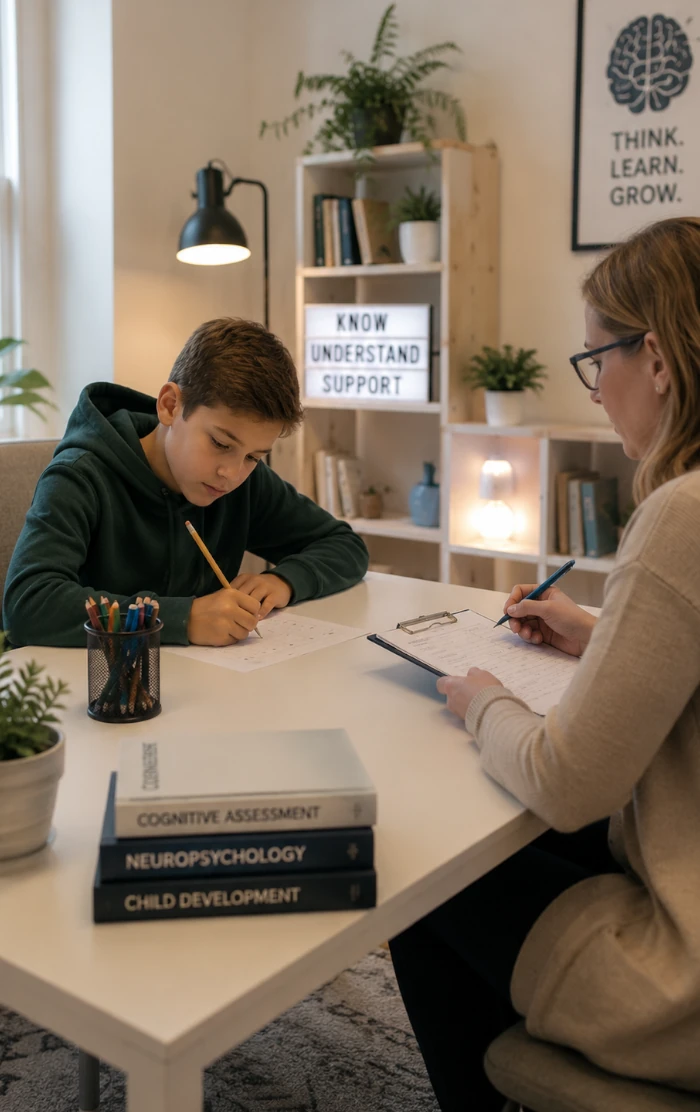
Professional child IQ testing in Naperville – whether you need an assessment for school placement, gifted program eligibility, or to understand your child's learning profile, we connect you with licensed psychologists in the Naperville area.
Last Updated: September 2026
Gifted Testing
Identify giftedness for school placement, enrichment, and talent programs using WISC-V or Stanford-Binet 5.
WISC-V Test
Wechsler Intelligence Scale for Children® Fifth Edition – the gold standard for child IQ testing.
Stanford-Binet 5
Stanford-Binet Intelligence Scales Fifth Edition – comprehensive cognitive assessment for all ages.
Full Evaluation
Combined assessment with detailed report and recommendations. Includes WISC-V or Stanford-Binet 5.
School Placement Testing
Testing for private school admission and gifted program eligibility using WISC-V or Stanford-Binet 5.
Schedule Child IQ Testing
Book your WISC-V & Stanford-Binet 5 for ages 6–16. Gifted identification, learning profiles, etc. with a licensed psychologist in Naperville today.
Child IQ Testing in Naperville, Illinois: city context
Naperville spans DuPage and Will counties in the western Chicago suburbs. The U.S. Census Bureau's July 1, 2025 estimate lists 153,114 residents, and the 2020 Census reports approximately 39.08 square miles of land. The city combines a major downtown and Riverwalk district, established residential areas, the I-88 employment corridor, health-care and professional-service centers, two Metra stations, and a large, highly educated population.
Local reasons for cognitive assessment include gifted or advanced-learning questions in Naperville Community Unit School District 203 and Indian Prairie School District 204, psychoeducational evaluation, ADHD or learning-disability concerns, private-school placement, disability accommodations, career planning, graduate-school documentation, adult diagnostic clarification, and qualification for high-IQ organizations. A licensed examiner should interpret scores in light of education, language history, culture, sensory or medical factors, attention, motivation, and testing conditions rather than treating one number as a complete description of a person.
IQ by gender & ethnicity
Female residents account for approximately 50.6% of Naperville's population, and male residents account for approximately 49.4%. Properly standardized intelligence tests are designed so broad male and female averages are comparable, although individuals can show very different profiles across verbal comprehension, visual-spatial reasoning, fluid reasoning, working memory, and processing speed. No authoritative dataset establishes separate Naperville IQ averages by sex, race, ethnicity, neighborhood, immigration history, or home language.
- Population and diversity: Census estimates show a multilingual, internationally connected community; 22.5% of residents are foreign-born and 26.9% of people age five and older speak a language other than English at home.
- Education: 97.3% of adults age 25 and older have completed high school or higher, and 72.5% hold a bachelor's degree or higher.
- Interpretation: Examiners should consider language dominance, disability, educational opportunity, cultural context, and the purpose of testing when selecting instruments and explaining results.
Naperville School Districts and Advanced Learning
Public-School Evaluation
Naperville Community Unit School District 203 and Indian Prairie School District 204 can evaluate students when a suspected disability affects education. A private WISC or other report may contribute information, but district teams determine educational eligibility, services, and placement under applicable law and district procedures.
Advanced Learning and Acceleration
District 203 publishes a multi-criteria process that may include MAP Growth, CogAT, Iowa achievement measures, and placement tests. District 204 describes a process using CogAT, achievement data such as i-Ready, classroom assessments, and learning characteristics. Families should use current district timelines and matrices rather than assuming a private IQ score guarantees placement.
Choice, Independent, and Parochial Schools
Naperville schools outside the public districts set their own admissions and placement rules. Some may request readiness, achievement, cognitive, language, or psychoeducational information, while others rely on records, interviews, recommendations, and classroom visits. Obtain the current written checklist before testing.
Naperville Private and Choice Schools: When Testing May Be Requested
Testing may be requested for admissions, grade placement, acceleration, learning support, accommodations, giftedness, twice-exceptionality, or clarification of an uneven academic profile. No single requirement applies to every Naperville private or parochial school. Confirm accepted instruments, examiner credentials, score age, direct-reporting rules, deadlines, and whether achievement testing or a full psychoeducational evaluation is required in addition to an IQ measure.
Naperville Gifted Identification Context
Gifted identification should be based on multiple sources rather than a single number. District processes may examine reasoning, achievement, classroom performance, creativity, learning characteristics, and local placement measures. Private testing can help explain a child's profile or answer a separate clinical question, but it does not override public-school criteria.
The child IQ testing process: step by step
Understanding the testing process can help parents prepare their child and reduce anxiety. Here's what to expect:
- Initial consultation (15–20 minutes): A brief phone or video call with the psychologist to discuss your child's background, concerns, and goals. This helps determine the right test and approach.
- Testing session (60–90 minutes): The child meets one-on-one with a licensed psychologist in a quiet, comfortable room. The psychologist administers the WISC-V or Stanford-Binet 5, which includes a series of subtests measuring verbal comprehension, visual-spatial reasoning, fluid reasoning, working memory, and processing speed. Breaks are offered as needed.
- Scoring and interpretation (1–2 days): The psychologist scores the test and analyzes the results. They consider the child's age, background, and any relevant medical or educational history.
- Feedback session (45–60 minutes): The psychologist meets with the parents (and the child, if appropriate) to explain the results. They discuss the Full-Scale IQ, index scores, strengths, and areas for growth. They also provide tailored recommendations for home, school, and extracurriculars.
- Comprehensive written report (5–7 days): You receive a detailed report with all scores, normative comparisons, and actionable next steps. This report can be shared with schools, doctors, or other professionals.
The entire process from consultation to report usually takes 1–2 weeks, depending on scheduling. The testing itself is non-invasive and designed to be engaging for children.
What is the WISC-V test?
The WISC-V (Wechsler Intelligence Scale for Children® – Fifth Edition) is the most widely used IQ test for children aged 6:0–16:11. It provides a Full-Scale IQ and five primary index scores: Verbal Comprehension, Visual-Spatial, Fluid Reasoning, Working Memory, and Processing Speed. The test is administered one-on-one by a trained psychologist and takes about 60–90 minutes.
The WISC-V is normed on a large, representative sample of U.S. children and is updated regularly to ensure accuracy. It is the gold standard for gifted identification, learning disability diagnosis, and school placement.
Why test your child's IQ?
IQ testing provides valuable insights into your child's cognitive strengths and weaknesses. It can help:
- Identify giftedness: For admission to gifted programs, private schools, or enrichment opportunities.
- Diagnose learning disabilities: Such as dyslexia, dyscalculia, or ADHD, which can be masked by high intelligence.
- Guide educational planning: Tailor instruction to your child's unique learning profile.
- Provide reassurance: Understand why your child is different from peers and how to support them.
Naperville Gifted Testing Timeline
- Before scheduling: Obtain written requirements from District 203, District 204, or the intended school or program.
- Six to twelve weeks before a deadline: Contact qualified examiners; admissions-season availability can be limited.
- After testing: Allow time for scoring, feedback, report preparation, direct school submission, and possible follow-up forms.
- For public programs: Follow the applicable district's screening, eligibility, placement, and appeal procedures rather than assuming a private score controls placement.
Naperville Gifted Programs by Age Group
- Early childhood: Developmentally appropriate enrichment, play, language, music, spatial activities, and careful readiness evaluation.
- Elementary and middle school: District advanced-learning services, classroom differentiation, honors mathematics, advanced language arts, subject acceleration, independent projects, competitions, and school-specific options.
- High school: Honors, Advanced Placement, dual-credit courses, research, arts, leadership, internships, and individualized planning.
- Outside school: Library programs, coding, robotics, mathematics, debate, music, visual arts, sports, nature, museum learning, and community service.
Naperville Child ADHD and Learning-Disability Assessment
A child can have strong reasoning ability and still meet criteria for ADHD, dyslexia, dysgraphia, dyscalculia, language disorder, autism, or another condition. A comprehensive evaluation may combine cognitive, academic, attention, executive-function, language, behavioral, emotional, adaptive, developmental, and school information. The battery should be driven by the referral question rather than by a desire to obtain one preferred score.
Naperville Summer and Enrichment Options
Naperville offers library programs, park-district activities, DuPage Children's Museum learning, North Central College and community programs, arts, sports, technology, robotics, mathematics, language, nature, and service opportunities. Enrichment should be chosen for fit and interest rather than as an attempt to coach a child on protected IQ-test items.
Naperville Child Testing Costs and Funding
- Focused testing: Often costs several hundred dollars, depending on age, instrument, report, and feedback.
- Comprehensive evaluation: May cost several thousand dollars when cognition, achievement, attention, language, behavior, adaptive functioning, records, and school consultation are included.
- Prosper Psychological Testing Services: Call (630) 557-9740 to confirm child services, current fees, insurance procedures, test editions, and report format.
- Public-school evaluation: Families may request an evaluation through the applicable district when a suspected disability affects education.
- Financial planning: Ask about insurance, payment schedules, health-savings accounts, school-provided evaluation, and whether the receiving program offers need-based assistance.
Areas we serve
We support all areas of Naperville. Provider location, age range, specialty, accessibility, language capacity, and in-person requirements vary, so confirm those details before scheduling.
Frequently Asked Questions
Both are excellent tests. WISC-V is more commonly used for school-age children, while Stanford-Binet 5 can be used for ages 2–85. We often recommend WISC-V for gifted identification.
The test itself takes 60–90 minutes. With the consultation, feedback, and report, the entire process is about 1–2 weeks.
No, you can book directly with our psychologists. We serve both self-referred and professionally referred children.
A private report may be submitted to local district or another school, but acceptance and eligibility are determined by the receiving organization. Confirm the required test, edition, evidence, examiner credentials, and deadline before testing.
Some plans cover cognitive assessments when there is a clinical indication. Check with your provider.
Get a good night's sleep, eat a healthy meal, and arrive relaxed. No specific preparation is needed.
You'll receive a comprehensive report with your child's scores and tailored recommendations.
Some interview and feedback components may be available remotely, but many standardized cognitive tests require in-person administration. Confirm with the psychologist and the organization receiving the report.