
IQ Testing in Moreno Valley

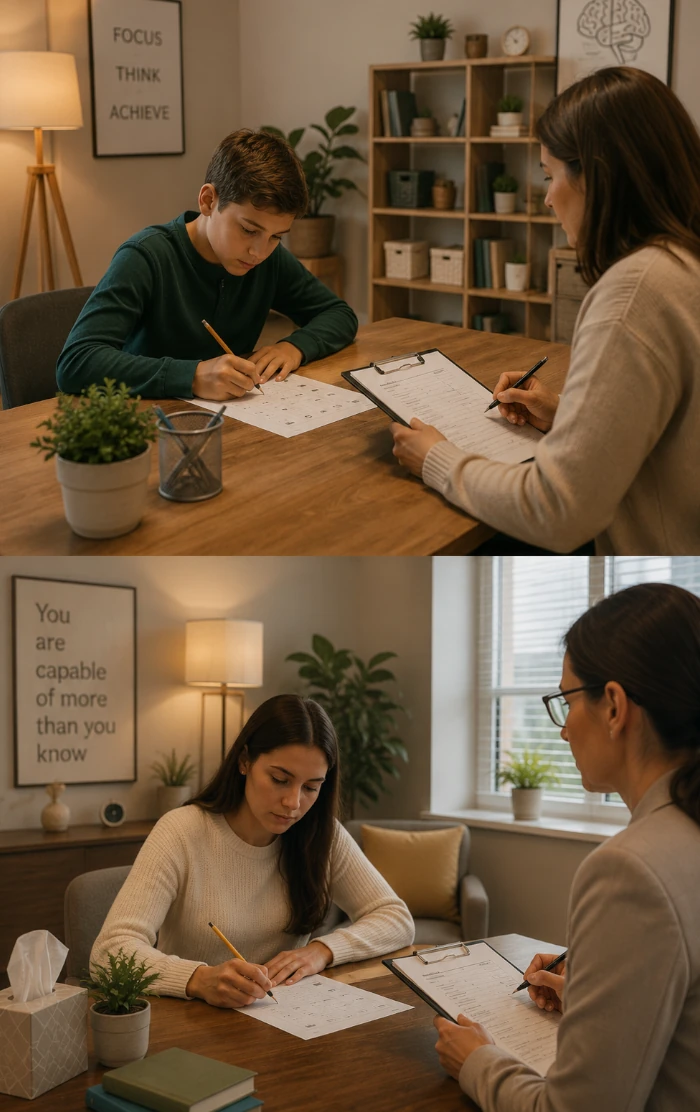
Professional IQ testing in Moreno Valley – whether you need an assessment for school, employment, gifted program eligibility, or personal insight, we connect you with licensed psychologists in the Moreno Valley area.
Last Updated: September 2026
Child IQ Testing
WISC-V & Stanford-Binet for ages 6–16. Gifted identification, learning profiles.
Adult IQ Testing
WAIS-IV & WAIS-5 available. Comprehensive adult cognitive assessments. Clinical & occupational.
WISC-V Test
Wechsler Intelligence Scale for Children® Fifth Edition – the gold standard for child IQ testing.
WAIS-IV & WAIS-5 Tests
Wechsler Adult Intelligence Scale® – Fourth Edition (WAIS-IV) and Fifth Edition (WAIS-5) available for adult IQ testing.
Gifted Testing
Identify giftedness for school placement, enrichment, and talent programs using WISC-V or Stanford-Binet.
Stanford-Binet 5
Stanford-Binet Intelligence Scales Fifth Edition – comprehensive cognitive assessment for all ages.
Mensa Testing
Mensa admission testing and preparation for the high-IQ society. Accepts WAIS-IV, WAIS-5, and Stanford-Binet 5 scores.
Full Evaluation
Combined assessment with detailed report and recommendations. Includes WISC-V, WAIS-IV, WAIS-5, or Stanford-Binet 5 as appropriate.
IQ Testing in Moreno Valley: city context
Gender, age and demographic statistics
Moreno Valley had an estimated 214,263 residents on July 1, 2025. U.S. Census Bureau 2020–2024 estimates report that 49.5% of residents are female, 25.9% are under age 18, and 9.8% are age 65 or older. The city is 19.2% White alone, 16.0% Black alone, 1.4% American Indian or Alaska Native alone, 5.4% Asian alone, 0.8% Native Hawaiian or Other Pacific Islander alone, and 17.1% reporting two or more races. 61.9% of residents are Hispanic or Latino; race and Hispanic-origin categories are not mutually exclusive.
These figures describe community context, not intelligence. IQ results must be interpreted individually in light of age, education, disability, health, culture, language exposure, educational opportunity, and testing conditions. Moreno Valley is highly multilingual: 50.4% of residents age five and older speak a language other than English at home, and 24.4% are foreign-born. English-Spanish bilingual history, literacy in each language, interpreter use, educational history in the United States or another country, and limits on verbal-score interpretation may therefore be central to a valid evaluation.
- Female residents: 49.5%.
- Children and teens: 25.9% are under 18.
- Older adults: 9.8% are 65 or older.
- Language context: 50.4% speak a language other than English at home.
- Educational context: 80.2% of adults age 25+ completed high school and 17.8% hold a bachelor’s degree or higher.
- Health-access context: 8.1% of residents under age 65 report a disability and 10.8% lack health insurance.
- Interpretation: No gender, racial, ethnic, immigration, language, neighborhood, or income group should be presumed to have a particular IQ profile.
What is professional IQ testing?
Intelligence quotient (IQ) testing is a standardized method to measure human cognitive abilities and intellectual potential. Professional IQ tests are administered by licensed psychologists in a controlled environment to ensure accuracy and reliability. Unlike online quizzes, clinical assessments provide a full-scale IQ score along with detailed breakdowns of verbal comprehension, perceptual reasoning, working memory, and processing speed.
In Moreno Valley, IQ testing is commonly used for gifted program admission, learning disability identification, career guidance, neuropsychological evaluation, and personal development. The results are presented in a comprehensive report that includes normative comparisons, strengths and weaknesses, and actionable recommendations.
Who should get tested?
IQ testing can benefit children, adolescents, and adults in various situations:
People in Moreno Valley who are curious about cognitive problem-solving may begin with an online IQ test, then consult a licensed psychologist when they need standardized scores or a written report.
- Children: Parents often seek testing for school readiness, gifted placement, or to understand learning challenges.
- Adults: Many adults take IQ tests for career advancement, graduate school applications, or personal curiosity.
- Mensa candidates: High-IQ societies require official test scores for membership.
- Clinical referrals: Psychologists may recommend testing as part of a broader neuropsychological evaluation.
Types of IQ tests
We offer the most recognized and scientifically validated intelligence tests in the field:
- WISC-V (Wechsler Intelligence Scale for Children® – Fifth Edition): The gold standard for children aged 6:0–16:11. It provides a Full-Scale IQ and five primary index scores.
- WAIS-IV (Wechsler Adult Intelligence Scale® – Fourth Edition): The most widely used adult IQ test for ages 16–90. It measures cognitive functioning across four domains.
- Stanford-Binet Intelligence Scales – Fifth Edition: A comprehensive assessment for ages 2–85, often used for gifted identification and clinical evaluations.
- Gifted Testing: Often includes the WISC-V or Stanford-Binet, plus additional creativity and achievement measures.
- Mensa Testing: We provide official Mensa admission testing and preparation materials.
How the testing process works
- Initial consultation: Brief phone or video call to discuss your needs and match you with the right psychologist.
- Testing session: In-person or remote testing (depending on the test) with a licensed psychologist. Most sessions last 1–2 hours.
- Scoring and interpretation: The psychologist scores the test and interprets the results in the context of your background and goals.
- Feedback session: A detailed review of your results, including strengths, weaknesses, and practical recommendations.
- Comprehensive report: You receive a written report with all scores, normative comparisons, and actionable next steps.
How much does IQ testing cost in Moreno Valley?
The cost of IQ testing in Moreno Valley varies depending on the type of test, the psychologist's experience, and whether a comprehensive report is required. Typical fees range from $200 to $1,200 for a full assessment. Gifted testing and Mensa admission testing are often at the lower end, while neuropsychological evaluations may be higher.
Some insurance plans cover IQ testing when it's deemed medically necessary. We recommend checking with your provider for details. We also offer affordable payment plans and sliding-scale options for qualifying individuals.
Moreno Valley's Intellectual History & Legacy
Moreno Valley is a relatively young incorporated city, but the valley’s history reaches from Indigenous homelands and ranching through March Field aviation, postwar suburban growth, healthcare expansion, community-college education, logistics, manufacturing, and regional environmental planning.
- Indigenous context: The region is connected to the homelands and living communities of Cahuilla, Luiseño, Serrano, and neighboring peoples. Ethical assessment respects culture, language, community history, and tribal sovereignty.
- March Field legacy: March Field, established during World War I and now March Air Reserve Base, shaped aviation, engineering, logistics, public service, and regional development.
- City formation: The communities of Moreno, Sunnymead, and Edgemont incorporated as Moreno Valley in 1984 after rapid Inland Empire growth.
- Healthcare and education: Riverside University Health System Medical Center, Kaiser Permanente Moreno Valley, Moreno Valley College, and nearby universities support clinical, technical, public-safety, and research pathways.
- Logistics and advanced industry: Distribution, e-commerce, manufacturing, clean technology, and aerospace-related activity require data, automation, safety, quality, and systems thinking.
- Ethical testing: Modern psychology rejects ranking communities by IQ. Valid assessment requires individual interpretation, measurement error, language and cultural context, and multiple sources of evidence.
Top Employers in Moreno Valley Requiring Cognitive Skills
Moreno Valley’s employment base combines healthcare, education, government, logistics, e-commerce, manufacturing, retail, construction, hospitality, aviation support, and professional services. Major institutions and companies include Riverside University Health System, Kaiser Permanente, Moreno Valley Unified School District, Moreno Valley College, the City of Moreno Valley, Amazon facilities, Procter & Gamble, Skechers, Deckers Outdoor, Harbor Freight Tools, Hisense, and businesses around March Air Reserve Base.
- Healthcare: Clinical reasoning, patient communication, documentation, diagnostics, laboratory work, rehabilitation, public health, and interdisciplinary teamwork.
- Education and public service: Teaching, special education, counseling, school psychology, administration, emergency response, planning, law, and social services.
- Logistics and e-commerce: Inventory systems, routing, automation, warehouse technology, quality, supervision, safety, and supply-chain analysis.
- Manufacturing and consumer products: Engineering, maintenance, production planning, quality systems, regulatory compliance, product testing, and continuous improvement.
- Aviation and defense support: Technical maintenance, cybersecurity, operations, logistics, emergency planning, and strict procedural accuracy.
- Professional services: Finance, IT, human resources, legal support, construction management, marketing, and bilingual client communication.
Moreno Valley IQ Testing by City Area
Residents seek testing from across the city, including central Moreno Valley and Sunnymead, neighborhoods near Moreno Valley Ranch and Lake Perris, the eastern Rancho Belago area, Hidden Springs and the northern foothills, and western areas near Box Springs, Edgemont, and March Air Reserve Base. The purpose of testing—not the neighborhood—should determine the examiner and battery.
- Central and Sunnymead corridors: Access to civic services, schools, retail, and local psychological practices.
- Eastern Moreno Valley and Rancho Belago: Growing residential areas with access to RUHS, Kaiser, Moreno Valley College, and Lake Perris.
- Western Moreno Valley and Box Springs: Connections to Riverside, UCR, I-215, SR-60, March Field, and regional specialty providers.
- Testing fit: Confirm age range, language, test edition, report purpose, school or agency requirements, accessibility, and travel conditions before scheduling.
Moreno Valley Universities and Research Institutions
- Moreno Valley College: Public community college offering associate degrees, transfer preparation, career certificates, extended learning, and the Ben Clark Training Center for public-safety education.
- University of California, Riverside: Nearby research university with psychology, neuroscience, education, engineering, public policy, business, and a medical school.
- Loma Linda University: Regional health-sciences university and academic medical system with psychology, rehabilitation, medicine, dentistry, public health, and neuroscience resources.
- California Baptist University: Riverside-based undergraduate and graduate programs in psychology, education, business, engineering, health, and counseling-related fields.
- CSU San Bernardino and University of Redlands: Regional graduate, professional, research, and teacher-development opportunities.
- RUHS teaching environment: The county medical center supports clinical education and affiliations with regional universities and health professions.
Moreno Valley Economic Context
- Median household income: $93,222 in 2020–2024 Census estimates.
- Per-capita income: $29,872.
- Residents in poverty: 11.7%.
- Bachelor's degree or higher: 17.8% of adults age 25 and older.
- Mean travel time to work: 35.5 minutes, with SR-60, I-215, SR-91, and Los Angeles–Orange County commutes often taking longer.
- Health and social-assistance activity: Census business data report approximately $1.384 billion in 2022 receipts/revenue within the city.
- Transportation and warehousing: Approximately $569.6 million in 2022 receipts/revenue reflects the city’s logistics and distribution role.
- Retail sales: Approximately $3.850 billion in 2022.
- Accommodation and food services: Approximately $448.8 million in 2022 sales.
- Regional strengths: Healthcare, education, county government, logistics, e-commerce, manufacturing, aviation, defense support, retail, construction, clean technology, and public safety.
Moreno Valley School District Data
Moreno Valley Unified GATE and advanced learning
Moreno Valley Unified School District publishes a Gifted and Talented Education framework that includes intellectual ability, high achievement, specific academic ability, leadership, creativity, and visual or performing arts categories. Families should use the district’s current referral, assessment, eligibility, and service procedures; a private IQ score does not automatically create placement.
Secondary pathways
Honors, Advanced Placement, dual enrollment, career technical education, AVID, STEM, health careers, arts, manufacturing, public safety, and subject acceleration use program-specific criteria. Moreno Valley College supports dual enrollment and transfer preparation.
Private and independent options
Charter, faith-based, private, homeschool, county, and specialized programs may use records, achievement tests, interviews, work samples, their own entrance exams, or cognitive reports. Obtain written requirements before ordering testing.
Local Testing Centers and Psychologists
Psychological Services and Assessments, Inc. (PSAS, Inc.) is located at 21250 Box Springs Road, Suite 201, Moreno Valley, CA 92557. Its assessment page explicitly lists psychological and cognitive testing, ADHD and learning-disability evaluations, employment and career aptitude testing, and learning-disability and IQ testing. The local number used throughout these pages is (951) 335-5858.
Callers should confirm the exact instrument, age range, language options, report format, cost, insurance status, turnaround, and whether the evaluation meets the requirements of the receiving school, employer, attorney, agency, or Mensa. Complex neurological or medical questions may require RUHS, Kaiser, Loma Linda, UCR-affiliated services, or another neuropsychology specialist.
Moreno Valley Events and Conferences
Moreno Valley and the surrounding Inland Empire host college lectures, public-health education, school events, workforce programs, arts and cultural festivals, business and logistics meetings, air-show activity at March, and professional training through Moreno Valley College, RUHS, UCR, Loma Linda, and regional associations.
- Education and healthcare: Moreno Valley College, RUHS, Kaiser, MVUSD, UCR, and Loma Linda programs.
- Business and workforce: City economic-development events, logistics and manufacturing training, job fairs, entrepreneurship, and supplier programs.
- Family enrichment: Libraries, parks, Lake Perris State Recreation Area, museums and science programs in Riverside, and regional arts organizations.
- Testing-day planning: School events, freeway congestion, air-show traffic, heat, wildfires, and major gatherings can affect arrival time and concentration.
Transportation and Accessibility
- Major roads: State Route 60 crosses northern Moreno Valley east–west; I-215 runs along the western side and connects Riverside, San Bernardino, Perris, and Temecula routes; SR-91 is reached through Riverside. Major local corridors include Sunnymead Boulevard, Alessandro Boulevard, Cactus Avenue, Iris Avenue, Perris Boulevard, Heacock Street, Frederick Street/Pigeon Pass Road, Lasselle Street, and Moreno Beach Drive.
- Public transit: Riverside Transit Agency operates fixed-route buses and paratransit serving Moreno Valley, Moreno Valley College, hospitals, shopping areas, Riverside, Perris, and regional connections.
- Regional rail: The Moreno Valley/March Field Metrolink station on the 91/Perris Valley Line provides commuter-rail access toward Riverside, Corona, Orange County, and Los Angeles; schedules and transfer times should be checked in advance.
- Airport: LA/Ontario International Airport (ONT), roughly 28 miles away, is the nearest major commercial airport. Palm Springs International Airport is another regional option. March Air Reserve Base and March Inland Port support military and limited civilian aviation rather than routine passenger service.
- Distance to other cities: Typical driving is about 15–25 minutes to Riverside, 25–35 minutes to San Bernardino or Redlands, 35–50 minutes to Ontario, 40–60 minutes to Temecula, 55–75 minutes to Palm Springs, and 70–110 minutes or more to central Los Angeles; freeway congestion can greatly increase these times.
- Walkability: The city is predominantly auto-oriented, but some errands are walkable around civic and commercial corridors, TownGate and Moreno Valley Mall, Sunnymead Boulevard, Moreno Valley College, and selected neighborhood centers. Heat, wide arterials, long blocks, and freeway barriers can limit walking.
- Bike infrastructure: Moreno Valley’s bicycle planning includes Class I paths, Class II lanes, Class III routes, and proposed trail connections among neighborhoods, parks, schools, transit, Lake Perris, and regional networks. Riders should verify current facility conditions and high-speed crossings.
- Appointment planning: SR-60 and I-215 congestion, school traffic, warehouse truck activity, summer heat, Santa Ana winds, wildfire smoke, and heavy-rain events can affect travel time and testing stamina.
Moreno Valley Weather and Seasonal Considerations
Moreno Valley has hot, dry summers, mild winters, strong sun, periodic Santa Ana winds, wildfire smoke, ozone and particulate pollution, and occasional intense rain. Weather and air quality can affect sleep, asthma, headache, hydration, medication use, and cognitive endurance.
- Summer heat: Morning appointments, hydration, and avoiding prolonged heat exposure may improve comfort and concentration.
- Air quality: Ozone, freeway and freight emissions, dust, and wildfire smoke can worsen respiratory symptoms and fatigue.
- Santa Ana winds: Wind, fire risk, power interruptions, and travel disruption may justify rescheduling.
- Heavy rain: Local flooding, debris, and freeway collisions can affect access even when rainfall is brief.
- Testing validity: Reschedule when illness, acute smoke exposure, sleep loss, unsafe travel, or severe symptoms would make performance unrepresentative.
Areas we serve
We support all areas of Moreno Valley.
Frequently Asked Questions
WISC-V is for children aged 6–16, while WAIS-IV is for adults aged 16–90. Each is normed for its specific age group.
Most IQ tests take between 60 and 90 minutes, plus a feedback session. Allow 2–3 hours total.
No, you can book directly with our psychologists. We serve both self-referred and professionally referred individuals.
Some professionally administered scores may be submitted as prior evidence, but acceptance is determined solely by American Mensa under its current rules.
Some plans cover cognitive assessments when there is a clinical indication. Check with your provider.
Get a good night's sleep, eat a healthy meal, and arrive relaxed. No specific preparation is needed.
You'll receive a comprehensive report with your scores and tailored recommendations.
Interviews and feedback may be available remotely, but many standardized cognitive tests require controlled administration and may need an in-person appointment. Contact us for details.