
IQ Testing in Irvine

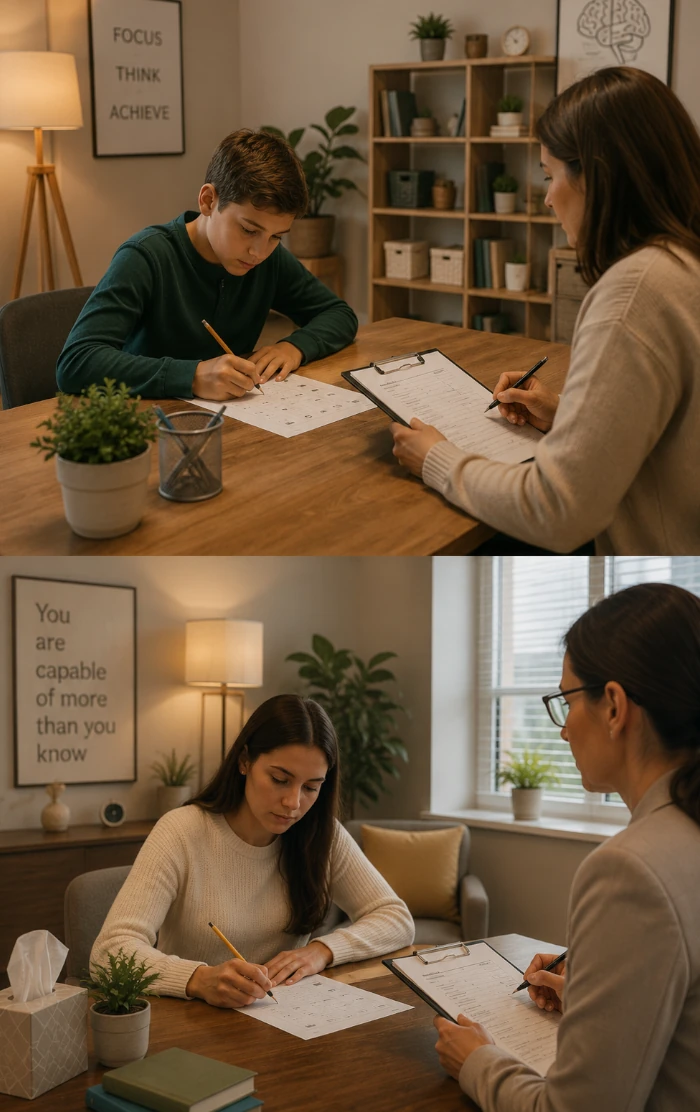
Professional IQ testing in Irvine – whether you need an assessment for school, employment, gifted program eligibility, or personal insight, we connect you with licensed psychologists in the Irvine area.
Last Updated: September 2026
Child IQ Testing
WISC-V & Stanford-Binet for ages 6–16. Gifted identification, learning profiles.
Adult IQ Testing
WAIS-IV & WAIS-5 available. Comprehensive adult cognitive assessments. Clinical & occupational.
WISC-V Test
Wechsler Intelligence Scale for Children® Fifth Edition – the gold standard for child IQ testing.
WAIS-IV & WAIS-5 Tests
Wechsler Adult Intelligence Scale® – Fourth Edition (WAIS-IV) and Fifth Edition (WAIS-5) available for adult IQ testing.
Gifted Testing
Identify giftedness for school placement, enrichment, and talent programs using WISC-V or Stanford-Binet.
Stanford-Binet 5
Stanford-Binet Intelligence Scales Fifth Edition – comprehensive cognitive assessment for all ages.
Mensa Testing
Mensa admission testing and preparation for the high-IQ society. Accepts WAIS-IV, WAIS-5, and Stanford-Binet 5 scores.
Full Evaluation
Combined assessment with detailed report and recommendations. Includes WISC-V, WAIS-IV, WAIS-5, or Stanford-Binet 5 as appropriate.
IQ Testing in Irvine: city context
Irvine is a master-planned city in central Orange County and a major education, research, healthcare, and technology center. The U.S. Census Bureau estimated 318,764 residents in 2025, up 3.6% from the 2020 estimates base, across approximately 65.61 square miles of land. Local demand for cognitive assessment is shaped by UC Irvine, Irvine Unified School District, medical and technology employers, a highly educated international population, and families navigating gifted education, disability documentation, school placement, and graduate or professional training.
The assessment ecosystem includes UC Irvine and UCI Health, Hoag facilities, private psychologists, Irvine Valley College, Concordia University Irvine, Westcliff University, Orange County school and disability services, and regional specialty providers throughout coastal and central Orange County.
Gender, age and demographic statistics
Current Census estimates describe a diverse population but do not establish separate city IQ averages for demographic groups:
- Female population: 51.2%.
- Residents under age 18: 21.7%.
- Residents age 65 and older: 10.8%.
- White alone: 36.7%.
- Black or African American alone: 2.0%.
- Asian alone: 44.8%.
- Two or more races: 11.8%.
- Hispanic or Latino: 11.4%; Hispanic origin may overlap with racial categories.
- Foreign-born residents: 39.8% in 2020–2024 estimates.
- Language other than English at home: 51.6% of residents age five and older.
- Education: 96.7% of adults age 25 and older are high-school graduates or higher, and 70.6% hold a bachelor's degree or higher.
- Labor-force participation: 67.1% overall and 61.7% among women age 16 and older.
- Clinical interpretation: Professional tests use age-based norms. Examiners consider education, first language, bilingual development, culture, disability, medical history, attention, mood, sleep, and testing conditions rather than inferring ability from group statistics.
What is professional IQ testing?
Intelligence quotient (IQ) testing is a standardized method to measure human cognitive abilities and intellectual potential. Professional IQ tests are administered by licensed psychologists in a controlled environment to ensure accuracy and reliability. Unlike online quizzes, clinical assessments provide a full-scale IQ score along with detailed breakdowns of verbal comprehension, perceptual reasoning, working memory, and processing speed.
In Irvine, IQ testing is commonly used for gifted program admission, learning disability identification, career guidance, neuropsychological evaluation, and personal development. The results are presented in a comprehensive report that includes normative comparisons, strengths and weaknesses, and actionable recommendations.
Who should get tested?
IQ testing can benefit children, adolescents, and adults in various situations:
- Children: Parents often seek testing for school readiness, gifted placement, or to understand learning challenges.
- Adults: Many adults take IQ tests for career advancement, graduate school applications, or personal curiosity.
- Mensa candidates: High-IQ societies require official test scores for membership.
- Clinical referrals: Psychologists may recommend testing as part of a broader neuropsychological evaluation.
Types of IQ tests
We offer the most recognized and scientifically validated intelligence tests in the field:
- WISC-V (Wechsler Intelligence Scale for Children® – Fifth Edition): The gold standard for children aged 6:0–16:11. It provides a Full-Scale IQ and five primary index scores.
- WAIS-IV (Wechsler Adult Intelligence Scale® – Fourth Edition): The most widely used adult IQ test for ages 16–90. It measures cognitive functioning across four domains.
- Stanford-Binet Intelligence Scales – Fifth Edition: A comprehensive assessment for ages 2–85, often used for gifted identification and clinical evaluations.
- Gifted Testing: Often includes the WISC-V or Stanford-Binet, plus additional creativity and achievement measures.
- Mensa Testing: We provide official Mensa admission testing and preparation materials.
How the testing process works
- Initial consultation: Brief phone or video call to discuss your needs and match you with the right psychologist.
- Testing session: In-person or remote testing (depending on the test) with a licensed psychologist. Most sessions last 1–2 hours.
- Scoring and interpretation: The psychologist scores the test and interprets the results in the context of your background and goals.
- Feedback session: A detailed review of your results, including strengths, weaknesses, and practical recommendations.
- Comprehensive report: You receive a written report with all scores, normative comparisons, and actionable next steps.
How much does IQ testing cost in Irvine?
The cost of IQ testing in Irvine varies depending on the type of test, the psychologist's experience, and whether a comprehensive report is required. Typical fees range from $200 to $1,200 for a full assessment. Gifted testing and Mensa admission testing are often at the lower end, while neuropsychological evaluations may be higher.
For Irvine residents who want an informal introduction to reasoning questions, an online IQ test can be a useful starting point, while a licensed psychologist is necessary when formal documentation or diagnosis is required.
Some insurance plans cover IQ testing when it's deemed medically necessary. We recommend checking with your provider for details. We also offer affordable payment plans and sliding-scale options for qualifying individuals.
Irvine's Intellectual History & Legacy
- Irvine Ranch: The area's agricultural and land-development history grew from the Irvine Ranch, which shaped roads, villages, open space, and the later master plan.
- Master-planned development: Residential villages, employment districts, schools, parks, greenbelts, and commercial centers were planned together as the city expanded after incorporation in 1971.
- UC Irvine: Founded in 1965, the university became a major research institution in medicine, neuroscience, engineering, computer science, biological sciences, education, social sciences, law, business, and the arts.
- Aerospace and electronics: Orange County's aerospace, defense, semiconductor, and communications industries helped establish a technically skilled workforce and a culture of applied research.
- Medical technology and life sciences: Irvine developed a substantial cluster of device, diagnostics, pharmaceutical, and healthcare organizations that rely on scientific, regulatory, clinical, and quantitative expertise.
- Great Park: Redevelopment of the former Marine Corps Air Station El Toro created a major civic, recreation, sports, arts, and planning project in eastern Irvine.
- International community: A large foreign-born and multilingual population connects the city to global education, trade, research, and entrepreneurship.
Top Employers in Irvine Requiring Cognitive Skills
- UC Irvine and UCI Health: Faculty, researchers, physicians, laboratory staff, engineers, analysts, administrators, and student-support teams work across the campus and health system.
- Irvine Unified School District: Teachers, school psychologists, counselors, administrators, special-education professionals, data teams, and technology staff support a large K–12 system.
- Medical-device and life-science companies: Organizations such as Edwards Lifesciences, Masimo, diagnostics firms, and clinical-research companies employ engineers, scientists, regulatory specialists, and quality professionals.
- Software, gaming, and data: Blizzard Entertainment, Alteryx, cybersecurity firms, cloud providers, and enterprise-software teams require programming, design, analytics, and project-management skills.
- Automotive and mobility: Rivian, Kia America, Mazda North American Operations, suppliers, and mobility startups support engineering, design, software, logistics, and business roles.
- Healthcare providers: UCI Health, Hoag, Kaiser Permanente, outpatient centers, rehabilitation providers, behavioral-health organizations, and private practices employ clinical and administrative professionals.
- Finance and professional services: Banking, insurance, real estate, law, accounting, consulting, and wealth-management firms rely on verbal, quantitative, and executive skills.
- City, transportation, and public agencies: Municipal government, OCTA, utilities, planning, public safety, environmental programs, and regional agencies require technical judgment and public communication.
Irvine IQ Testing by City Area
- UC Irvine and University Town Center: Campus, medical, research, student, and residential activity makes this a common area for academic, adult, and accommodation-related referrals.
- Irvine Business Complex: Offices, apartments, medical practices, and access to John Wayne Airport serve professionals and families near the western edge of the city.
- Irvine Spectrum: Technology offices, retail, housing, the Irvine Station, and I-5/I-405/SR-133 access make the area convenient for south and east Orange County travelers.
- Woodbridge, Westpark, and Oak Creek: Established villages with schools, parks, and central road access generally require appointment-specific parking and travel planning.
- Northwood, Northpark, and Orchard Hills: Northern villages connect to I-5, Jamboree Road, Culver Drive, and SR-261, with some residents also using Tustin-area services.
- Turtle Rock, Quail Hill, and Shady Canyon: Southern and hillside neighborhoods connect to UC Irvine, Bonita Canyon Drive, Jeffrey Road, and SR-73/SR-133.
- Great Park, Portola Springs, and Eastwood: Rapidly growing eastern neighborhoods use Irvine Boulevard, Sand Canyon Avenue, Portola Parkway, and toll-road connections.
- Regional access: Clients may also travel from Tustin, Lake Forest, Newport Beach, Costa Mesa, Santa Ana, Laguna Hills, Mission Viejo, and other Orange County communities.
Irvine Universities and Research Institutions
- University of California, Irvine: Reported 36,621 students in 2024–2025, including 5,456 general-campus graduate students and 2,080 health-sciences graduate students, with broad research and professional programs.
- UC Irvine Graduate Division: Supports master's, doctoral, and professional education across more than 90 academic programs, with research laboratories and interdisciplinary centers throughout the campus.
- UC Irvine School of Medicine and UCI Health: Train health professionals and support biomedical, neuroscience, public-health, clinical, and translational research.
- Irvine Valley College: Provides transfer, honors, career-technical, certificate, and workforce pathways within the South Orange County Community College District.
- Concordia University Irvine: Offers undergraduate, graduate, credential, nursing, business, education, coaching, theology, and professional programs.
- Westcliff University: Irvine-based programs include business, education, technology, engineering, law-related, and professional study, with delivery formats that vary by program.
- UCI Division of Continuing Education: Offers professional certificates and continuing education in technology, business, project management, healthcare, and other fields.
- Regional institutions: Chapman University, Cal State Fullerton, Orange Coast College, Saddleback College, and other Southern California institutions expand graduate, transfer, and research options.
Irvine Economic Context
- Median household income: $136,719 in 2020–2024 Census estimates.
- Per-capita income: $64,055.
- Residents in poverty: 10.8%.
- Bachelor's degree or higher: 70.6% of adults age 25 and older.
- Mean travel time to work: 24.7 minutes, although I-5, I-405, SR-55, SR-73, and regional commuting can substantially lengthen trips.
- Health and social-assistance activity: Census business data report approximately $4.86 billion in 2022 receipts/revenue within the city.
- Transportation and warehousing: Approximately $1.16 billion in 2022 receipts/revenue reflects logistics, airport access, regional distribution, and business travel.
- Retail sales: Approximately $10.37 billion in 2022.
- Accommodation and food services: Approximately $1.98 billion in 2022 sales.
- Regional strengths: Higher education, healthcare, medical devices, life sciences, software, gaming, semiconductors, automotive technology, finance, professional services, research, design, retail, hospitality, and international business.
Irvine School District Data
- Irvine Unified School District: Serves most of the city through elementary, K–8, middle, and comprehensive high schools, with local policies governing advanced learning, special education, acceleration, and outside reports.
- Advanced Learning and Differentiation: IUSD describes differentiated instruction and a GATE program designed for the academic, social, and emotional needs of advanced learners.
- Elementary GATE model: Identified students in grades 4–6 may be clustered in general-education classrooms with trained teachers using depth, complexity, acceleration, and differentiated curriculum.
- APAAS: The Alternative Program for Academically Accelerated Students is a specialized grades 4–6 option at a designated site for students whose acceleration needs extend beyond a typical GATE cluster; current eligibility and placement rules should be confirmed with IUSD.
- Middle and high school: Schools use multiple criteria for advanced placement, honors, accelerated courses, AP, dual enrollment, and other options; course access is not determined by a private IQ score alone.
- Tustin Unified School District: Some Irvine addresses are served by TUSD, which has separate boundaries, advanced-learning procedures, and school-assignment rules.
- Independent schools: Private schools establish their own admissions, testing, acceleration, and learning-support requirements and may change them by year.
- Outside evaluations: Families should obtain written confirmation of accepted instruments, examiner credentials, score age, report components, and deadlines before scheduling.
Local Testing Centers and Psychologists
- Private licensed psychologists: Irvine and central Orange County practices offer IQ, gifted, ADHD, autism, learning-disability, psychoeducational, disability, and neuropsychological evaluations.
- UCI Health: Provides academic medical and neurological services through Irvine and Orange County locations; referral questions and the exact site of neuropsychological care should be confirmed in advance.
- Hoag: Irvine-based clinical neuropsychologists and neuroscience services address adult cognitive, neurological, sport, injury, and memory concerns, subject to referral and insurance requirements.
- CHOC: Pediatric specialty and neuropsychological services are available regionally, primarily through Orange-area facilities, for children with medical, developmental, or neurological needs.
- Kaiser Permanente: Orange County members can access behavioral-health, neurology, and assessment pathways according to plan rules and internal referrals.
- Regional Center of Orange County: Coordinates intake and eligibility assessment for qualifying developmental-disability services; this process is distinct from private IQ or school testing.
- School evaluations: Public-school assessments address educational eligibility and services under school procedures, while private evaluations may answer broader clinical or placement questions.
- Credential verification: Confirm California licensure, age expertise, test edition, language capability, report purpose, total fee, turnaround time, and whether the receiving institution will accept the results.
Irvine Events and Conferences
- UC Irvine programs: The university hosts lectures, research symposia, conferences, graduate showcases, performances, athletics, and public educational events.
- Great Park: Sports tournaments, cultural programs, arts activities, community events, and large gatherings can affect traffic and parking in eastern Irvine.
- Irvine Barclay Theatre and arts venues: Performances, lectures, festivals, and university events provide cultural and educational opportunities.
- Technology and life-science events: Companies, accelerators, professional associations, and university centers hold networking, training, product, and research programs.
- Family and youth programs: IPSF, IUSD, libraries, parks, camps, robotics groups, and community organizations offer academic and enrichment activities.
- Scheduling advice: Allow extra time during university move-in or commencement, major Great Park tournaments, large conventions, freeway construction, and peak holiday retail periods.
Transportation and Accessibility
- Major roads: I-5 runs northwest–southeast through Irvine, I-405 crosses the western and southern city, SR-133 connects Laguna Canyon and the Spectrum area, and toll roads SR-241 and SR-261 serve eastern and northern Irvine. SR-73 lies near the southwest edge. Major local corridors include Jamboree Road, Culver Drive, Jeffrey Road, Sand Canyon Avenue, Irvine Center Drive, Barranca Parkway, Alton Parkway, Irvine Boulevard, Campus Drive, and University Drive.
- Public transit: Orange County Transportation Authority operates OC Bus routes and Stationlink services connecting neighborhoods, UC Irvine, employment centers, shopping areas, and rail stations. Irvine Connect provides a local shuttle on its current city route, and UCI students have access to university transit programs.
- Regional rail: Irvine Station is served by Metrolink and Amtrak Pacific Surfliner trains under current schedules. Tustin Station also serves nearby Irvine residents, and local shuttles or buses connect selected employment and activity centers.
- Airport: John Wayne Airport (SNA) borders the Irvine area and is generally the closest commercial airport. Long Beach Airport is roughly 25–35 miles away, while Los Angeles International and Ontario International provide additional regional options.
- Distance to other cities: Approximately 10–20 minutes to Santa Ana, 20–30 minutes to Anaheim, 20–35 minutes to Newport Beach or Costa Mesa, 30–45 minutes to Long Beach, 45–75 minutes to Los Angeles, 45–70 minutes to Riverside, and 1.25–2 hours to San Diego depending on traffic.
- Walkability: University Town Center and portions of the UC Irvine campus, Irvine Business Complex, Spectrum Center, and village shopping centers are among the more walkable areas. The city overall is spread out, and many appointments still require a car, bicycle, shuttle, or rideshare connection.
- Bike infrastructure: The City reports approximately 113.24 miles of off-street bikeway trails and 286.42 lane miles of on-street bikeways. Major connections include the San Diego Creek Trail, Peters Canyon Trail, Jeffrey Open Space Trail, Walnut Trail, University Trail, and routes through the Great Park and village greenbelts.
- Parking: University permits, medical-center garages, office lots, shopping-center rules, and station parking differ; verify validation and allow extra time during events or construction.
- Accessibility: Ask providers about step-free entry, accessible parking, elevator access, sensory needs, language services, rest breaks, and approved testing accommodations before the appointment.
Irvine Weather and Seasonal Considerations
- Mild Mediterranean climate: Winters are generally mild and wetter, while summers are warm and dry, with cooler conditions closer to the coast than in inland Orange County.
- Heat: Hot spells can occur from late spring through fall; hydration, shaded parking, and a comfortable indoor testing room help reduce fatigue.
- Marine layer: Morning clouds and cooler coastal air can affect travel visibility but often clear later in the day.
- Santa Ana winds: Strong, dry winds can increase wildfire danger, allergies, headaches, power-safety concerns, and regional travel disruption.
- Wildfire smoke and air quality: Smoke from regional fires, ozone, and particulate pollution may affect breathing, sleep, and concentration.
- Winter rain: Intense storms can slow freeways and create localized flooding, especially near low-lying roads and drainage corridors.
- Academic cycles: Gifted, placement, accommodation, and graduate-school evaluations should be scheduled well before IUSD, private-school, university, or testing-agency deadlines.
Areas we serve
We support all areas of Irvine.
Frequently Asked Questions
WISC-V is for children aged 6–16, while WAIS-IV is for adults aged 16–90. Each is normed for its specific age group.
Most IQ tests take between 60 and 90 minutes, plus a feedback session. Allow 2–3 hours total.
No, you can book directly with our psychologists. We serve both self-referred and professionally referred individuals.
Some professionally administered scores may be submitted as prior evidence, but acceptance is determined solely by American Mensa under its current rules.
Some plans cover cognitive assessments when there is a clinical indication. Check with your provider.
Get a good night's sleep, eat a healthy meal, and arrive relaxed. No specific preparation is needed.
You'll receive a comprehensive report with your scores and tailored recommendations.
Interviews and feedback may be available remotely, but many standardized cognitive tests require controlled administration and may need an in-person appointment. Contact us for details.