
Full Evaluation in Honolulu
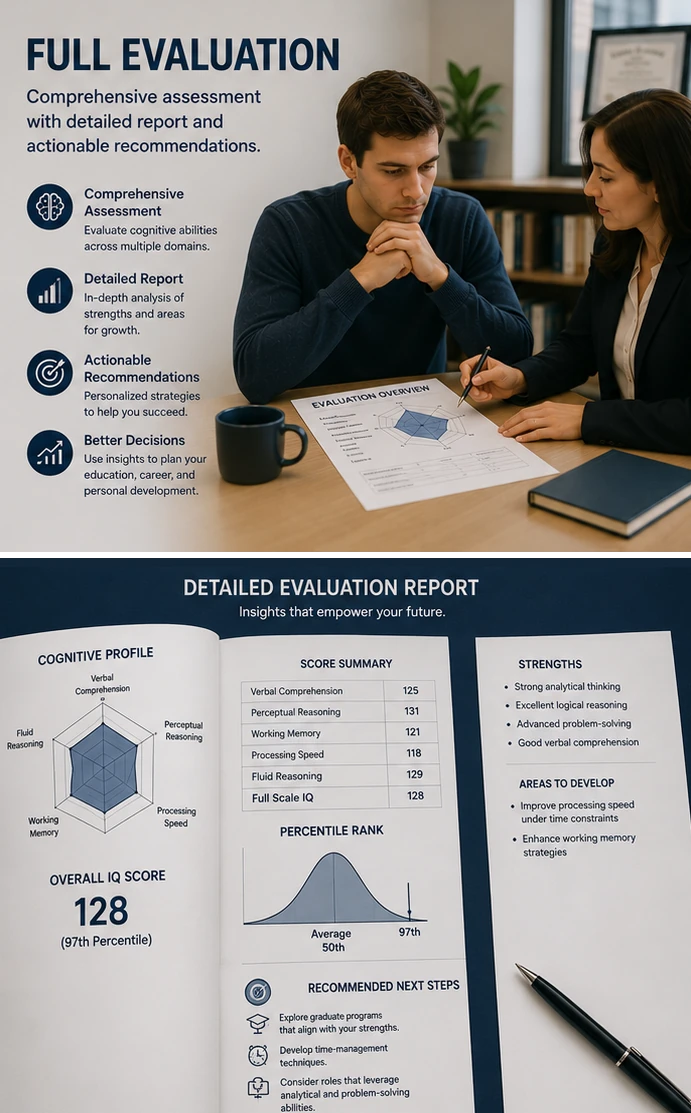
A full evaluation goes beyond one IQ score. Depending on the referral question, it may combine cognitive, academic, attention, executive-function, emotional, behavioral, adaptive, developmental, and record-review components to produce integrated findings and practical recommendations.
Last Updated: September 2026
Child IQ Testing
WISC-V and Stanford-Binet assessment for gifted identification, learning profiles, and educational planning.
Adult IQ Testing
WAIS-IV and WAIS-5 assessment for clinical, educational, occupational, and personal questions.
WISC-V Test
Detailed child cognitive testing with index-level interpretation and age-appropriate recommendations.
WAIS-IV & WAIS-5
Adult cognitive assessment covering verbal, visual, fluid, memory, and processing-speed abilities.
Gifted Testing
Identification and planning using cognitive, achievement, developmental, and educational information.
Stanford-Binet 5
Broad-age verbal and nonverbal assessment with a high ceiling and five cognitive factors.
Mensa Qualification
Prior-evidence guidance and testing subject to current American Mensa requirements.
Full Evaluation
Integrated cognitive, academic, behavioral, emotional, executive, and adaptive assessment as needed.
What Is a Full Evaluation?
A full psychological or psychoeducational evaluation integrates multiple data sources to answer a defined question. Testing may take two to six or more hours across one or several sessions, followed by scoring, interpretation, report writing, and feedback.
Possible Evaluation Components
- Cognitive assessment: WISC-V, WAIS-IV, WAIS-5, Stanford-Binet 5, or another appropriate measure.
- Academic achievement: Reading, writing, mathematics, oral language, and academic fluency.
- Attention and executive functioning: Interviews, rating scales, performance measures, and real-world functional history.
- Emotional and behavioral functioning: Symptoms, personality, coping, mood, anxiety, behavior, and social functioning.
- Autism and developmental assessment: Developmental history, observation, social communication, restricted behavior, adaptive functioning, and differential diagnosis.
- Adaptive behavior: Communication, daily living, socialization, community functioning, and independence.
- Records and collateral information: School, medical, employment, prior testing, parent, teacher, partner, or caregiver information as appropriate.
Common Tests Used
| Domain | Examples | Purpose |
|---|---|---|
| Cognitive | WISC-V, WAIS-IV/5, SB-5 | Reasoning, memory, speed, and intellectual profile |
| Academic | WIAT-4, Woodcock-Johnson, KTEA-3 | Reading, writing, mathematics, and oral language |
| Attention/Executive | Conners, BRIEF, CPT-type tasks, D-KEFS | Attention, inhibition, planning, flexibility, and real-world regulation |
| Behavior/Emotion | BASC, CBCL/ASEBA, personality measures | Mood, anxiety, behavior, social and personality functioning |
| Adaptive | Vineland, ABAS | Everyday independence and functional skills |
Questions a Full Evaluation May Address
- ADHD, learning disability, autism, intellectual disability, giftedness, or twice-exceptionality.
- College or testing accommodations and current functional limitations.
- School eligibility, educational planning, or transition services.
- Effects of neurological, medical, developmental, or psychiatric conditions.
- Complex cases where more than one diagnosis may explain the difficulties.
Evaluation Timeline
- Referral clarification and records request.
- Clinical interview and test planning.
- One or more assessment sessions.
- Scoring, integration, and differential diagnosis.
- Written report and feedback conference.
- Optional school, medical, or workplace consultation with written authorization.
What the Final Report Should Contain
- Referral question, history, tests, dates, and conditions.
- Behavioral observations and validity discussion.
- Scores with confidence intervals and plain-language interpretation.
- Integrated findings rather than a disconnected list of test results.
- Diagnoses only when criteria are supported.
- Specific, prioritized recommendations and documentation language relevant to the receiving setting.
IQ, Gender, Language, and Demographic Context
Professional intelligence tests use national age-based norms rather than a separate Honolulu norm for women, men, Native Hawaiians, Pacific Islanders, Asian populations, other racial or ethnic groups, military families, neighborhoods, islands, or school systems. Overall intelligence distributions overlap substantially by sex. An individual may still show meaningful differences among verbal comprehension, visual-spatial reasoning, fluid reasoning, quantitative reasoning, working memory, and processing speed.
Current Census context for Urban Honolulu residents:
- Female residents: 50.1% of the population.
- Age context: 16.5% of residents are under 18 and 22.0% are age 65 or older, so age-appropriate norms and developmental or health context are essential.
- Female civilian labor-force participation: 59.5% among residents age 16 and older in 2020–2024.
- High-school graduate or higher: 91.2% of adults age 25 and older.
- Bachelor’s degree or higher: 41.5% of adults age 25 and older.
- Foreign-born residents: 27.6%.
- Language other than English spoken at home: 35.0% of residents age 5 and older.
- Selected racial context: 52.3% Asian alone, 8.2% Native Hawaiian and Other Pacific Islander alone, and 19.3% two or more races. These categories describe population composition; they are not valid proxies for an individual’s ability.
- Disability and health-access context: 7.5% of residents under 65 have a disability and 4.4% of residents under 65 are uninsured.
Honolulu’s linguistic and cultural diversity makes referral planning especially important. The clinician should document the person’s strongest language, schooling language, migration and educational history, exposure to Standard American English, hearing and vision needs, and familiarity with test content. A casual translation of standardized items can invalidate norms. When language or cultural exposure may materially affect results, consider bilingual assessment, validated nonverbal measures, interpreter-supported history taking, collateral records, and cautious conclusions.
Gender, race, ethnicity, language, income, school, neighborhood, and military status should never be used to predict a person’s IQ. Interpretation must be individualized and should explain confidence intervals, score variability, behavioral observations, and limitations.
Local Clinical and Educational Context
Honolulu includes pediatric and adult hospitals, military and veteran health systems, university medical and research programs, rehabilitation services, community health centers, public-school evaluation teams, private schools, and independent psychology, neuropsychology, psychiatry, speech-language, occupational-therapy, and educational practices. Availability varies greatly by age, insurance, medical necessity, language, referral question, and whether the evaluation is for treatment, school eligibility, private admission, disability documentation, legal use, or personal planning.
Because residents may travel from other parts of Oʻahu or other islands, ask whether intake, record review, and feedback can occur securely by telehealth while standardized testing remains in person when required. Confirm the provider’s Hawaiʻi license, specialty training, wait time, parking, accessibility, interpreter policy, report turnaround, and whether the receiving school or agency accepts the proposed battery.
Honolulu Universities, Training Centers, and Health Institutions
- University of Hawaiʻi at Mānoa: Hawaiʻi’s flagship public research campus offers undergraduate, graduate, and professional education across education, psychology, business, engineering, social sciences, law, medicine, public health, languages, ocean and earth sciences, and many other fields.
- Honolulu and Kapiʻolani Community Colleges: UH community-college campuses provide transfer pathways, career and technical education, health programs, trades, liberal arts, hospitality, business, and continuing education. Leeward Community College and UH West Oʻahu add options for residents traveling from central and leeward Oʻahu.
- Hawaiʻi Pacific University: A private university with downtown and waterfront facilities and undergraduate, graduate, and professional programs including business, psychology, nursing, public health, social work, communication, and health-science pathways.
- Chaminade University of Honolulu: A private university offering undergraduate and graduate programs that include psychology, education, counseling, school psychology, nursing, business, data science, and criminal justice.
- John A. Burns School of Medicine and the University of Hawaiʻi Cancer Center: Kakaʻako-based medical education and research institutions that contribute to clinical training, biomedical research, public health, and specialist networks.
- Major civilian health systems: The Queen’s Medical Center, Kapiʻolani Medical Center for Women & Children, Straub Benioff Medical Center, Kuakini Medical Center, Kaiser Permanente Moanalua Medical Center, rehabilitation services, community health centers, and private practices serve different ages and referral needs.
- Military and federal health resources: Tripler Army Medical Center and the VA Pacific Islands Health Care System contribute medical, rehabilitation, training, and referral resources for eligible service members, veterans, and families.
Listing an institution provides local educational and clinical context; it does not imply that the institution offers private IQ testing or endorses this website. Families and adults should verify current services, eligibility, insurance, language access, documentation rules, and referral requirements directly.
Honolulu Economic Context
- Median household income: $86,504 in 2020–2024 Census estimates, measured in 2024 dollars for Urban Honolulu CDP.
- Per-capita income: $49,569.
- Residents in poverty: 11.9%.
- Bachelor’s degree or higher: 41.5% of adults age 25 and older.
- Mean travel time to work: 21.9 minutes, although H-1 congestion, school-day traffic, visitor activity, weather, road work, and cross-island trips can make appointment travel substantially longer.
- Accommodation and food-service activity: Census business data report approximately $4.892 billion in 2022 sales within Urban Honolulu, reflecting the scale of hospitality, restaurants, visitor services, and event activity.
- Health and social-assistance activity: Approximately $6.362 billion in 2022 receipts/revenue.
- Transportation and warehousing: Approximately $5.689 billion in 2022 receipts/revenue, consistent with the importance of Daniel K. Inouye International Airport, Honolulu Harbor, freight distribution, transit, and an island supply chain.
- Retail sales: Approximately $12.749 billion in 2022, or $37,098 per resident on the Census per-capita measure.
- Regional strengths: State and local government, federal defense, tourism and hospitality, health care, education and research, aviation and maritime activity, logistics, construction and real estate, professional and financial services, technology, creative industries, and international business linked to Hawaiʻi’s Pacific location.
These figures describe community and labor-market conditions, not intelligence. They help explain why Honolulu residents may seek testing for educational planning, disability documentation, career transitions, professional programs, military or civilian employment, and retraining.
Access Patterns Across Honolulu
There is no authoritative neighborhood-level IQ database, and responsible clinicians do not estimate ability from a person’s address, school, ethnicity, income, or community. The areas below are included only to explain transportation, institutional, school, and appointment-access patterns.
- Downtown, Chinatown, and Kakaʻako: The government, legal, business, medical-education, and waterfront core includes state and city offices, Hawaiʻi Pacific University facilities, JABSOM, the UH Cancer Center, hospitals, and major bus corridors.
- Ala Moana and Waikīkī: Dense residential, retail, hospitality, and visitor districts with frequent bus service, Biki stations, significant pedestrian activity, and traffic or parking constraints that can affect arrival time.
- Makiki, Punahou, Mānoa, and Mōʻiliʻili: Central neighborhoods near UH Mānoa, schools, Kapiʻolani Medical Center, clinics, and the King Street, Beretania Street, University Avenue, and Punahou Street corridors.
- Kaimukī, Kapahulu, Diamond Head, Kāhala, and East Honolulu: Residential, educational, medical, and commercial areas connected by Kapiʻolani Boulevard, Waialae Avenue, Monsarrat Avenue, and Kalanianaʻole Highway.
- Kalihi, Liliha, Nuʻuanu, Moanalua, and Salt Lake: Communities near H-1, H-201, Pali Highway, Likelike Highway, Tripler Army Medical Center, airport employment, industrial areas, and central Oʻahu connections.
- Central, leeward, and windward connections: Residents coming from ʻAiea, Pearl City, Kapolei, ʻEwa, Kailua, Kāneʻohe, and farther parts of Oʻahu may need to plan around freeway bottlenecks, mountain routes, rail-and-bus transfers, parking, and longer travel windows.
Transportation and Appointment Access
- Major roads: Interstate H-1 (Lunalilo Freeway and Queen Liliʻuokalani Freeway) is the principal east-west freeway through urban Honolulu; H-201/Moanalua Freeway provides an alternate central connection; H-2 and H-3 connect the urban core with central and windward Oʻahu. Important surface routes include Nimitz Highway, Ala Moana Boulevard, Kapiʻolani Boulevard, South King Street, Beretania Street, Pali Highway, Likelike Highway, Kalanianaʻole Highway, Waialae Avenue, and University Avenue.
- Public transit: TheBus operates extensive island-wide fixed-route service. Skyline rail serves the west and central corridor and Daniel K. Inouye International Airport, with bus connections toward Downtown Honolulu, Ala Moana, Waikīkī, UH Mānoa, and other destinations. TheHandi-Van provides ADA complementary paratransit for eligible riders. Check current routes, station access, transfers, and service alerts before testing day.
- Airport: Daniel K. Inouye International Airport (HNL) is Hawaiʻi’s principal airport, providing inter-island, mainland, and international service. Honolulu has no road connection to the other Hawaiian Islands, so residents traveling from Maui, Hawaiʻi Island, Kauaʻi, Molokaʻi, or Lānaʻi must use air service and allow for check-in, ground transportation, and possible weather delays.
- Distance to other cities and Oʻahu communities: Under light traffic, central Honolulu is often about 20–35 minutes from Pearl City or ʻAiea, 25–40 minutes from Kailua or Kāneʻohe, 30–50 minutes from Kapolei, and 45–75 minutes from Haleʻiwa. Peak H-1 conditions, crashes, school traffic, rain, lane closures, and the exact starting point can add substantial time.
- Walkability: Downtown/Chinatown, Kakaʻako, Ala Moana, Waikīkī, and parts of Mōʻiliʻili and Kaimukī contain relatively walkable concentrations of offices, shops, schools, and services. Heat, heavy rain, hills, construction, crowded sidewalks, large intersections, and limited shade can still affect children, older adults, and people with mobility or sensory needs.
- Bike infrastructure: The City reports more than 200 miles of bicycle paths, lanes, and routes across Oʻahu. Urban facilities include protected or buffered bikeways on corridors such as South King, South Street, Ward Avenue, and Pensacola Street, together with Biki bikeshare, the Ala Wai and waterfront network, and expanding Complete Streets connections. Confirm the safest current route and secure bicycle parking at the appointment site.
- Practical scheduling: Ask about parking cost, validation, elevator access, drop-off space, bus or rail proximity, waiting-room noise, air conditioning, restroom access, breaks, and whether multi-session evaluations can be scheduled to reduce fatigue, rush-hour exposure, and inter-island travel burdens.
Cost, Insurance, and Scope
Full evaluations cost more than focused IQ testing because they require more measures, records review, integration, and report writing. Insurance may cover medically necessary components but often excludes school admission, gifted testing, career guidance, or legal/forensic work. Ask for a written scope and estimate before testing begins.
Red Flags When Choosing a Service
- Guaranteed diagnoses, guaranteed accommodations, guaranteed gifted placement, or guaranteed Mensa admission.
- Only a score sheet when a comprehensive report is required.
- No discussion of language, disability, medication, fatigue, or validity.
- Use of outdated or inappropriate norms without explanation.
- Recommendations copied from a template without connection to findings.
Honolulu Data and Planning Sources
Population estimates, city services, transportation information, school policies, and institutional programs can change. To keep this section concise, the Honolulu tailoring uses these three primary official source pages:
- U.S. Census Bureau QuickFacts: Urban Honolulu CDP, Hawaiʻi
- City and County of Honolulu
- Hawaiʻi State Department of Education
Frequently Asked Questions
Testing often takes two to six or more hours, plus intake, scoring, report writing, and feedback.
Depending on scope, evaluations may address ADHD, learning disorders, autism, intellectual disability, giftedness, emotional conditions, and neuropsychological questions.
Usually not. Documentation requires diagnosis, functional limitations, history, and a rationale for requested accommodations.
It depends on medical necessity and plan rules. Educational, career, gifted, and forensic purposes are often excluded.
Integrated findings, scores, confidence intervals, validity, diagnoses when supported, and specific recommendations.