
Graduate School Preparation in Hollywood, FL

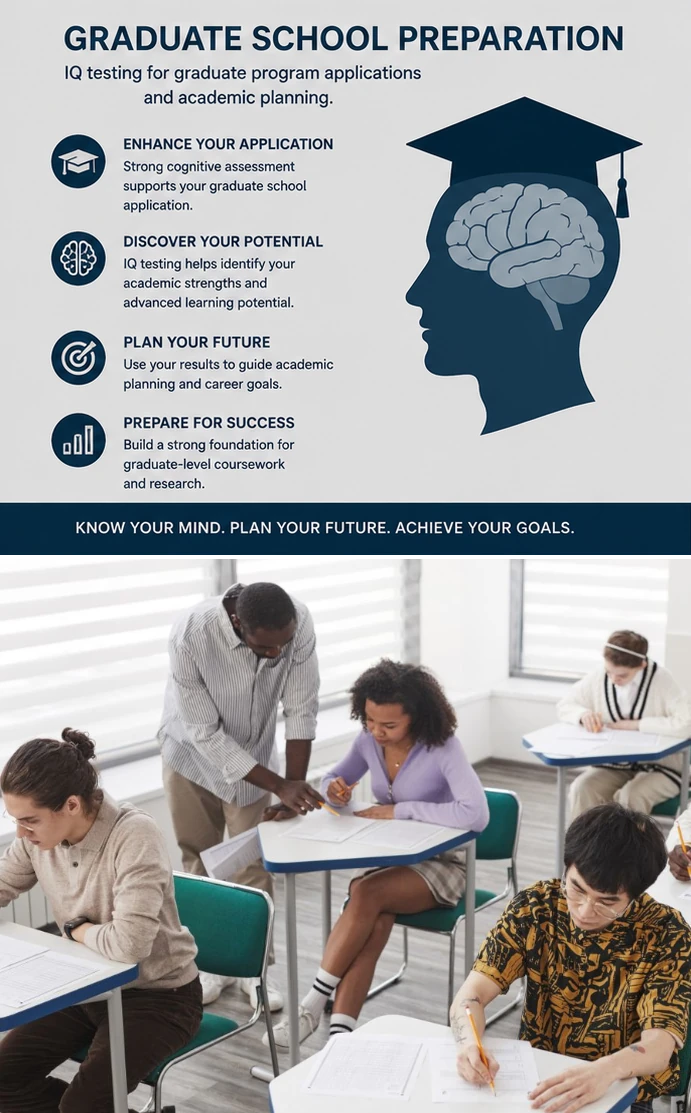
IQ testing can be a valuable tool for graduate school preparation, helping you identify your cognitive strengths, select the right program, and plan for academic success. This comprehensive guide covers how IQ testing supports graduate school applications, which tests are accepted, and how to leverage your results.
Last Updated: September 2026
Adult IQ Testing
WAIS-IV & WAIS-5 available. Comprehensive adult cognitive assessments for graduate school planning.
WAIS-IV & WAIS-5 Tests
Wechsler Adult Intelligence Scale® – Fourth Edition (WAIS-IV) and Fifth Edition (WAIS-5) – the gold standard for adult IQ testing in graduate school applications.
Career Guidance
Use IQ testing to identify career paths and graduate programs that align with your cognitive strengths.
Mensa Testing
Official Mensa testing – another way to demonstrate exceptional cognitive ability for applications. Accepts WAIS-IV, WAIS-5, and Stanford-Binet 5 scores.
Full Evaluation
Comprehensive assessment with detailed report and recommendations for academic planning. Includes WAIS-IV or WAIS-5.
Schedule Graduate School Preparation Testing
Book your graduate school preparation testing with a licensed psychologist in Hollywood, FL today.
How IQ Testing Supports Graduate School Preparation
IQ testing provides valuable insights that can help you make informed decisions about graduate school:
- Identify your cognitive strengths: Understand your intellectual profile – verbal comprehension, perceptual reasoning, working memory, and processing speed – and how these align with different graduate programs
- Select the right program: Match your cognitive abilities with program demands – for example, law school requires strong verbal reasoning, while engineering programs demand high perceptual reasoning
- Strengthen your application: Some graduate programs, particularly in clinical psychology, neuropsychology, and education, require or strongly recommend cognitive testing as part of the application process
- Academic planning: Use your cognitive profile to guide your choice of courses, research areas, and career paths
- Identify learning needs: If you have a cognitive weakness in a specific area (e.g., processing speed), you can develop strategies to compensate and succeed in graduate-level work
Graduate Programs That May Require or Recommend IQ Testing
Graduate programs rarely use IQ testing for ordinary admission. Cognitive assessment may instead be relevant to a clinical-training requirement, disability documentation, diagnostic clarification, or individualized learning planning:
- Clinical and Counseling Psychology: Many doctoral programs in psychology require cognitive testing as part of the application or training process
- Neuropsychology: Cognitive assessment is central to the field, and programs often expect familiarity with tests like WAIS-IV and WAIS-5
- School Psychology: Programs require knowledge of cognitive assessment, including the WISC-V and WAIS-IV
- Educational Psychology: Understanding cognitive assessment is essential for careers in educational testing and evaluation
- Gifted Education: Programs in gifted education often require knowledge of IQ testing for identification
- Speech-Language Pathology: Some programs may recommend cognitive testing to understand a client's full profile
- Occupational Therapy: Cognitive assessment can be relevant for some specializations
Hollywood, FL Graduate Programs Requiring IQ Testing
Most graduate programs available to Hollywood residents—including programs at Nova Southeastern University, Florida Atlantic University, Florida International University, the University of Miami, and online institutions—do not require a clinical IQ test for admission. They usually rely on transcripts, prerequisites, recommendations, essays, experience, portfolios, interviews, and program-specific examinations.
Testing is more commonly relevant for disability accommodations, diagnostic clarification, rehabilitation, or documentation requested by a specific licensing or training program. Obtain written requirements before scheduling.
An IQ score should not be presented as a substitute for academic preparation or program-specific admissions evidence.
Tests Used for Graduate School Preparation
Hollywood, FL Research Opportunities
Regional opportunities include research and training through Nova Southeastern University, Florida Atlantic University, Florida International University, the University of Miami, Memorial Healthcare System, Broward College, public agencies, schools, nonprofit organizations, and South Florida healthcare, marine, aviation, tourism, and technology employers.
Students should distinguish research participation from clinical evaluation. A study may not provide an individual diagnosis or report, and research tests may not be accepted for accommodations.
Ask about prerequisites, ethics training, supervision, transportation, data privacy, and whether work is paid, for credit, or volunteer.
Hollywood, FL Graduate School Scholarships
Hollywood students may explore institutional aid, Broward College transfer resources, university fellowships, graduate assistantships, employer tuition programs, professional associations, community foundations, and federal or state aid. Scholarship criteria change and usually emphasize academic, service, research, financial-need, or demographic factors rather than IQ scores.
Never purchase testing solely because a vague scholarship advertisement claims that a high score guarantees funding. Verify the sponsor and written eligibility rules.
Disability-related scholarships may require diagnosis or functional documentation, but the required evidence varies.
Hollywood, FL Graduate School Preparation Timeline
Work backward from application, examination, and accommodation deadlines. Allow time for records, authorization, testing, scoring, feedback, report revision, and institutional review.
Plan around work, family, South Florida commuting, hurricane season, and the distinction between the testing date and final-report date. Ask about report recency before testing too early.
Most preparation should focus on prerequisites, writing, research experience, recommendations, financial planning, and program fit. Cognitive assessment is useful only when it answers a genuine documentation or diagnostic question.
Benefits of IQ Testing for Graduate School Preparation
- Self-awareness: Understand your cognitive strengths and weaknesses and how they relate to different academic and career paths
- Informed decision-making: Choose a graduate program that matches your abilities and interests
- Academic planning: Use your cognitive profile to guide your choice of courses and research areas
- Application enhancement: Some programs may value cognitive testing as evidence of your intellectual abilities
- Career guidance: Identify career paths that align with your cognitive strengths
- Personal growth: Gain insight into your intellectual potential and how to maximize it
Cost of IQ Testing for Graduate School Preparation
The cost of IQ testing for graduate school preparation varies depending on the type of test and the psychologist's experience:
- Single IQ test (WAIS-IV or WAIS-5): $200-$600
- Comprehensive cognitive assessment: $400-$1,200
- Full psychoeducational evaluation: $1,200-$3,000
Some insurance plans may cover testing when it's deemed medically necessary. We recommend checking with your provider for details.
Applicants should keep copies of documentation and track each program’s rules separately. Testing agencies and universities may use different recency standards or require evidence of longstanding impairment and current functional limitation. An evaluator should not recommend accommodations solely from an IQ score without relevant history and academic or clinical evidence.
Frequently Asked Questions
Usually not. Admissions more often rely on transcripts, prerequisites, recommendations, experience, interviews, portfolios, or program-specific examinations. Obtain written instructions if a program, accessibility office, or licensing agency requests psychological documentation.
WAIS-IV is the most widely used adult IQ test and is appropriate for graduate school preparation. WAIS-5 is also available for those who prefer the newest version. Both provide comprehensive cognitive profiles with index scores for verbal comprehension, perceptual reasoning, working memory, and processing speed.
Understanding your cognitive strengths can help you identify career paths that align with your abilities. For example, high verbal comprehension may indicate strength in law, teaching, or writing, while high perceptual reasoning may indicate strength in engineering, design, or technology.
The testing session often takes about 60–90 minutes for a focused measure, but broader batteries take longer. Intake, records review, scoring, feedback, and report timing vary by provider and referral complexity.
The report includes Full-Scale IQ, index scores, strengths and weaknesses, normative comparisons, and recommendations for graduate school planning and career development.
Some plans cover cognitive assessments when there is a clinical indication. Graduate school preparation is often considered an educational rather than medical service, so coverage varies. Check with your provider.
Some interview and feedback components may be completed remotely, but standardized WAIS administration depends on publisher rules, clinical appropriateness, technology, Florida licensure, and the receiving organization. Many evaluations require in-person testing.
Get a good night's sleep, eat a healthy meal, and arrive relaxed. No specific preparation is needed. The test measures innate cognitive abilities, so studying is not necessary.
Typical fees range from $200 to $1,200 for a single IQ test, with full evaluations costing up to $3,000. Some insurance plans cover testing when medically necessary.
Mensa membership is generally not a graduate-admissions requirement and should not replace evidence such as academic preparation, research, professional experience, recommendations, or program fit. Applicants should include it only when relevant and should verify current Mensa testing or prior-evidence options directly with American Mensa.