
Child IQ Testing in Gainesville
Professional child IQ testing in Gainesville – whether you need an assessment for school placement, gifted program eligibility, or to understand your child's learning profile, we connect you with licensed psychologists in the Gainesville area.
Last Updated: September 2026
Gifted Testing
Identify giftedness for school placement, enrichment, and talent programs using WISC-V or Stanford-Binet 5.
WISC-V Test
Wechsler Intelligence Scale for Children® Fifth Edition – the gold standard for child IQ testing.
Stanford-Binet 5
Stanford-Binet Intelligence Scales Fifth Edition – comprehensive cognitive assessment for all ages.
Full Evaluation
Combined assessment with detailed report and recommendations. Includes WISC-V or Stanford-Binet 5.
School Placement Testing
Testing for private school admission and gifted program eligibility using WISC-V or Stanford-Binet 5.
Schedule Child IQ Testing
Book your WISC-V & Stanford-Binet 5 for ages 6–16. Gifted identification, learning profiles, etc. with a licensed psychologist in Gainesville today.
Child IQ Testing in Gainesville: city context
Gainesville children attend Gainesville-Alachua County public schools, charter and specialty programs, private and faith-based schools, and home-study programs. Families seek testing for gifted referral, learning differences, ADHD, autism, school placement, acceleration, disability documentation, or an uneven developmental profile.
Testing should reflect the child's age, language, schooling, culture, sensory and motor needs, health, and referral question. A private report does not automatically determine public-school eligibility or placement.
IQ by gender & ethnicity (child population)
Gainesville is approximately 52.5% female overall. Properly normed tests do not support ranking local children by gender, race, ethnicity, neighborhood, family income, disability, or home language. No authoritative city dataset publishes such IQ averages.
- Interpret language development and opportunity to learn separately from reasoning potential.
- Review school records, teacher evidence, achievement, creativity, motivation, and adaptive functioning as relevant.
- Consider twice-exceptionality when advanced reasoning coexists with ADHD, autism, dyslexia, language disorder, or another disability.
- Avoid drawing conclusions from a single composite when index scores are meaningfully uneven.
Gainesville School Districts and Gifted Programs
Alachua County Public Schools
Alachua County Public Schools serves Gainesville and Alachua County through neighborhood schools, choice and specialty programs, charter options, career academies, and advanced secondary pathways. Exact assignment depends on the residence and current district rules.
Alachua County Public Schools Gifted Nomination and Assessment
Students may be nominated or referred for gifted consideration. Those who proceed to evaluation are assessed under Florida requirements and district procedures; a referral or private IQ score does not guarantee eligibility.
Elementary Advanced Programs
Elementary services may use differentiated content, enrichment, advanced problem solving, flexible grouping, or other district models. Families should ask the assigned school how identified students are served in the current year.
Secondary Advanced and Enrichment Pathways
Middle- and high-school students may access advanced coursework, Advanced Placement, International Baccalaureate, dual enrollment, career pathways, specialty programs, arts, research, and academic competitions according to school offerings.
Florida Requirements and Other School Options
Florida gifted eligibility considers mental ability, achievement, creativity, and motivation. Charter, private, faith-based, and home-study programs may use different admissions, acceleration, and placement criteria.
Gainesville Private Schools Requiring IQ Testing
Independent schools do not share one testing rule, and many do not require an IQ test. Gainesville-area options include schools with college-preparatory, faith-based, Montessori, classical, arts, and specialized-learning models.
- Ask whether the school needs an admission test, achievement data, classroom records, readiness measures, an interview, or a full psychoeducational evaluation.
- Obtain written requirements for examiner credentials, test edition, acceptable age of results, score format, and supporting records.
- Do not assume public-school gifted eligibility transfers to a private program or that a private report controls Alachua County Public Schools placement.
- For disability support, ask specifically how the school reviews diagnoses, functional limitations, and recommended accommodations.
Gainesville Gifted Identification Statistics
No authoritative public source reports a single current gifted-identification rate for children living specifically inside Gainesville city limits. Alachua County Public Schools data cover the countywide district, while private and charter programs report differently.
- Use current district reports when a countywide participation figure is needed.
- Do not estimate giftedness by applying a national percentage to Gainesville's population.
- Representation gaps can reflect referral, opportunity, language, disability, mobility, and access to advanced instruction.
The child IQ testing process: step by step
Understanding the testing process can help parents prepare their child and reduce anxiety. Here's what to expect:
- Initial consultation (15–20 minutes): A brief phone or video call with the psychologist to discuss your child's background, concerns, and goals. This helps determine the right test and approach.
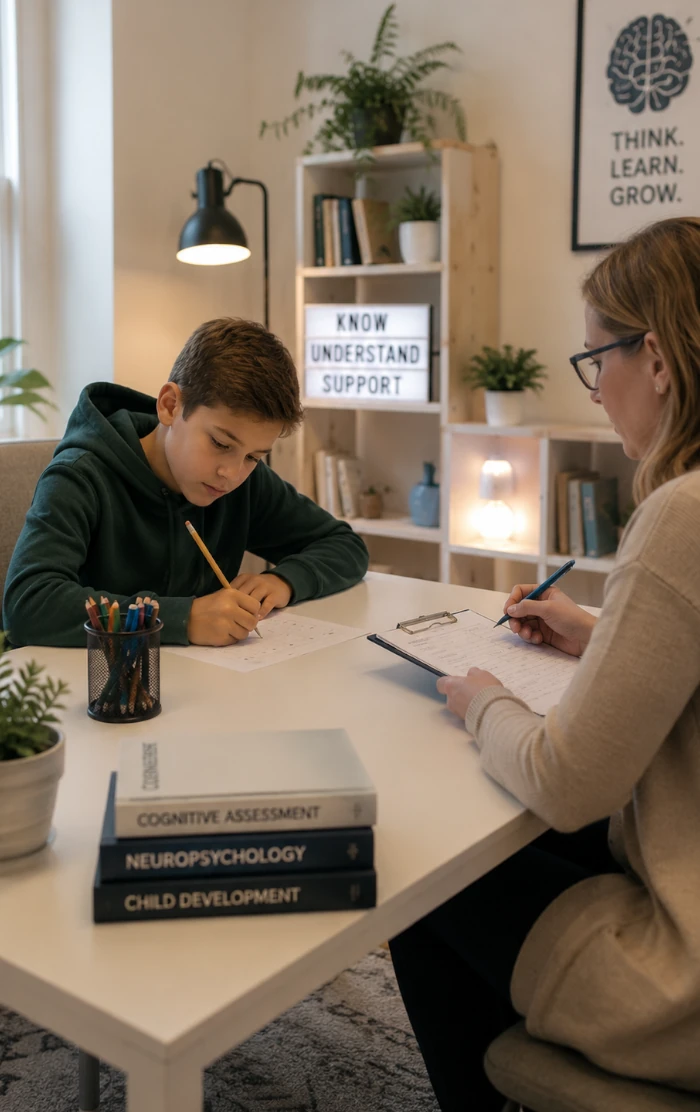
- Testing session (60–90 minutes): The child meets one-on-one with a licensed psychologist in a quiet, comfortable room. The psychologist administers the WISC-V or Stanford-Binet 5, which includes a series of subtests measuring verbal comprehension, visual-spatial reasoning, fluid reasoning, working memory, and processing speed. Breaks are offered as needed.
- Scoring and interpretation (1–2 days): The psychologist scores the test and analyzes the results. They consider the child's age, background, and any relevant medical or educational history.
- Feedback session (45–60 minutes): The psychologist meets with the parents (and the child, if appropriate) to explain the results. They discuss the Full-Scale IQ, index scores, strengths, and areas for growth. They also provide tailored recommendations for home, school, and extracurriculars.
- Comprehensive written report (5–7 days): You receive a detailed report with all scores, normative comparisons, and actionable next steps. This report can be shared with schools, doctors, or other professionals.
The entire process from consultation to report usually takes 1–2 weeks, depending on scheduling. The testing itself is non-invasive and designed to be engaging for children.
What is the WISC-V test?
The WISC-V (Wechsler Intelligence Scale for Children® – Fifth Edition) is the most widely used IQ test for children aged 6:0–16:11. It provides a Full-Scale IQ and five primary index scores: Verbal Comprehension, Visual-Spatial, Fluid Reasoning, Working Memory, and Processing Speed. The test is administered one-on-one by a trained psychologist and takes about 60–90 minutes.
The WISC-V is normed on a large, representative sample of U.S. children and is updated regularly to ensure accuracy. It is the gold standard for gifted identification, learning disability diagnosis, and school placement.
Why test your child's IQ?
IQ testing provides valuable insights into your child's cognitive strengths and weaknesses. It can help:
- Identify giftedness: For admission to gifted programs, private schools, or enrichment opportunities.
- Diagnose learning disabilities: Such as dyslexia, dyscalculia, or ADHD, which can be masked by high intelligence.
- Guide educational planning: Tailor instruction to your child's unique learning profile.
- Provide reassurance: Understand why your child is different from peers and how to support them.
Gainesville Gifted Testing Timeline
- Before referral: Gather report cards, work samples, teacher observations, prior tests, language history, and evidence of both strengths and concerns.
- District route: Ask the school for current Alachua County Public Schools nomination, referral, consent, assessment, eligibility, and service timelines.
- Private route: Allow time for intake, records review, testing, scoring, feedback, and report delivery; receiving organizations may request revisions or additional measures.
- Planning: Begin well before choice-school, private-school, accommodation, or summer-program deadlines.
Gainesville Gifted Programs by Age Group
- Preschool: Focus on development, play, language, curiosity, regulation, and readiness; stable IQ interpretation is more limited at very young ages.
- Elementary: Differentiation, enrichment, flexible pacing, specialty options, and district gifted services may address advanced learning needs.
- Middle school: Advanced courses, arts, STEM, competitions, mentorship, and specialty pathways can provide challenge.
- High school: AP, IB, dual enrollment, career academies, arts programs, research, internships, and college planning create multiple advanced routes.
Gainesville Child ADHD and Learning Disability Assessment
ADHD and learning-disability evaluations require more than an IQ score. A useful assessment integrates developmental history, school records, interviews, rating scales, achievement testing, observations, and exclusionary factors.
- Ask whether the referral concerns reading, writing, mathematics, attention, executive function, language, autism, mood, or a broader neurodevelopmental question.
- Coordinate with Alachua County Public Schools or the child's school when educational eligibility and classroom services are at issue.
- Ensure the report translates findings into functional recommendations for home, school, and treatment.
Gainesville Summer Programs for Gifted Children
Summer enrichment changes annually. Gainesville families can check official calendars from the University of Florida, Santa Fe College, Florida Museum of Natural History, Harn Museum of Art, Alachua County Library District, Gainesville Parks, Recreation and Cultural Affairs, science organizations, and school or recreation providers.
- Programs may emphasize art, design, writing, coding, robotics, environmental and life sciences, history, performance, athletics, entrepreneurship, or college readiness.
- Some programs use age, portfolio, grades, teacher recommendations, or prerequisites rather than IQ scores.
- Verify accessibility, transportation, supervision, cost, scholarship availability, and severe-weather policies.
Gainesville Child Testing Costs by District
Eligible public-school evaluations are conducted under district procedures without charging families. Private testing fees vary with the referral, clinician, battery, records review, feedback, and report complexity.
- A brief gifted or cognitive assessment generally costs less than a comprehensive psychoeducational or neuropsychological evaluation.
- Insurance may cover medically necessary diagnostic testing but often excludes gifted, admission, or personal-interest evaluation.
- Ask for a written estimate and clarify deposits, cancellation fees, school meetings, expedited reports, and reimbursement documentation.
Areas we serve
We support all areas of Gainesville.
Frequently Asked Questions
Both are excellent tests. WISC-V is more commonly used for school-age children, while Stanford-Binet 5 can be used for ages 2–85. We often recommend WISC-V for gifted identification.
The test itself takes 60–90 minutes. With the consultation, feedback, and report, the entire process is about 1–2 weeks.
No, you can book directly with our psychologists. We serve both self-referred and professionally referred children.
Possibly. Alachua County Public Schools and private programs apply their own current criteria, so obtain written confirmation about accepted tests, editions, examiner credentials, and report requirements before scheduling.
Some plans cover cognitive assessments when there is a clinical indication. Check with your provider.
Get a good night's sleep, eat a healthy meal, and arrive relaxed. No specific preparation is needed.
You'll receive a comprehensive report with your child's scores and tailored recommendations.
Some interview and feedback components may be available remotely, but many standardized cognitive tests require in-person administration. Confirm with the psychologist and the organization receiving the report.