
Child IQ Testing in Fort Lauderdale

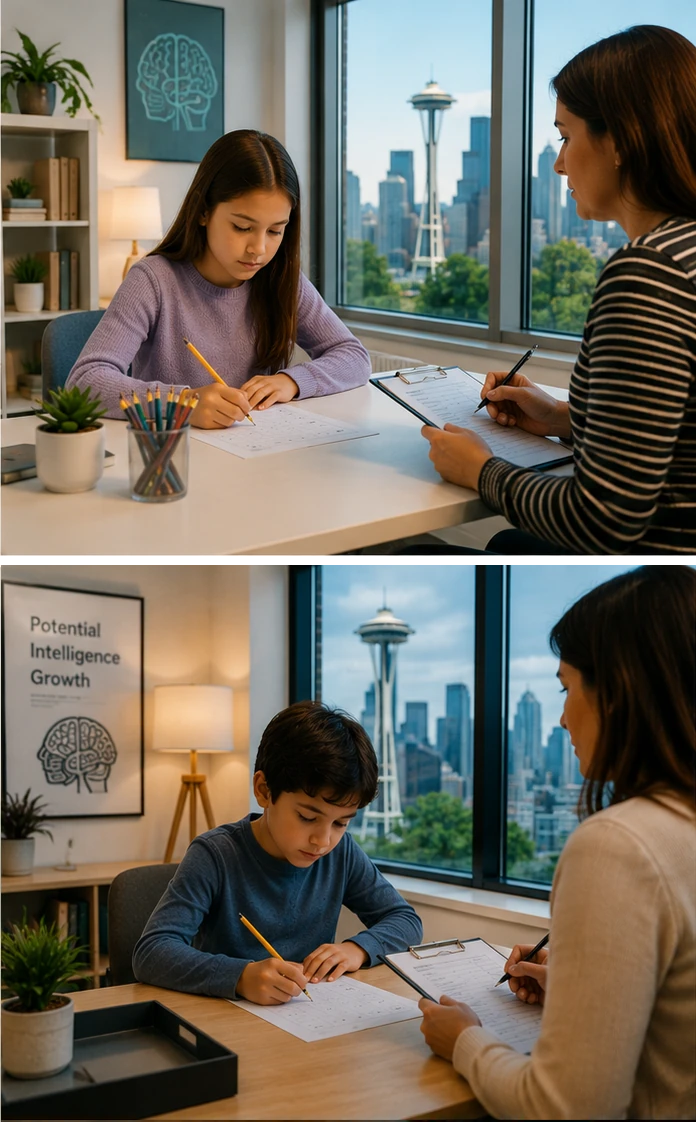
Professional child IQ testing in Fort Lauderdale – whether you need an assessment for school placement, gifted program eligibility, or to understand your child's learning profile, we connect you with licensed psychologists in the Fort Lauderdale area.
Last Updated: September 2026
Gifted Testing
Identify giftedness for school placement, enrichment, and talent programs using WISC-V or Stanford-Binet 5.
WISC-V Test
Wechsler Intelligence Scale for Children® Fifth Edition – the gold standard for child IQ testing.
Stanford-Binet 5
Stanford-Binet Intelligence Scales Fifth Edition – comprehensive cognitive assessment for all ages.
Full Evaluation
Combined assessment with detailed report and recommendations. Includes WISC-V or Stanford-Binet 5.
School Placement Testing
Testing for gifted, learning, and school-planning questions using measures selected for the child and referral purpose.
Schedule Child IQ Testing
Book your WISC-V & Stanford-Binet 5 for ages 6–16. Gifted identification, learning profiles, etc. with a licensed psychologist in Fort Lauderdale today.
Child IQ Testing in Fort Lauderdale: city context
Children under age 18 account for 17.3% of Fort Lauderdale's population. Families are served by Broward County Public Schools, charter schools, private and independent schools, faith-based schools, early-childhood programs, university and college resources, libraries, museums, arts organizations, recreation programs, and clinical providers across the city and surrounding county.
A child evaluation may address gifted eligibility, uneven academic performance, suspected learning or attention difficulties, school placement, twice-exceptionality, developmental questions, or the need for educational accommodations. Because 30.1% of residents age five and older speak a language other than English at home and 27.0% are foreign-born, language history and cultural experience can be especially important when choosing measures and interpreting results.
IQ by gender & ethnicity (child population)
Fort Lauderdale's overall population is 47.5% female and approximately 52.5% male. Citywide race and ethnicity figures include 48.4% White alone, 28.9% Black alone, 1.5% Asian alone, 17.3% two or more races, and 20.3% Hispanic or Latino. These community figures describe population composition; they do not establish expected IQ scores for any child.
No credible public source reports a Fort Lauderdale child-IQ average by gender, race, or ethnicity. A properly trained examiner considers language exposure, educational opportunity, disability, cultural experience, motor or sensory needs, attention, anxiety, and rapport. Interpretation should focus on the individual child's score pattern and real-world functioning, not demographic stereotypes.
The child IQ testing process: step by step
Understanding the process can help parents prepare their child and reduce uncertainty. A Fort Lauderdale evaluation commonly includes:
- Initial consultation: The psychologist reviews the referral question, developmental and medical history, school history, family concerns, language background, prior testing, and the exact documentation requested by Broward County Public Schools, a private school, physician, or other receiving organization.
- Records and measure selection: Relevant report cards, intervention records, IEP or Section 504 documents, prior evaluations, and teacher information are reviewed. The examiner selects the WISC-V, Stanford-Binet 5, achievement measures, attention or executive-function measures, and other tools that fit the child's age and referral question.
- Testing session: The child works individually with a qualified examiner in a controlled setting. Cognitive testing often takes 60–90 minutes, while a broader psychoeducational evaluation may require additional sessions. Breaks and reasonable accessibility supports are used when appropriate without invalidating standardized procedures.
- Scoring and interpretation: The psychologist considers the Full-Scale IQ, index or factor scores, confidence intervals, meaningful discrepancies, behavioral observations, effort, and the child's educational and developmental context rather than relying on a single number.
- Feedback and written report: Parents receive an explanation of strengths, relative weaknesses, limitations, and practical recommendations. The written report can be shared, with authorization, with Fort Lauderdale-area schools, healthcare providers, or other professionals, but the receiving organization decides whether it satisfies current eligibility or documentation rules.
The full timeline depends on the scope of testing, records needed, scheduling, scoring requirements, and report preparation. Families should ask about estimated turnaround time before booking when a school or application deadline applies.
What is the WISC-V test?
The WISC-V (Wechsler Intelligence Scale for Children® – Fifth Edition) is the most widely used IQ test for children aged 6:0–16:11. It provides a Full-Scale IQ and five primary index scores: Verbal Comprehension, Visual-Spatial, Fluid Reasoning, Working Memory, and Processing Speed. The test is administered one-on-one by a trained psychologist and takes about 60–90 minutes.
The WISC-V is normed on a large, representative sample of U.S. children and is updated regularly to ensure accuracy. It is the gold standard for gifted identification, learning disability diagnosis, and school placement.
Why test your child's IQ?
IQ testing provides valuable insights into your child's cognitive strengths and weaknesses. It can help:
- Identify giftedness: For admission to gifted programs, private schools, or enrichment opportunities.
- Diagnose learning disabilities: Such as dyslexia, dyscalculia, or ADHD, which can be masked by high intelligence.
- Guide educational planning: Tailor instruction to your child's unique learning profile.
- Provide reassurance: Understand why your child is different from peers and how to support them.
Areas we serve
We support all areas of the City of Fort Lauderdale.
Frequently Asked Questions
Both are excellent tests. WISC-V is more commonly used for school-age children, while Stanford-Binet 5 can be used for ages 2–85. We often recommend WISC-V for gifted identification.
The test itself takes 60–90 minutes. With the consultation, feedback, and report, the entire process is about 1–2 weeks.
No, you can book directly with our psychologists. We serve both self-referred and professionally referred children.
A WISC-V or other evaluation may contribute useful evidence, but Broward County Public Schools and each private program apply their own current eligibility and documentation rules. Confirm acceptance before testing.
Some plans cover cognitive assessments when there is a clinical indication. Check with your provider.
Get a good night's sleep, eat a healthy meal, and arrive relaxed. No specific preparation is needed.
You'll receive a comprehensive report with your child's scores and tailored recommendations.
Some interviews, feedback sessions, and selected assessment components may be available by secure telehealth when clinically appropriate and permitted. Many standardized cognitive tests still require controlled, in-person administration; confirm the format before booking.