
IQ Testing in Colorado Springs

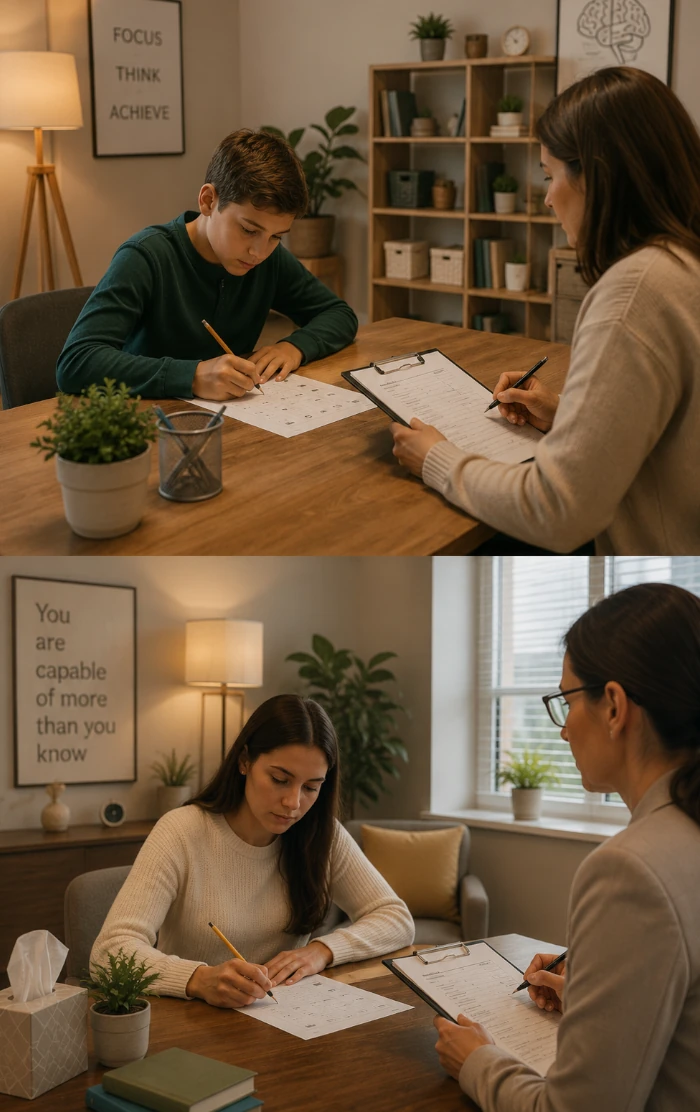
Professional IQ testing in Colorado Springs – whether you need an assessment for school, employment, gifted program eligibility, or personal insight, we connect you with licensed psychologists in the Colorado Springs area.
Last Updated: October 2026
Child IQ Testing
WISC-V & Stanford-Binet for ages 6–16. Gifted identification, learning profiles.
Adult IQ Testing
WAIS-IV & WAIS-5 available. Comprehensive adult cognitive assessments. Clinical & occupational.
WISC-V Test
Wechsler Intelligence Scale for Children® Fifth Edition – the gold standard for child IQ testing.
WAIS-IV & WAIS-5 Tests
Wechsler Adult Intelligence Scale® – Fourth Edition (WAIS-IV) and Fifth Edition (WAIS-5) available for adult IQ testing.
Gifted Testing
Identify giftedness for school placement, enrichment, and talent programs using WISC-V or Stanford-Binet.
Stanford-Binet 5
Stanford-Binet Intelligence Scales Fifth Edition – comprehensive cognitive assessment for all ages.
Mensa Testing
Mensa admission testing and preparation for the high-IQ society. Accepts WAIS-IV, WAIS-5, and Stanford-Binet 5 scores.
Full Evaluation
Combined assessment with detailed report and recommendations. Includes WISC-V, WAIS-IV, WAIS-5, or Stanford-Binet 5 as appropriate.
IQ Testing in Colorado Springs: city context
Colorado Springs is Colorado’s second-largest city and the economic, military, educational, medical, and cultural center of the Pikes Peak region. The city combines a large defense and aerospace workforce with universities, healthcare systems, advanced manufacturing, cybersecurity, tourism, and Olympic and Paralympic organizations.
Professional IQ testing in Colorado Springs serves children, adults, military families, university students, working professionals, and older adults. Testing may support gifted identification, school planning, diagnostic evaluations, accommodations, career guidance, graduate preparation, Mensa evidence, or personal understanding.
Gender, age and demographic statistics
- Population: The U.S. Census Bureau estimates 494,743 residents as of July 1, 2025, up 3.1% from the 2020 estimates base.
- Land area: Colorado Springs covers 195.40 square miles, extending from the foothills west of downtown to rapidly growing eastern and northern corridors.
- Children and older adults: Residents under age 18 account for 21.8% of the population, while adults age 65 and older account for 15.1%.
- Gender: Female residents represent 50.0% of the city population. Professional testing interprets each person against age-appropriate norms rather than assuming ability from gender.
- White residents: 69.6% identify as White alone; 65.2% identify as White alone and not Hispanic or Latino.
- Black residents: 5.7% identify as Black or African American alone.
- American Indian and Alaska Native residents: 1.1% identify as American Indian or Alaska Native alone.
- Asian residents: 3.0% identify as Asian alone.
- Native Hawaiian and Pacific Islander residents: 0.2% identify as Native Hawaiian or Other Pacific Islander alone.
- Multiracial residents: 14.9% identify with two or more races.
- Hispanic or Latino residents: 19.3% identify as Hispanic or Latino; Hispanic origin may overlap with any racial category.
- Veterans: The 2020–2024 Census estimate lists 52,224 veterans, reflecting the city’s unusually strong military presence.
- Foreign-born residents: 7.6% of residents are foreign born.
- Home language: 11.9% of residents age five and older speak a language other than English at home; examiners should consider language history and test-language appropriateness.
- Educational attainment: 94.6% of adults age 25 and older have completed high school, and 42.7% hold a bachelor’s degree or higher.
- Disability and access: 10.2% of residents under age 65 report a disability, reinforcing the importance of accessible scheduling, physical access, and appropriate testing accommodations.
- Interpretation standard: There is no authoritative Colorado Springs dataset establishing average IQ by gender, race, ethnicity, or neighborhood. Group demographics must not be used to infer an individual’s cognitive ability.
What is professional IQ testing?
Intelligence quotient (IQ) testing is a standardized method to measure human cognitive abilities and intellectual potential. Professional IQ tests are administered by licensed psychologists in a controlled environment to ensure accuracy and reliability. Unlike online quizzes, clinical assessments provide a full-scale IQ score along with detailed breakdowns of verbal comprehension, perceptual reasoning, working memory, and processing speed.
In Colorado Springs, IQ testing is commonly used for gifted program admission, learning disability identification, career guidance, neuropsychological evaluation, and personal development. The results are presented in a comprehensive report that includes normative comparisons, strengths and weaknesses, and actionable recommendations.
Who should get tested?
IQ testing can benefit children, adolescents, and adults in various situations:
- Children: Parents often seek testing for school readiness, gifted placement, or to understand learning challenges.
- Adults: Many adults take IQ tests for career advancement, graduate school applications, or personal curiosity.
- Mensa candidates: High-IQ societies require official test scores for membership.
- Clinical referrals: Psychologists may recommend testing as part of a broader neuropsychological evaluation.
Types of IQ tests
We offer the most recognized and scientifically validated intelligence tests in the field:
- WISC-V (Wechsler Intelligence Scale for Children® – Fifth Edition): The gold standard for children aged 6:0–16:11. It provides a Full-Scale IQ and five primary index scores.
- WAIS-IV (Wechsler Adult Intelligence Scale® – Fourth Edition): The most widely used adult IQ test for ages 16–90. It measures cognitive functioning across four domains.
- Stanford-Binet Intelligence Scales – Fifth Edition: A comprehensive assessment for ages 2–85, often used for gifted identification and clinical evaluations.
- Gifted Testing: Often includes the WISC-V or Stanford-Binet, plus additional creativity and achievement measures.
- Mensa Testing: We provide official Mensa admission testing and preparation materials.
How the testing process works
- Initial consultation: Brief phone or video call to discuss your needs and match you with the right psychologist.
- Testing session: In-person or remote testing (depending on the test) with a licensed psychologist. Most sessions last 1–2 hours.
- Scoring and interpretation: The psychologist scores the test and interprets the results in the context of your background and goals.
- Feedback session: A detailed review of your results, including strengths, weaknesses, and practical recommendations.
- Comprehensive report: You receive a written report with all scores, normative comparisons, and actionable next steps.
How much does IQ testing cost in Colorado Springs?
The cost of IQ testing in Colorado Springs varies depending on the type of test, the psychologist's experience, and whether a comprehensive report is required. Typical fees range from $200 to $1,200 for a full assessment. Gifted testing and Mensa admission testing are often at the lower end, while neuropsychological evaluations may be higher.
For Colorado Springs residents who want an informal introduction to reasoning questions, an online IQ test can be a useful starting point, while a licensed psychologist is necessary when formal documentation or diagnosis is required.
Some insurance plans cover IQ testing when it's deemed medically necessary. We recommend checking with your provider for details. We also offer affordable payment plans and sliding-scale options for qualifying individuals.
Colorado Springs' Intellectual History & Legacy
- City founding: General William Jackson Palmer founded Colorado Springs in 1871, shaping an early identity built around rail access, planned development, health tourism, education, and proximity to Pikes Peak.
- Colorado College: Colorado College was founded in 1874 and developed into a nationally recognized liberal-arts institution known for its Block Plan and intensive academic study.
- University of Colorado Colorado Springs: UCCS grew from a commuter campus into a public research university serving more than 11,000 students across undergraduate, graduate, and doctoral programs.
- United States Air Force Academy: The academy north of the city combines military leadership, engineering, science, humanities, athletics, and commissioned-officer preparation.
- Military and space legacy: Fort Carson, Peterson Space Force Base, Schriever Space Force Base, Cheyenne Mountain Space Force Station, and the Air Force Academy created a deep concentration of technical, analytical, cybersecurity, and command occupations.
- Olympic and Paralympic movement: Colorado Springs is home to the U.S. Olympic & Paralympic Committee and a major Olympic & Paralympic Training Center, strengthening local expertise in performance science, sports medicine, coaching, and human development.
- Cybersecurity ecosystem: UCCS, the National Cybersecurity Center, military commands, defense contractors, and technology employers support cybersecurity education, applied research, and workforce development.
- Research and innovation: Local work spans aerospace, satellite systems, national security, semiconductors, medical technology, sports performance, behavioral health, and advanced manufacturing.
- Libraries and public learning: Pikes Peak Library District supports research, literacy, technology access, genealogy, workforce development, youth enrichment, and public educational programming.
Top Employers in Colorado Springs Requiring Cognitive Skills
- Fort Carson: The Army installation supports military operations, logistics, healthcare, engineering, intelligence, cybersecurity, administration, education, and civilian technical roles.
- Peterson Space Force Base: Military and civilian teams work in space operations, command and control, communications, intelligence, cybersecurity, engineering, and mission support.
- Schriever Space Force Base: The installation supports satellite command, space-domain operations, navigation, communications, and highly technical defense missions.
- United States Air Force Academy: Faculty, officers, researchers, healthcare staff, engineers, administrators, and support personnel work in an academically and operationally demanding environment.
- UCHealth: UCHealth Memorial Hospital and associated clinics employ physicians, nurses, psychologists, therapists, analysts, technologists, and administrators.
- CommonSpirit Health: Penrose Hospital, St. Francis Hospital, and related services employ clinical, technical, behavioral-health, and operational professionals.
- Colorado Springs School District 11: The district employs educators, psychologists, specialists, administrators, technology staff, and support personnel serving central Colorado Springs.
- University of Colorado Colorado Springs: UCCS employs faculty, researchers, healthcare educators, analysts, IT professionals, and student-support teams.
- Lockheed Martin: Regional aerospace and defense work uses systems engineering, software, cybersecurity, data analysis, program management, and cleared technical expertise.
- Northrop Grumman and L3Harris: Defense contractors support space, missile warning, communications, cybersecurity, systems integration, and mission operations.
- Microchip Technology: The Colorado Springs semiconductor operation uses engineering, manufacturing, quality, automation, supply-chain, and technical problem-solving skills.
- Progressive Insurance: Insurance operations rely on analytical reasoning, claims evaluation, customer service, technology, management, and risk-related decision-making.
- United States Olympic & Paralympic Committee: The organization employs professionals in sports science, athlete services, medicine, analytics, operations, communications, and organizational leadership.
- City of Colorado Springs and El Paso County: Public-sector roles span planning, public safety, utilities, information technology, engineering, human services, finance, law, and administration.
- Important limitation: Employers generally do not require a clinical IQ score for ordinary hiring. Cognitive or aptitude assessments, when used, differ from a comprehensive psychological evaluation and must comply with employment law.
Colorado Springs IQ Testing by Neighborhood
- Downtown: Central access to government offices, Pikes Peak State College facilities, cultural institutions, transit routes, and professional services can simplify appointments for some clients.
- Old North End and Patty Jewett: Historic residential areas near Colorado College, downtown, hospitals, parks, and established professional services.
- Old Colorado City and the Westside: Western neighborhoods offer access to schools, small businesses, parks, and routes toward Manitou Springs and Ute Pass.
- Broadmoor and southwest Colorado Springs: The southwest includes established residential areas, Cheyenne Mountain schools, healthcare access, military connections, and major recreational destinations.
- Briargate and Northgate: Northern growth corridors include Academy District 20 schools, medical offices, technology and defense employers, and access toward the Air Force Academy and Monument.
- Powers corridor and northeast Colorado Springs: Rapidly growing eastern neighborhoods connect to Peterson Space Force Base, Colorado Springs Airport, healthcare, retail, and newer school communities.
- Southeast Colorado Springs: Families may use District 2, District 3, District 11, charter, and community resources depending on residence and school choice.
- Fountain and Security-Widefield: Southern communities have strong Fort Carson connections and access to Fountain-Fort Carson District 8, Widefield District 3, and regional providers.
- Manitou Springs: The neighboring city has its own school district and close access to west-side Colorado Springs services; travel time can increase during tourism peaks.
- Monument and the Tri-Lakes area: Northern El Paso County families often use Lewis-Palmer District 38, Academy District 20, private options, and Colorado Springs clinical providers.
- Testing interpretation: Neighborhood education, income, and access patterns may affect opportunity, but they do not establish a neighborhood IQ and must never be used to infer an individual score.
Colorado Springs Universities and Research Institutions
- University of Colorado Colorado Springs: UCCS serves more than 11,000 students and offers undergraduate, graduate, and doctoral education in psychology, engineering, business, nursing, education, public affairs, health sciences, and other fields.
- Colorado College: The private liberal-arts college uses an intensive Block Plan and supports research, writing, sciences, social sciences, education, and interdisciplinary study.
- United States Air Force Academy: The federal service academy provides rigorous undergraduate education in engineering, science, social science, humanities, leadership, and military studies.
- Pikes Peak State College: The public community college provides transfer education, career and technical programs, workforce credentials, and accessible pathways for adult learners.
- Colorado Technical University: The institution offers campus and online programs in technology, business, healthcare management, engineering, security studies, and related professional fields.
- National Cybersecurity Center: Based in Colorado Springs, the center supports cybersecurity education, collaboration, workforce development, and public-sector and private-sector resilience.
- UCCS Lyda Hill Institute for Human Resilience: The institute supports trauma-related research, training, community resilience, and behavioral-health initiatives.
- UCCS health and performance programs: The William J. Hybl Sports Medicine and Performance Center connects education, clinical work, research, athlete services, and human-performance science.
- Air Force and Space Force research environment: Military laboratories, operational commands, and contractor partnerships create opportunities involving aerospace, cyber, data, engineering, and human performance.
- Regional graduate access: Students also use University of Colorado Anschutz, CU Denver, University of Denver, and other Front Range programs when a specialty is not offered locally.
Colorado Springs Economic Context
- Median household income: $84,818 in 2020–2024 Census estimates.
- Per-capita income: $46,513.
- Residents in poverty: 9.0%.
- Bachelor's degree or higher: 42.7% of adults age 25 and older.
- High-school completion: 94.6% of adults age 25 and older have completed high school or higher.
- Mean travel time to work: 22.7 minutes, though I-25, Powers Boulevard, military gate traffic, snow, and construction can lengthen cross-city trips.
- Labor-force participation: 64.9% of residents age 16 and older participate in the civilian labor force; female participation is 61.4%.
- Health and social-assistance activity: Census business data report approximately $5.76 billion in 2022 receipts or revenue within the city.
- Transportation and warehousing: Approximately $905.6 million in 2022 receipts or revenue.
- Retail sales: Approximately $11.11 billion in 2022, or $22,841 per resident.
- Accommodation and food services: Approximately $2.22 billion in 2022 sales, reflecting tourism, conventions, military travel, and outdoor recreation.
- Housing: The owner-occupied housing rate is 60.9%, median owner-occupied home value is $452,600, and median gross rent is $1,648.
- Regional strengths: Aerospace and defense, cybersecurity and software, advanced manufacturing, semiconductors, medical equipment, healthcare, education, finance and insurance, tourism, outdoor recreation, and public administration.
- Cleared and veteran workforce: The city’s installations and large veteran population support a deep pool of leadership, logistics, technical, security, and mission-focused experience.
Colorado Springs School District Data
- Colorado Springs School District 11: NCES reported 22,227 students for 2024–2025. D11 serves central Colorado Springs and provides school-based gifted services, a Gifted Magnet Program, and Gifted and Talented Academies at North and Jenkins middle schools.
- D11 talent-development tier: Students with assessment data generally in the 85th–94th percentile, or other evidence of gifted potential, may receive Tier 2 enrichment and talent-development support.
- D11 formal identification: Formal identification uses a body of evidence; D11 states that 95th-percentile evidence may be part of that record, but one score alone is not sufficient.
- D11 Gifted and Talented Academy: North and Jenkins use individualized scheduling and allow advanced students to participate in multiple accelerated classes according to demonstrated strengths.
- Academy School District 20: The TAG program serves exceptional ability in academics, creative thinking, leadership, and visual or performing arts, with Advanced Learning Plans and options such as subject acceleration and independent study.
- Cheyenne Mountain School District 12: The southwest district provides gifted and talented programming and Advanced Learning Plans within a smaller district setting.
- Harrison School District 2: The southeast district offers advanced coursework, specialized programs, and gifted services according to district identification procedures.
- Widefield School District 3: Serving southern Colorado Springs and Security-Widefield, the district provides gifted programming and academic pathways for identified students.
- Fountain-Fort Carson School District 8: The district serves many military-connected families and provides gifted identification, Advanced Learning Plans, acceleration, and enrichment.
- Falcon School District 49: The eastern and northeastern district serves fast-growing communities with gifted services, charter options, and advanced coursework.
- Lewis-Palmer School District 38: Northern El Paso County students may access gifted services, advanced coursework, and academic pathways in the Monument area.
- Manitou Springs School District 14: The neighboring district provides gifted programming and small-district options west of Colorado Springs.
- Colorado gifted framework: Colorado’s Exceptional Children’s Educational Act requires identification and programming for gifted students; an Advanced Learning Plan is a legal educational-planning document for each identified student.
- Statewide context: Colorado reported 76,058 gifted and talented students in 2025–2026. That statewide figure should not be treated as a Colorado Springs city count.
- Charter and specialized options: AcademyACL provides an all-day K–8 gifted model; other charters and magnet programs offer classical, STEM, arts, or accelerated approaches without necessarily requiring a clinical IQ test.
Local Testing Centers and Psychologists
- Colorado Psychological Association: The statewide professional organization provides public education and psychologist-finding resources; consumers should verify current licensure and specialty experience.
- Colorado Department of Regulatory Agencies: DORA’s license lookup can confirm whether a psychologist or other behavioral-health professional holds an active Colorado credential.
- UCHealth Memorial Hospital: Neurology, rehabilitation, behavioral health, and related specialty services may coordinate cognitive assessment when medically indicated.
- Children’s Hospital Colorado – Colorado Springs: Pediatric specialty care includes neurological, developmental, rehabilitation, and behavioral services; comprehensive neuropsychology may involve the broader Children’s Colorado system.
- CommonSpirit Penrose–St. Francis: Hospital and outpatient services provide neurological, rehabilitation, behavioral-health, and medical referral pathways.
- PFC Floyd K. Lindstrom VA Clinic: Eligible veterans can access VA medical and behavioral-health services, with referrals for neuropsychological or specialty assessment when appropriate.
- UCCS clinics and training resources: University programs support behavioral-health education, community services, trauma and resilience work, and professional referral networks.
- School-district evaluation teams: District psychologists assess educational needs under school procedures; independent clinical testing may supplement but does not automatically replace district decision-making.
- Private-practice psychologists: Practices throughout the city provide WISC, WAIS, Stanford-Binet, ADHD, learning-disability, gifted, autism, and comprehensive evaluations, depending on credentials and scope.
- Testing qualifications: Families should ask about Colorado licensure, the examiner’s age-group experience, test editions, report format, school or agency acceptance, turnaround time, accessibility, and total fees.
Colorado Springs Events and Conferences
- Space Symposium: The annual Colorado Springs event brings together military, government, commercial-space, engineering, policy, and technology leaders.
- National Cybersecurity Center events: Programs and conferences address cyber education, workforce development, public-sector security, election security, and organizational resilience.
- UCCS academic events: Public lectures, research presentations, student conferences, psychology and health events, engineering showcases, and graduate information sessions occur throughout the year.
- Colorado College lectures: The college hosts visiting scholars, arts programming, science events, public discussions, and interdisciplinary academic presentations.
- U.S. Olympic & Paralympic programming: Training-center tours, sports-science activities, athlete events, and community programs connect education with high-performance sport.
- Pikes Peak Library District: Libraries host STEM activities, literacy programs, career workshops, technology classes, youth enrichment, and community lectures.
- Colorado Association for Gifted and Talented: The statewide organization offers conferences, advocacy, family resources, educator learning, and professional-development opportunities.
- School-district information nights: Districts schedule gifted, magnet, charter, advanced-course, early-access, and school-choice sessions according to annual calendars.
- Military and aerospace career events: Installations, contractors, UCCS, workforce agencies, and professional organizations host security-cleared, engineering, cyber, and veteran-transition events.
- Schedule verification: Dates, venues, admission rules, security requirements, and age limits change; verify current information directly with each organizer.
Transportation and Accessibility
- Major roads: I-25 is the primary north–south corridor; US-24 crosses east–west; SH-21/Powers Boulevard serves eastern Colorado Springs; SH-115 connects the southwest; US-85/87, Academy Boulevard, Woodmen Road, Austin Bluffs Parkway, Garden of the Gods Road, and Platte Avenue are major routes.
- Public transit: Mountain Metropolitan Transit operates fixed-route buses across Colorado Springs and selected surrounding communities, with real-time information available through current system tools.
- Paratransit: Mountain Metro Mobility provides ADA paratransit for eligible riders who cannot use regular fixed-route service; advance eligibility and reservation procedures apply.
- Regional bus connections: Bustang’s South Line and private intercity carriers connect Colorado Springs with Denver, Pueblo, and other Front Range destinations; schedules and stops should be confirmed before travel.
- Airport: Colorado Springs Airport (COS) is the region’s commercial airport, offering nonstop service to major U.S. hubs and connections nationwide.
- Intercity rail: Colorado Springs does not currently have Amtrak passenger service. Travelers commonly use bus or automobile connections to Denver Union Station or other rail points.
- Distance to other cities: Approximately 45–60 minutes to Pueblo, 1.25–1.5 hours to Denver, 1.5–2 hours to Boulder, about 2.5 hours to Fort Collins, and roughly 4.5–5 hours to Santa Fe, depending on weather and traffic.
- Walkability: Downtown, Old Colorado City, Colorado College, parts of the Old North End, and nearby Manitou Springs have concentrated walking access; most of the city remains automobile oriented.
- Bike infrastructure: The city’s urban-trail and bikeway network includes the Pikes Peak Greenway, Legacy Loop, Midland Trail, Rock Island Trail, Shooks Run Trail, Cottonwood Creek Trail, and connections to the New Santa Fe Regional Trail.
- Pikes Peak Greenway: The approximately 15–16-mile north–south trail follows Monument and Fountain creeks and links parks, downtown, sports facilities, and regional trails.
- Military gate traffic: Appointments near Fort Carson, Peterson, Schriever, or the Air Force Academy should account for security procedures, gate congestion, identification requirements, and mission-related closures.
- Testing-day planning: Check I-25 construction, Powers corridor congestion, snow and ice, afternoon thunderstorms, wildfire smoke, school-release traffic, major events, and transit alerts before traveling.
Colorado Springs Weather and Seasonal Considerations
- High-altitude setting: Colorado Springs sits at roughly 6,000 feet above sea level. Visitors and new residents may experience headache, fatigue, dehydration, or sleep disruption that can affect testing comfort.
- Semi-arid climate: The city has low humidity, abundant sunshine, strong temperature swings, and rapidly changing Front Range weather.
- Summer temperatures: Many summer afternoons reach the 80s°F, but dry air, intense sun, and higher-elevation ultraviolet exposure increase hydration needs.
- Afternoon thunderstorms: Summer storms can bring lightning, hail, heavy rain, flash flooding, and sudden travel delays, especially near the foothills.
- Winter temperatures: Winter days are often sunny and cool, but Arctic outbreaks, snow, blowing snow, and icy roads can disrupt school and appointment schedules.
- Spring wind and snow: March and April can produce heavy, wet snow, strong winds, and abrupt temperature changes.
- Wildfire smoke: Regional wildfires can reduce air quality and worsen headaches, asthma, fatigue, or concentration for sensitive clients.
- Climate-controlled testing: Assessment rooms should be quiet, temperature controlled, well lit, and supplied with water and appropriate breaks.
- School-placement cycle: Fall and winter often bring gifted referrals, Advanced Learning Plan reviews, magnet applications, early-access planning, and private-school deadlines.
- Graduate and adult cycle: Winter and early spring often bring graduate applications, disability documentation, career evaluation, and adult diagnostic requests.
- Summer availability: School breaks may improve scheduling flexibility, though camps, travel, altitude exposure, heat, and disrupted sleep routines should be considered.
- Seasonal interpretation: There is no reliable Colorado Springs “average IQ by season.” Examiners document temporary influences such as sleep, illness, medication, anxiety, altitude, hydration, weather, and travel disruption.
Areas we serve
We support clients throughout the City of Colorado Springs. Recommendations are based on age, referral purpose, examiner qualifications, accessibility, school or agency requirements, and the need for in-person administration—not repetitive neighborhood keywords.
- Children and families: Gifted identification, school placement, learning profiles, ADHD and learning-disability assessment, and comprehensive evaluations.
- Adults: WAIS testing, career guidance, graduate planning, Mensa evidence, accommodations, and diagnostic evaluations.
- Schools and professionals: Consultation and documentation subject to the receiving organization’s current requirements.
- All areas of Colorado Springs: We support all areas of the city without using repetitive neighborhood lists in the footer.
Frequently Asked Questions
WISC-V is for children aged 6–16, while WAIS-IV is for adults aged 16–90. Each is normed for its specific age group.
Most IQ tests take between 60 and 90 minutes, plus a feedback session. Allow 2–3 hours total.
No, you can book directly with our psychologists. We serve both self-referred and professionally referred individuals.
Some professionally administered scores may be submitted as prior evidence, but acceptance is determined solely by American Mensa under its current rules.
Some plans cover cognitive assessments when there is a clinical indication. Check with your provider.
Get a good night's sleep, eat a healthy meal, and arrive relaxed. No specific preparation is needed.
You'll receive a comprehensive report with your scores and tailored recommendations.
Interviews and feedback may be available remotely, but many standardized cognitive tests require controlled administration and may need an in-person appointment. Contact us for details.