
Graduate School Preparation in Cincinnati

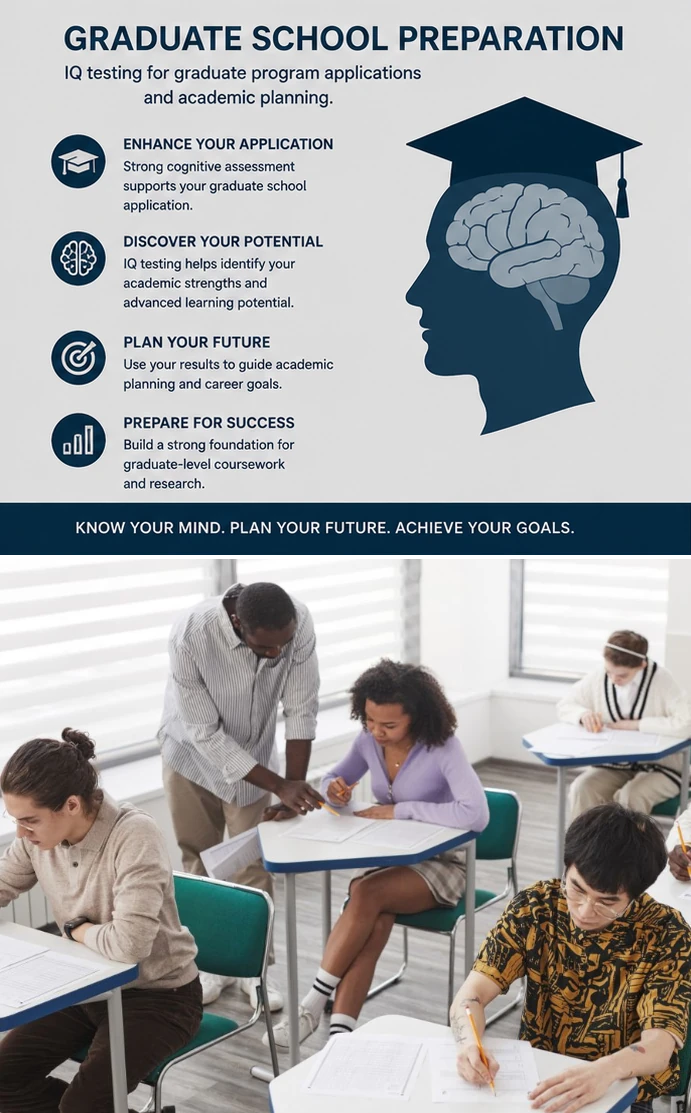
IQ testing can be a valuable tool for graduate school preparation, helping you identify your cognitive strengths, select the right program, and plan for academic success. This comprehensive guide covers how IQ testing supports graduate school applications, which tests are accepted, and how to leverage your results.
Last Updated: September 2026
Adult IQ Testing
WAIS-IV & WAIS-5 available. Comprehensive adult cognitive assessments for graduate school planning.
WAIS-IV & WAIS-5 Tests
Wechsler Adult Intelligence Scale® – Fourth Edition (WAIS-IV) and Fifth Edition (WAIS-5) – the gold standard for adult IQ testing in graduate school applications.
Career Guidance
Use IQ testing to identify career paths and graduate programs that align with your cognitive strengths.
Mensa Testing
Official Mensa testing – another way to demonstrate exceptional cognitive ability for applications. Accepts WAIS-IV, WAIS-5, and Stanford-Binet 5 scores.
Full Evaluation
Comprehensive assessment with detailed report and recommendations for academic planning. Includes WAIS-IV or WAIS-5.
Schedule Graduate School Preparation Testing
Book your graduate school preparation testing with a licensed psychologist in Cincinnati today.
How IQ Testing Supports Graduate School Preparation
IQ testing provides valuable insights that can help you make informed decisions about graduate school:
- Identify your cognitive strengths: Understand your intellectual profile – verbal comprehension, perceptual reasoning, working memory, and processing speed – and how these align with different graduate programs
- Select the right program: Match your cognitive abilities with program demands – for example, law school requires strong verbal reasoning, while engineering programs demand high perceptual reasoning
- Strengthen your application: Some graduate programs, particularly in clinical psychology, neuropsychology, and education, require or strongly recommend cognitive testing as part of the application process
- Academic planning: Use your cognitive profile to guide your choice of courses, research areas, and career paths
- Identify learning needs: If you have a cognitive weakness in a specific area (e.g., processing speed), you can develop strategies to compensate and succeed in graduate-level work
Graduate Programs That May Require or Recommend IQ Testing
While most graduate programs do not require IQ testing, some fields may request or benefit from cognitive assessment:
- Clinical and Counseling Psychology: Many doctoral programs in psychology require cognitive testing as part of the application or training process
- Neuropsychology: Cognitive assessment is central to the field, and programs often expect familiarity with tests like WAIS-IV and WAIS-5
- School Psychology: Programs require knowledge of cognitive assessment, including the WISC-V and WAIS-IV
- Educational Psychology: Understanding cognitive assessment is essential for careers in educational testing and evaluation
- Gifted Education: Programs in gifted education often require knowledge of IQ testing for identification
- Speech-Language Pathology: Some programs may recommend cognitive testing to understand a client's full profile
- Occupational Therapy: Cognitive assessment can be relevant for some specializations
Cincinnati Graduate Programs and Preparation Resources
University of Cincinnati
- Scale: 53,682 students in fall 2025, including 11,116 graduate and professional students.
- Programs: Master's, doctoral, medical, law, engineering, architecture, design, education, psychology, business, public affairs, sciences, and health programs.
- Cooperative education: UC pioneered co-op and maintains extensive employer partnerships linking study with paid professional experience.
- Research: Carnegie R1 activity spans medicine, neuroscience, engineering, data science, education, design, public health, and social sciences.
- Preparation: Applicants should review department prerequisites, faculty fit, funding, portfolios, writing samples, research experience, and current test policies.
Cincinnati and Northern Kentucky Institutions
- Xavier University: Graduate study in psychology, counseling, education, business, leadership, health services, and related professional fields.
- Northern Kentucky University: Law, informatics, business, education, counseling, public administration, health, and applied research programs.
- Mount St. Joseph University: Programs in education, nursing, physical therapy, organizational leadership, and other professional areas.
- Cincinnati State: Prerequisites, transfer pathways, technical credentials, applied bachelor's study, and workforce preparation.
- Regional options: Miami University, University of Dayton, Wright State, Ohio State, University of Kentucky, and University of Louisville expand choices.
Tri-State Research and Career Pathways
- Cincinnati Children's: Pediatric medicine, neuroscience, developmental science, behavioral medicine, genetics, rehabilitation, and clinical research.
- UC Health and College of Medicine: Academic medicine, neuroscience, psychiatry, public health, and translational research.
- Corporate research: P&G, Kroger, GE Aerospace, finance, insurance, logistics, and manufacturing employers support applied research and analytics careers.
- Federal and nonprofit work: EPA research in the region, VA healthcare, museums, schools, and community organizations offer public-interest pathways.
- Commute planning: Program, laboratory, practicum, and internship sites may be in Ohio, Kentucky, or Indiana.
Tests Used for Graduate School Preparation
Cincinnati Research Opportunities
- UC laboratories: Medicine, neuroscience, engineering, computer science, psychology, education, design, chemistry, environmental science, and data research.
- Cincinnati Children's: Pediatric clinical, behavioral, developmental, neurological, genetic, and rehabilitation research.
- UC Health and VA: Neurology, psychiatry, brain health, rehabilitation, aging, and clinical-care research opportunities depend on role and eligibility.
- Corporate R&D: Consumer science, product development, aerospace, analytics, finance, logistics, and manufacturing provide applied research careers.
- Community research: Public health, housing, education, transportation, environmental justice, racial equity, and neighborhood development are important local topics.
- Research distinction: Study participation does not necessarily provide a diagnosis, clinical report, or accommodation documentation.
Cincinnati Graduate School Scholarships
- University funding: Assistantships, fellowships, tuition awards, stipends, and research grants vary by program and admission cycle.
- Employer support: Regional healthcare, corporate, government, and education employers may offer tuition assistance or professional-development benefits.
- Professional associations: Field-specific organizations offer scholarships, travel awards, and diversity initiatives.
- Ohio and regional programs: Workforce, teacher, healthcare, public-service, and nonprofit funding may carry service or eligibility requirements.
- Federal aid: FAFSA-based loans, work-study, traineeships, and grants depend on program and student status.
- Planning: Compare total cost, assistantship workload, health insurance, transportation, practicum expenses, and expected time to degree.
Cincinnati Graduate School Preparation Timeline
- 12–18 months before enrollment: Research programs, prerequisites, faculty fit, accreditation, funding, and career outcomes.
- 9–12 months: Complete prerequisite courses, request recommendations, develop research or professional experience, and draft statements.
- 6–9 months: Take required admissions tests if any, arrange accommodation documentation, and order transcripts.
- 3–6 months: Submit applications, prepare for interviews, compare assistantships, and visit campuses or clinical sites.
- After admission: Review housing, transportation, bridge traffic, parking, practicum travel, health insurance, and disability services.
- IQ-testing role: Cognitive assessment is most useful for self-understanding or documented disability needs; it is not a routine graduate admissions requirement.
Benefits of IQ Testing for Graduate School Preparation
- Self-awareness: Understand your cognitive strengths and weaknesses and how they relate to different academic and career paths
- Informed decision-making: Choose a graduate program that matches your abilities and interests
- Academic planning: Use your cognitive profile to guide your choice of courses and research areas
- Application enhancement: Some programs may value cognitive testing as evidence of your intellectual abilities
- Career guidance: Identify career paths that align with your cognitive strengths
- Personal growth: Gain insight into your intellectual potential and how to maximize it
Cost of IQ Testing for Graduate School Preparation
- Focused WAIS assessment: Private fees depend on interview, testing, scoring, feedback, and report detail.
- Documentation evaluation: Disability accommodations often require academic, diagnostic, and functional evidence beyond IQ, increasing cost.
- Typical range: A focused cognitive assessment may cost several hundred dollars to more than $1,500; comprehensive evaluations can cost $1,500 to $4,000 or more.
- Insurance: Career planning and graduate preparation are usually not medically necessary benefits; diagnostic evaluations may have different coverage.
- University services: Campus counseling or disability offices generally do not replace a full outside evaluation but may provide referrals or documentation guidance.
- Before scheduling: Obtain the receiving program's standards and a written estimate so you do not purchase an assessment that cannot be used.
Frequently Asked Questions
Most graduate programs do not require IQ testing. However, some programs in clinical psychology, neuropsychology, school psychology, and gifted education may recommend or require cognitive assessment. Check with your target programs for specific requirements.
WAIS-IV is the most widely used adult IQ test and is appropriate for graduate school preparation. WAIS-5 is also available for those who prefer the newest version. Both provide comprehensive cognitive profiles with index scores for verbal comprehension, perceptual reasoning, working memory, and processing speed.
Understanding your cognitive strengths can help you identify career paths that align with your abilities. For example, high verbal comprehension may indicate strength in law, teaching, or writing, while high perceptual reasoning may indicate strength in engineering, design, or technology.
The test itself takes 60-90 minutes. With the consultation, feedback, and report, the entire process is about 1-2 weeks.
The report includes Full-Scale IQ, index scores, strengths and weaknesses, normative comparisons, and recommendations for graduate school planning and career development.
Some plans cover cognitive assessments when there is a clinical indication. Graduate school preparation is often considered an educational rather than medical service, so coverage varies. Check with your provider.
Interviews and feedback may be available remotely, but WAIS administration must follow publisher, legal and professional requirements and may require an in-person appointment. Contact us for details.
Get a good night's sleep, eat a healthy meal, and arrive relaxed. No specific preparation is needed. The test measures innate cognitive abilities, so studying is not necessary.
Typical fees range from $200 to $1,200 for a single IQ test, with full evaluations costing up to $3,000. Some insurance plans cover testing when medically necessary.
Mensa membership demonstrates high cognitive ability and may be a positive addition to your graduate school application. We offer official Mensa testing and documentation.