
IQ Testing in Baton Rouge

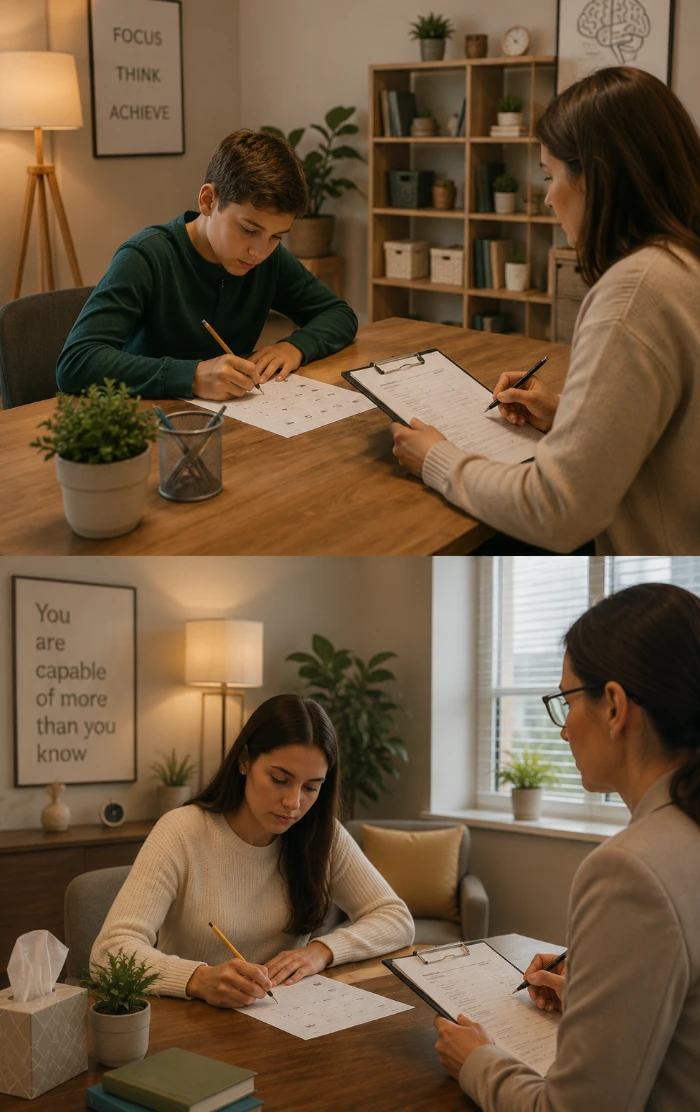
Professional IQ testing in Baton Rouge – whether you need an assessment for school, employment, gifted program eligibility, or personal insight, we connect you with licensed psychologists in the Baton Rouge area.
Last Updated: September 2026
Child IQ Testing
WISC-V & Stanford-Binet for ages 6–16. Gifted identification, learning profiles.
Adult IQ Testing
WAIS-IV & WAIS-5 available. Comprehensive adult cognitive assessments. Clinical & occupational.
WISC-V Test
Wechsler Intelligence Scale for Children® Fifth Edition – the gold standard for child IQ testing.
WAIS-IV & WAIS-5 Tests
Wechsler Adult Intelligence Scale® – Fourth Edition (WAIS-IV) and Fifth Edition (WAIS-5) available for adult IQ testing.
Gifted Testing
Identify giftedness for school placement, enrichment, and talent programs using WISC-V or Stanford-Binet.
Stanford-Binet 5
Stanford-Binet Intelligence Scales Fifth Edition – comprehensive cognitive assessment for all ages.
Mensa Testing
Mensa admission testing and preparation for the high-IQ society. Accepts WAIS-IV, WAIS-5, and Stanford-Binet 5 scores.
Full Evaluation
Combined assessment with detailed report and recommendations. Includes WISC-V, WAIS-IV, WAIS-5, or Stanford-Binet 5 as appropriate.
IQ Testing in Baton Rouge: city context
Gender, age and demographic statistics
Baton Rouge had an estimated 222,795 residents on July 1, 2025. Census 2020–2024 estimates report that 52.6% of residents are female, 21.0% are under age 18, and 14.2% are age 65 or older. The city is 50.5% Black alone, 35.8% White alone, 4.0% Asian alone, 0.1% American Indian or Alaska Native alone, 5.9% reporting two or more races, and 6.2% Hispanic or Latino; race and Hispanic-origin categories are not mutually exclusive.
These figures describe community context, not intelligence. IQ scores must be interpreted individually in light of age, education, disability, health, culture, language exposure, socioeconomic opportunity, and testing conditions. Census estimates report that 9.8% of residents age five and older speak a language other than English at home and 7.6% are foreign-born. Examiners should still document dialect, language history, educational opportunity, hearing or vision needs, and whether verbal scores are valid for the referral question.
- Female residents: 52.6%.
- Children and teens: 21.0% are under 18.
- Older adults: 14.2% are 65 or older.
- Language context: 9.8% speak a language other than English at home.
- Educational context: 87.6% of adults age 25+ completed high school and 36.6% hold a bachelor’s degree or higher.
- Interpretation: No gender, racial, ethnic, language, neighborhood, or income group should be presumed to have a particular IQ profile.
What is professional IQ testing?
Intelligence quotient (IQ) testing is a standardized method to measure human cognitive abilities and intellectual potential. Professional IQ tests are administered by licensed psychologists in a controlled environment to ensure accuracy and reliability. Unlike online quizzes, clinical assessments provide a full-scale IQ score along with detailed breakdowns of verbal comprehension, perceptual reasoning, working memory, and processing speed.
In Baton Rouge, IQ testing is commonly used for gifted program admission, learning disability identification, career guidance, neuropsychological evaluation, and personal development. The results are presented in a comprehensive report that includes normative comparisons, strengths and weaknesses, and actionable recommendations.
Who should get tested?
IQ testing can benefit children, adolescents, and adults in various situations:
- Children: Parents often seek testing for school readiness, gifted placement, or to understand learning challenges.
- Adults: Many adults take IQ tests for career advancement, graduate school applications, or personal curiosity.
- Mensa candidates: High-IQ societies require official test scores for membership.
- Clinical referrals: Psychologists may recommend testing as part of a broader neuropsychological evaluation.
Types of IQ tests
Common professionally administered intelligence tests include:
- WISC-V (Wechsler Intelligence Scale for Children® – Fifth Edition): The gold standard for children aged 6:0–16:11. It provides a Full-Scale IQ and five primary index scores.
- WAIS-IV (Wechsler Adult Intelligence Scale® – Fourth Edition): The most widely used adult IQ test for ages 16–90. It measures cognitive functioning across four domains.
- Stanford-Binet Intelligence Scales – Fifth Edition: A comprehensive assessment for ages 2–85, often used for gifted identification and clinical evaluations.
- Gifted Testing: Often includes the WISC-V or Stanford-Binet, plus additional creativity and achievement measures.
- Mensa Testing: Psychologist-administered testing may support Mensa prior evidence when current acceptance rules are met.
How the testing process works
- Initial consultation: Brief phone or video call to discuss your needs and match you with the right psychologist.
- Testing session: In-person or remote testing (depending on the test) with a licensed psychologist. Most sessions last 1–2 hours.
- Scoring and interpretation: The psychologist scores the test and interprets the results in the context of your background and goals.
- Feedback session: A detailed review of your results, including strengths, weaknesses, and practical recommendations.
- Comprehensive report: You receive a written report with all scores, normative comparisons, and actionable next steps.
How much does IQ testing cost in Baton Rouge?
The cost of IQ testing in Baton Rouge varies depending on the type of test, the psychologist's experience, and whether a comprehensive report is required. Typical fees range from $200 to $1,200 for a full assessment. Gifted testing and Mensa admission testing are often at the lower end, while neuropsychological evaluations may be higher.
For a quick, informal look at reasoning skills, Baton Rouge residents may explore an online IQ test; official educational or clinical purposes still call for evaluation by a qualified psychologist.
Some insurance plans may cover testing when it is medically necessary, while educational or elective testing is often excluded. Confirm benefits, authorization requirements, fees, and any payment arrangements directly with the provider before scheduling.
Baton Rouge's Intellectual History & Legacy
- Capital-city institutions: Baton Rouge is Louisiana’s capital, placing the State Capitol, state agencies, courts, archives, museums, libraries, and policy organizations within the city’s educational and professional landscape.
- Louisiana State University: LSU supports research and graduate training in psychology, cognitive and brain sciences, school psychology, clinical psychology, education, engineering, data science, law, business, agriculture, and medicine-related fields.
- Southern University and A&M College: Southern is the flagship of the nation’s only historically Black land-grant university system and offers undergraduate, graduate, professional, doctoral, public-policy, science, engineering, education, and research pathways.
- Pennington Biomedical Research Center: The LSU-affiliated center is a major local research institution focused on obesity, diabetes, nutrition, metabolism, healthy aging, and related biomedical questions.
- Mississippi River and industrial science: River commerce, the Port of Greater Baton Rouge, refining, petrochemicals, process engineering, environmental science, logistics, and infrastructure have shaped the region’s technical workforce.
- Cultural learning: The Old State Capitol, Capitol Park Museum, Louisiana Art & Science Museum, LSU Museum of Art, Southern University Museum of Art, libraries, archives, music, foodways, and festivals provide broad opportunities for lifelong learning.
Top Baton Rouge Employers Requiring Cognitive Skills
- State of Louisiana and City-Parish government: Public administration, law, policy, budgeting, data, engineering, planning, public safety, and social services.
- Louisiana State University: Teaching, research, psychology, information technology, healthcare partnerships, engineering, agriculture, analytics, and administration.
- Southern University and Baton Rouge Community College: Education, research, workforce development, counseling, assessment, technology, and student services.
- Our Lady of the Lake, Baton Rouge General, Ochsner, Woman’s Hospital, and related systems: Clinical care, behavioral health, diagnostics, rehabilitation, research, health information, and administration.
- ExxonMobil and the regional process-industry supply chain: Refining, chemical operations, process engineering, maintenance, laboratory science, safety, environmental compliance, and logistics.
- Blue Cross and Blue Shield of Louisiana and insurance employers: Actuarial work, analytics, healthcare administration, cybersecurity, compliance, and customer operations.
- Turner Industries and construction/engineering firms: Project controls, fabrication, industrial construction, engineering, safety, procurement, and skilled trades.
- Community Coffee, Raising Cane’s, Lamar Advertising, technology firms, and local headquarters: Marketing, finance, operations, supply chain, software, design, and management.
Baton Rouge IQ Testing by City Area
Appointments can serve all parts of Baton Rouge without repeating neighborhood names as SEO filler. Practical differences usually involve travel time, school jurisdiction, access to I-10 or I-12, and congestion near the Mississippi River Bridge, the I-10/I-12 split, LSU, and the medical corridor.
- Downtown and Capitol Park: Convenient to state offices, courts, museums, the River Center, the Mississippi River levee, and the CATS terminal network.
- Mid City and Government Street: Access through Government Street, Florida Boulevard, North Boulevard, Acadian Thruway, and Foster Drive; this area includes libraries, arts organizations, healthcare, and mixed-use districts.
- LSU, University Acres, Southdowns, and the Garden District: Nicholson Drive, Highland Road, Dalrymple Drive, Perkins Road, and LSU traffic patterns shape appointment planning.
- Perkins Overpass, Bocage, Goodwood, and Corporate Boulevard: Perkins, Jefferson, College, Essen, and Corporate provide access to offices, retail, and healthcare.
- Essen–Bluebonnet medical corridor: Our Lady of the Lake, Baton Rouge General Bluebonnet, medical offices, Siegen Lane, Bluebonnet Boulevard, and I-10 can produce weekday congestion.
- Shenandoah, Jones Creek, O’Neal, and southeast Baton Rouge: I-12, Coursey, Sherwood Forest, Jones Creek, Millerville, and O’Neal are common east–west access routes.
- North Baton Rouge and Scotlandville: I-110, Scenic Highway, Plank Road, Airline Highway, Harding Boulevard, and Southern University are major reference points.
Baton Rouge Universities and Research Institutions
- Louisiana State University: Doctoral and professional study, psychology research, cognitive and brain sciences, school and clinical psychology, education, engineering, business, law, data science, and extensive laboratory opportunities.
- Southern University and A&M College: Four-year, graduate, professional, and doctoral programs, with research in agriculture, engineering, public policy, sciences, education, social sciences, and technology.
- Baton Rouge Community College: More than 100 academic and workforce programs, transfer pathways, adult education, dual enrollment, healthcare, technology, business, and technical training.
- Franciscan Missionaries of Our Lady University: Undergraduate and graduate health-science education, including nursing, health administration, physician assistant, nutrition, behavioral science, and allied-health pathways.
- Pennington Biomedical Research Center: Clinical and basic research in nutrition, metabolism, obesity, diabetes, healthy aging, and population health.
- LSU AgCenter and regional research network: Agriculture, food science, environmental research, extension, coastal and water issues, entrepreneurship, and employer-sponsored technical research.
Baton Rouge Economic Context
- Median household income: $49,994 in 2020–2024 Census estimates.
- Per-capita income: $34,731.
- Residents in poverty: 25.7%.
- Bachelor's degree or higher: 36.6% of adults age 25 and older.
- Mean travel time to work: 21.0 minutes, although the I-10/I-12 split, Mississippi River Bridge, LSU events, and suburban commutes can be much longer.
- Health and social-assistance activity: Census business data report approximately $4.06 billion in 2022 receipts/revenue within the city.
- Transportation and warehousing: Approximately $869.3 million in 2022 receipts/revenue reflects river, highway, rail, airport, warehouse, and distribution activity.
- Accommodation and food services: Approximately $1.28 billion in 2022 sales.
- Retail sales: Approximately $8.69 billion in 2022.
- Regional strengths: State government, higher education, healthcare, energy, refining and petrochemicals, process manufacturing, engineering and construction, logistics and distribution, insurance, food and hospitality, technology, research, and professional services.
Baton Rouge School District Data
- East Baton Rouge Parish School System: The district describes its Gifted Program as accelerated, complex instruction for identified students in Pre-K through grade 12, taught by gifted-certified teachers with reduced class sizes.
- Screening: Gifted and talented screening may occur throughout the school year. District students begin with their school counselor; private, parochial, and home-school families should contact Pupil Appraisal for current procedures.
- Related pathways: EBRPSS also describes Talented Arts, Scholastic Academy, and Great Scholars Academy options, each with separate criteria and placement rules.
- Louisiana identification framework: Gifted identification follows state pupil-appraisal rules and a multi-step process. A private WISC-V or Stanford-Binet report does not automatically replace district screening, evaluation, or placement.
- Advanced coursework: Honors, Advanced Placement, dual enrollment, magnet programs, career and technical education, arts, and subject acceleration use program-specific requirements.
- Equity and validity: Evaluation should account for disability, school opportunity, race and ethnicity, language or dialect, family resources, and the possibility of twice-exceptionality rather than relying on one score.
Local Testing Centers and Psychologists
- PTI (Post Trauma Institute of Louisiana): 11911 Justice Avenue, Baton Rouge, LA 70816; (225) 751-5412. Its Baton Rouge testing page explicitly lists psychological testing for IQ, cognitive assessment, learning disabilities, and Section 504 questions.
- LSU Psychological Services Center: 33 Johnston Hall, Baton Rouge, LA 70803; (225) 578-1494. The university clinic provides professional testing and assessment and offers child psychoeducational services on a sliding-fee basis, subject to scope and availability.
- Child and Adult Psychological Services (CAPS): 10211 Siegen Lane, Suite 2B, Baton Rouge, LA 70810; (225) 767-3121. CAPS advertises psychological and psychoeducational evaluations across the lifespan.
- Under The Oak: 9239 Bluebonnet Boulevard, Suite B, Baton Rouge, LA 70810; (225) 242-9217. The child-psychology practice provides assessment, treatment, and consultation and discusses cognitive/IQ components of psychoeducational assessment.
- Baton Rouge Clinic Pediatric Psychology: 7373 Perkins Road, Baton Rouge, LA 70808; pediatric psychology line (225) 246-9510. The clinic lists general psychological testing; families should confirm the exact referral question and test battery.
- Neuropsychological referral options: The NeuroMedical Center, Olivier Neuropsychology, the Neuropsychology Center of Louisiana, Our Lady of the Lake, Baton Rouge General, Ochsner, and other specialists may be appropriate for neurological, medical, developmental, or complex diagnostic questions.
Before scheduling: confirm examiner licensure, age range, test edition, report purpose, fees, insurance status, turnaround, language competence, and whether school, disability, court, workplace, or Mensa documentation requirements will be met.
Baton Rouge Events and Conferences
Learning and professional-development opportunities may be offered through LSU, Southern University, Baton Rouge Community College, FranU, Pennington Biomedical, the East Baton Rouge Parish Library, Louisiana Art & Science Museum, Capitol Park Museum, BREC, the Louisiana Psychological Association, school-system family programs, healthcare systems, and local professional associations.
- Academic events: Research talks, thesis defenses, public lectures, graduate fairs, psychology seminars, engineering showcases, and career events at LSU and Southern.
- Gifted and school events: EBRPSS Gifted & Talented information sessions, magnet or program fairs, parent workshops, and school-specific application events.
- Science and enrichment: Pennington Biomedical outreach, LASM programming, library makerspaces, BREC nature and astronomy programs, robotics, coding, debate, music, and arts events.
- Professional development: Healthcare conferences, state-government training, industrial safety and engineering events, teacher development, and association meetings.
Schedules, eligibility, costs, and locations change; verify the current organizer’s page before relying on an event for testing, admissions, or continuing-education purposes.
Transportation and Accessibility
- Major roads: I-10, I-12, and I-110; US-61/Airline Highway; US-190/Florida Boulevard; Nicholson Drive/LA-30; Perkins Road; Highland Road; Government Street; Jefferson Highway; Essen Lane; Bluebonnet Boulevard; Siegen Lane; College Drive; Acadian Thruway; Sherwood Forest Boulevard; and O’Neal Lane.
- Public transit: Capital Area Transit System (CATS) operates 29 fixed bus lines in Baton Rouge and provides real-time tracking, trip planning, and CATS On Demand paratransit for eligible riders. LSU operates Tiger Trails for campus and nearby routes.
- Airport: Baton Rouge Metropolitan Airport (BTR) provides American, Delta, and United service to major hubs including Atlanta, Charlotte, Dallas–Fort Worth, Houston Intercontinental, and Washington National, with onward connections.
- Distance to other cities: Approximately 1 hour to Lafayette, 45–55 minutes to Hammond, 1 hour 20 minutes to New Orleans, 1 hour 40 minutes to Natchez, and about 4 hours to Houston, depending on route and traffic.
- Walkability: Downtown/Capitol Park, the LSU campus, Government Street in Mid City, the Garden District, and the Perkins Overpass area are among the city’s more walkable pockets; many other trips remain car-dependent.
- Bike infrastructure: The Mississippi River levee path, LSU Lakes routes, downtown connections, and a growing set of MOVEBR sidewalk, crossing, shared-use path, and bike-lane projects support active transportation, but network continuity varies.
- Congestion: Allow extra time near the I-10/I-12 split, the Mississippi River Bridge, College Drive, Essen Lane, Bluebonnet/Siegen, school arrival periods, and LSU football or major downtown events.
- Accessibility: Ask the testing office about accessible parking, entrance routes, elevators, quiet waiting space, service animals, sensory needs, interpreter arrangements, and the distinction between access accommodations and changes that affect standardized scores.
Baton Rouge Weather and Seasonal Considerations
- Summer heat and humidity: Afternoon temperatures commonly reach the low 90s, and heat, dehydration, and long outdoor waits can reduce comfort and concentration.
- Thunderstorms and heavy rain: Intense rainfall can cause localized street flooding, traffic delays, power interruptions, and appointment disruptions.
- Hurricane season: The Atlantic season runs from June through November. Tropical systems can affect travel, utilities, school schedules, and office operations even when the center does not cross Baton Rouge.
- Winter and spring: Winters are generally mild, but cold fronts, severe thunderstorms, tornado watches, pollen, and rapid weather changes can affect health and travel.
- Testing preparation: Check forecasts and emergency notices, confirm the office is open after major storms, bring prescribed medication and sensory aids, and reschedule when illness, evacuation stress, sleep loss, or unsafe travel would invalidate results.
Areas we serve
We support all areas of Baton Rouge.
Frequently Asked Questions
WISC-V is for children aged 6–16, while WAIS-IV is for adults aged 16–90. Each is normed for its specific age group.
Most IQ tests take between 60 and 90 minutes, plus a feedback session. Allow 2–3 hours total.
Referral requirements depend on the provider, insurance plan, and purpose of testing. Ask the Baton Rouge office whether self-referral is accepted and whether authorization or supporting records are needed.
Some professionally administered scores may be submitted as prior evidence, but acceptance is determined solely by American Mensa under its current rules.
Some plans cover cognitive assessments when there is a clinical indication. Check with your provider.
Get a good night's sleep, eat a healthy meal, and arrive relaxed. No specific preparation is needed.
You'll receive a comprehensive report with your scores and tailored recommendations.
Interviews and feedback may be available remotely, but many standardized cognitive tests require controlled administration and may need an in-person appointment. Contact us for details.