
Child IQ Testing in Baltimore

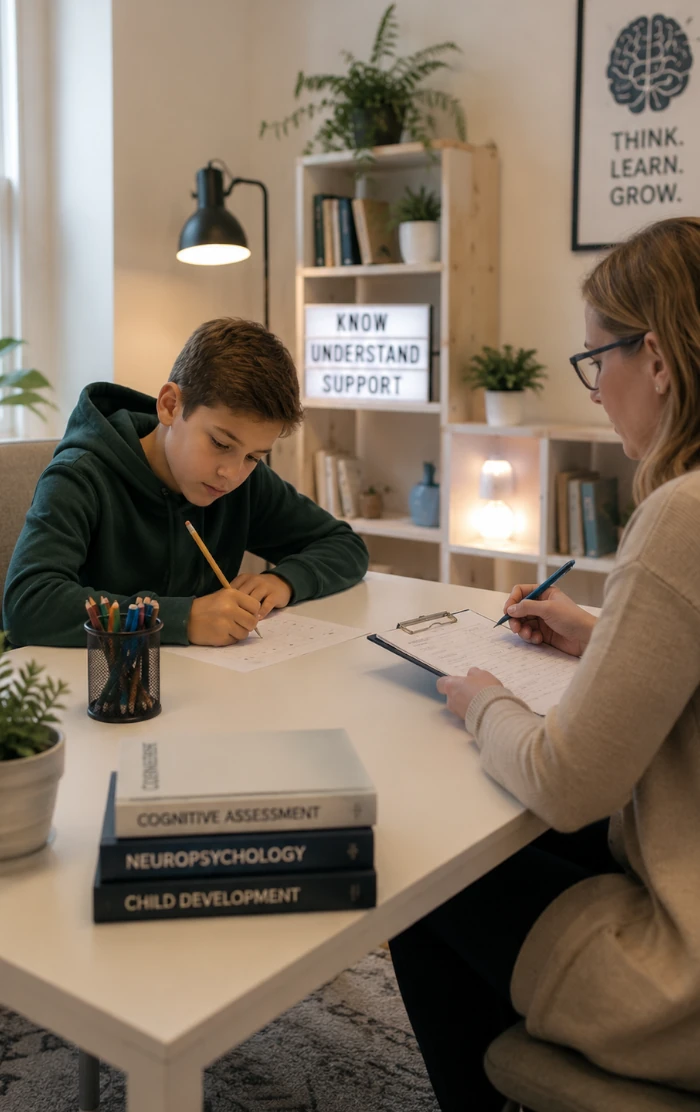
Professional child IQ testing in Baltimore – whether you need an assessment for school placement, gifted program eligibility, or to understand your child's learning profile, we connect you with licensed psychologists in the Baltimore area.
Last Updated: July 2026
Gifted Testing
Identify giftedness for school placement, enrichment, and talent programs using WISC-V or Stanford-Binet 5.
WISC-V Test
Wechsler Intelligence Scale for Children® Fifth Edition – the gold standard for child IQ testing.
Stanford-Binet 5
Stanford-Binet Intelligence Scales Fifth Edition – comprehensive cognitive assessment for all ages.
Full Evaluation
Combined assessment with detailed report and recommendations. Includes WISC-V or Stanford-Binet 5.
School Placement Testing
Testing for private school admission and gifted program eligibility using WISC-V or Stanford-Binet 5.
Schedule Child IQ Testing
Book your WISC-V & Stanford-Binet 5 for ages 6–16. Gifted identification, learning profiles, etc. with a licensed psychologist in Baltimore today.
Child IQ Testing in Baltimore: city context
The city serves a diverse school-age population through Baltimore City Public Schools, charter and transformation schools, entrance-criteria high schools, independent schools, parochial schools, homeschool communities, enrichment programs, and clinical providers. Families seek testing for gifted and advanced learning, school placement, learning concerns, disability documentation, twice-exceptionality, or a clearer understanding of cognitive strengths.
Potential resources include City Schools evaluation teams, private psychologists, Johns Hopkins and Kennedy Krieger programs, Mount Washington Pediatric Hospital, University of Maryland services, and other pediatric or developmental providers when clinically indicated.
IQ, gender, language, and demographic context
Child IQ tests such as the WISC-V and Stanford-Binet 5 use national age-based norms. They do not use separate Baltimore norms for boys and girls, and overall IQ distributions overlap substantially by sex. Individual children may nevertheless show meaningful differences among verbal, visual-spatial, fluid-reasoning, working-memory, quantitative, and processing-speed abilities.
- Residents under age 18: 20.9% of the city population.
- Female residents: 53.5% of the total population.
- Black or African American alone: 59.2%.
- White alone: 26.9%.
- Hispanic or Latino: 8.2%.
- Asian alone: 2.6%.
- Two or more races: 6.1%.
- Language other than English spoken at home: 12.0% of residents age 5 and older.
No valid local source supports assigning IQ averages to children by gender, race, ethnicity, district, school, or neighborhood. Equitable evaluation considers language exposure, cultural context, educational opportunity, disability, health, sensory and motor needs, trauma, test familiarity, and whether the selected instrument is appropriate for the referral question.
Local school system and gifted programs
Baltimore City Public Schools Gifted and Advanced Learning
- Universal screening: All kindergarten students are initially screened, with ongoing review as students progress.
- Identification: City Schools uses multiple indicators rather than a single private score or referral source.
- Planning: Identified students may receive differentiated instruction and an individualized learning plan under district procedures.
- Referrals: Families should review current district guidance and submit relevant records when requesting consideration.
Maryland Gifted-Education Context
- Local implementation: Maryland districts develop identification and service procedures consistent with state requirements.
- Multiple evidence: Ability, achievement, classroom performance, and other information may be considered.
- Outside testing: A private WISC-V or Stanford-Binet result may provide useful clinical information but does not guarantee district identification or a particular service.
School Choice and Advanced Programs
- Entrance criteria: Some high schools use composite scores based on grades and standardized assessments.
- Specialized programs: Arts, design, career-technical, International Baccalaureate, college-preparatory, STEM, and other pathways use different application rules.
- Examples: Baltimore City College, Baltimore Polytechnic Institute, Western High School, Baltimore School for the Arts, and Baltimore Design School each have distinct requirements.
Surrounding Districts
- Separate systems: Baltimore County, Anne Arundel County, Howard County, Harford County, and other jurisdictions maintain independent gifted, magnet, transfer, and special-education procedures.
- Outside tests: Acceptance varies; ask the receiving district before scheduling.
Private schools and testing requirements
Independent-school admissions vary by grade and application cycle. Some schools use records, interviews, teacher recommendations, school-administered assessments, standardized admissions tests, or developmental observations rather than a private clinical IQ test.
Friends School of Baltimore
Independent coeducational school. Confirm current grade-specific application and assessment requirements.
Gilman School
Independent boys' school with division-specific admissions procedures.
Bryn Mawr School
Independent girls' school. Verify current records, testing, visit, and interview expectations.
Roland Park Country School
Independent girls' school with grade-specific admissions review.
Calvert School
Independent elementary and middle school. Confirm developmental and academic assessment practices.
Park School and St. Paul's Schools
Regional independent schools with separate admissions criteria, deadlines, and accepted measures.
Ask the school in writing whether it accepts outside WISC-V or Stanford-Binet reports, which scores it needs, how recent testing must be, and whether the report must come from a Maryland-licensed psychologist.
Gifted-identification context
City Schools screens all kindergarten students and continues reviewing achievement and classroom evidence. Publicly reported citywide percentages may change as identification rules, enrollment, assessments, and student records change, so a fixed local gifted rate should not be treated as a permanent statistic.
- Universal screening: Reduces dependence on parent knowledge or teacher nomination alone.
- Multiple indicators: Helps identify students whose strengths may not be reflected in a single score.
- Equity: Language, disability, educational opportunity, and access to advanced instruction should be considered.
- Private reports: Useful for clinical and educational planning but not an automatic district placement decision.
The child IQ testing process: step by step
Understanding the testing process can help parents prepare their child and reduce anxiety. Here's what to expect:
- Initial consultation (15–20 minutes): A brief phone or video call with the psychologist to discuss your child's background, concerns, and goals. This helps determine the right test and approach.
- Testing session (60–90 minutes): The child meets one-on-one with a licensed psychologist in a quiet, comfortable room. The psychologist administers the WISC-V or Stanford-Binet 5, which includes a series of subtests measuring verbal comprehension, visual-spatial reasoning, fluid reasoning, working memory, and processing speed. Breaks are offered as needed.
- Scoring and interpretation (1–2 days): The psychologist scores the test and analyzes the results. They consider the child's age, background, and any relevant medical or educational history.
- Feedback session (45–60 minutes): The psychologist meets with the parents (and the child, if appropriate) to explain the results. They discuss the Full-Scale IQ, index scores, strengths, and areas for growth. They also provide tailored recommendations for home, school, and extracurriculars.
- Comprehensive written report (5–7 days): You receive a detailed report with all scores, normative comparisons, and actionable next steps. This report can be shared with schools, doctors, or other professionals.
The entire process from consultation to report usually takes 1–2 weeks, depending on scheduling. The testing itself is non-invasive and designed to be engaging for children.
What is the WISC-V test?
The WISC-V (Wechsler Intelligence Scale for Children® – Fifth Edition) is the most widely used IQ test for children aged 6:0–16:11. It provides a Full-Scale IQ and five primary index scores: Verbal Comprehension, Visual-Spatial, Fluid Reasoning, Working Memory, and Processing Speed. The test is administered one-on-one by a trained psychologist and takes about 60–90 minutes.
The WISC-V is normed on a large, representative sample of U.S. children and is updated regularly to ensure accuracy. It is the gold standard for gifted identification, learning disability diagnosis, and school placement.
Why test your child's IQ?
IQ testing provides valuable insights into your child's cognitive strengths and weaknesses. It can help:
- Identify giftedness: For admission to gifted programs, private schools, or enrichment opportunities.
- Diagnose learning disabilities: Such as dyslexia, dyscalculia, or ADHD, which can be masked by high intelligence.
- Guide educational planning: Tailor instruction to your child's unique learning profile.
- Provide reassurance: Understand why your child is different from peers and how to support them.
Gifted-testing timeline
- Before testing: Obtain the receiving program's written rules, deadlines, accepted tests, score requirements, and examiner qualifications.
- Consultation: Review developmental, educational, language, health, and prior-testing history.
- Testing: A WISC-V or Stanford-Binet session often requires 60–90 minutes, with breaks and additional measures when needed.
- Report: Scoring, interpretation, records review, and recommendations may take several business days or longer.
- School submission: Leave enough time for application, district review, appeals, or supplemental documentation.
Gifted and advanced programs by age group
Early Childhood and Kindergarten
City Schools begins universal screening in kindergarten. Families considering early entrance or private-school placement should verify age cutoffs and required measures before testing.
Elementary School
Gifted and advanced learning may involve differentiated instruction, enrichment, accelerated content, individualized planning, or school-specific programs. Outside testing may help with clinical questions but does not replace district procedures.
Middle School
Advanced coursework, honors, enrichment, STEM, arts, and School Choice preparation become more prominent. Families should distinguish cognitive ability from achievement and prerequisite skills.
High School
Entrance-criteria and specialized high schools use different composite-score, audition, portfolio, and application systems. AP, IB, dual enrollment, career-technical education, and arts pathways should be evaluated separately.
Child ADHD and learning-disability assessment
An IQ test alone does not diagnose ADHD, dyslexia, dyscalculia, dysgraphia, autism, or another learning condition. A full evaluation may include achievement testing, attention and executive-function measures, developmental history, teacher and parent ratings, school records, language assessment, and behavioral or emotional measures.
- School evaluation: Families may request evaluation through City Schools when a disability is suspected.
- Clinical services: Private psychologists and clinically indicated pediatric or neurodevelopmental programs may provide broader assessments.
- Twice-exceptionality: High reasoning ability can coexist with ADHD, autism, language disorders, or learning disabilities.
- Documentation: Recommendations should connect test findings to classroom functioning, accommodations, interventions, and progress monitoring.
Summer and enrichment programs for advanced learners
Universities, museums, libraries, schools, camps, arts organizations, science programs, and youth nonprofits offer changing summer and enrichment opportunities. Examples may include Johns Hopkins Center for Talented Youth offerings, Maryland Science Center programs, Port Discovery, Enoch Pratt Library activities, arts programs, robotics, coding, debate, music, and college-preparation initiatives.
Admission requirements, scholarships, age limits, and schedules change. A program's use of the word “gifted” does not necessarily mean it requires an IQ score, and a high score does not guarantee admission.
Child-testing costs and school evaluations
Private fees vary with the referral question, test battery, records review, report detail, feedback, and clinician credentials. A stand-alone cognitive assessment generally costs less than a psychoeducational, developmental, or neuropsychological evaluation.
- Public-school evaluations: May be available without direct family payment when disability or advanced-learning needs are suspected, but the district selects instruments and controls the educational decision.
- Insurance: More likely to contribute when testing is medically necessary than when requested only for school admission, curiosity, or gifted enrichment.
- Written estimate: Ask what consultation, testing, scoring, report, feedback, and additional measures are included.
- Recipient rules: Confirm acceptance before paying for private testing.
Records to bring: Useful records include report cards, benchmark and state-test results, intervention plans, attendance, work samples, teacher comments, prior evaluations, speech-language records, occupational-therapy records, and information about language exposure. The psychologist should connect test findings to actual classroom performance rather than interpreting scores in isolation.
Twice-exceptional profiles: A child may show advanced reasoning while also having ADHD, dyslexia, autism, anxiety, language difficulties, motor limitations, or slow processing speed. In such cases, the Full-Scale IQ may understate some abilities or may be difficult to interpret. A broader battery can clarify achievement, attention, executive function, behavior, adaptive functioning, and the supports needed for both challenge and access.
School communication: Parents should ask how outside reports are reviewed, who participates in the decision, what appeal or reconsideration process exists, and how services are documented. A private evaluator can make recommendations, but the district or school retains authority over eligibility, placement, scheduling, curriculum, and available services.
Testing-day preparation: Children should sleep normally, eat a familiar meal, bring glasses or hearing devices, and take medication as prescribed unless the treating professional directs otherwise. Avoid intensive test coaching, which can reduce validity. Tell the examiner about recent illness, major stress, school refusal, sleep problems, or language concerns before the session.
Language and cultural considerations: For multilingual children, determine the languages used at home and school, age of English exposure, quality of instruction, and whether language proficiency affects the selected tasks. Nonverbal measures may reduce some language demands but are not culture-free. Interpretation should avoid treating limited exposure to vocabulary, testing routines, or enrichment as a lack of reasoning ability.
Health and sensory factors: Vision, hearing, seizures, headaches, sleep-disordered breathing, chronic illness, motor coordination, and medication can affect performance. Bring corrective devices and tell the examiner about accommodations used at school. A child who cannot access a task reliably should not be penalized as though the difficulty reflected the intended cognitive skill.
Feedback with children: Results should be explained in developmentally appropriate language that emphasizes strategies and growth rather than labels. Parents and schools should avoid repeatedly discussing a child's numerical IQ in ways that create pressure, fixed expectations, or comparisons with siblings and classmates.
After testing: Review the recommendations with the school and identify which actions can begin immediately, which require a formal team process, and how progress will be measured. A report is most useful when it leads to specific instruction, support, enrichment, or monitoring rather than remaining only in a file.
Document decisions, timelines, and responsible contacts.
Areas we serve
Service is available throughout the city. Confirm provider location, child-testing experience, Maryland licensure, accessibility, and school-report requirements before scheduling.
Frequently Asked Questions
Both are excellent tests. WISC-V is more commonly used for school-age children, while Stanford-Binet 5 can be used for ages 2–85. We often recommend WISC-V for gifted identification.
The test itself takes 60–90 minutes. With the consultation, feedback, and report, the entire process is about 1–2 weeks.
No, you can book directly with our psychologists. We serve both self-referred and professionally referred children.
A report may be considered, but acceptance is never automatic. Confirm City Schools, charter, private-school or program requirements before testing.
Some plans cover cognitive assessments when there is a clinical indication. Check with your provider.
Get a good night's sleep, eat a healthy meal, and arrive relaxed. No specific preparation is needed.
You'll receive a comprehensive report with your child's scores and tailored recommendations.
Remote administration may be possible only in limited circumstances. The evaluator must confirm publisher guidance, test validity, state licensing, technology requirements, and acceptance by the receiving school or organization.