
Stanford-Binet Test in Baltimore

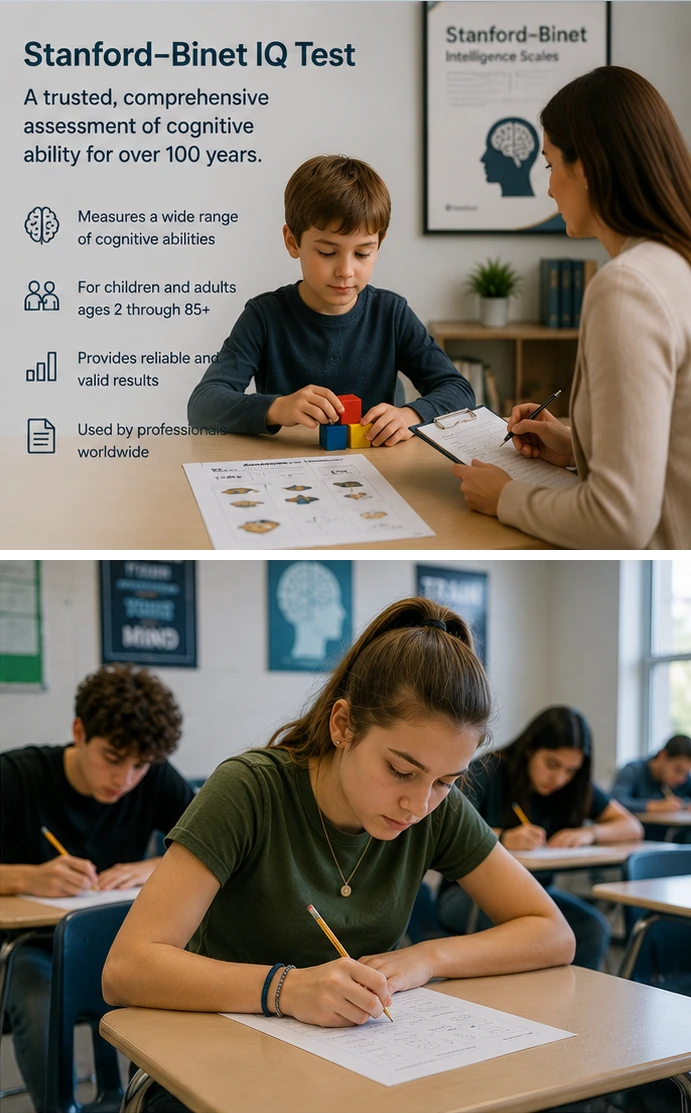
The Stanford-Binet Intelligence Scales is one of the oldest and most respected IQ tests in the world. This comprehensive guide covers the complete history of the Stanford-Binet, the key differences between SB-5 and other major IQ tests (WISC, WAIS, Mensa, and Full Evaluations), and what you need to know about testing in Baltimore.
Last Updated: July 2026
Complete SB History
From Binet-Simon (1905) to SB-5 (2003) – the evolution of intelligence testing.
SB-5 vs Other Tests
Detailed comparison of Stanford-Binet vs WISC, WAIS, Mensa, and Full Evaluations.
SB in Baltimore
How many people take the Stanford-Binet in Baltimore and what the data tells us.
All SB Versions
Complete breakdown of subtests and scores for every Stanford-Binet version.
Why Choose SB-5?
Understanding the advantages of the Stanford-Binet and who it's best for.
Schedule SB Testing
Book your Stanford-Binet assessment with a licensed psychologist in Baltimore today.
The Complete History of the Stanford-Binet
The Origins: Binet-Simon Scale (1905)
The story of the Stanford-Binet begins in France with Alfred Binet and Théodore Simon. In 1905, the French Ministry of Education commissioned Binet to develop a test to identify children who would need special assistance in school. The result was the Binet-Simon Scale, which measured memory, attention, comprehension, and judgment.
Stanford-Binet (1916)
Lewis Terman of Stanford University adapted the Binet-Simon Scale for American use in 1916. This version introduced the Intelligence Quotient (IQ) concept, which was calculated as (Mental Age ÷ Chronological Age) × 100. Terman's version became the foundation for modern IQ testing.
Stanford-Binet (1937)
This revision expanded the test to two forms (L and M) and extended the age range to cover ages 2 to adult. It was the first major revision of the SB.
Stanford-Binet (1960)
This version incorporated the best items from Forms L and M into a single Form L-M. It was the first to introduce deviation IQ scores, which are now standard in all modern IQ tests.
Stanford-Binet (1972)
A minor revision with updated norms based on the 1960s population.
Stanford-Binet (1986) – SB-IV
A major revision that introduced a multi-factor structure. It assessed four cognitive areas: Verbal Reasoning, Abstract/Visual Reasoning, Quantitative Reasoning, and Short-Term Memory. It also introduced the concept of Standard Age Score (SAS).
Stanford-Binet (2003) – SB-5
The current version, SB-5, represents the most comprehensive revision to date. It features:
- Five factors: Fluid Reasoning, Knowledge, Quantitative Reasoning, Visual-Spatial Processing, and Working Memory
- Full scale IQ score
- Ten subtests (5 verbal, 5 nonverbal)
- Age range: 2 years to 85+ years
- Administration time: 45-75 minutes
Stanford-Binet vs Other Tests: What's the Difference?
| Feature | Stanford-Binet (SB-5) | WISC-V | WAIS-IV | Mensa Test | Full Evaluation |
|---|---|---|---|---|---|
| Age Range | 2–85+ years | 6–16 years | 16–90 years | 16+ years | Varies |
| Primary Use | Gifted identification, clinical assessment, all ages | Children's IQ, school placement, gifted programs | Adult IQ, career guidance, neuropsychology | High-IQ society admission | Comprehensive cognitive & psychological assessment |
| Factors/Indices | 5 factors (Fluid Reasoning, Knowledge, Quantitative, Visual-Spatial, Working Memory) | 5 indices (VCI, VSI, FRI, WMI, PSI) | 4 indices (VCI, PRI, WMI, PSI) | Varies by test | Multiple cognitive, behavioral, and emotional domains |
| Subtests | 10 (5 verbal, 5 nonverbal) | 10 primary + 5 secondary + 5 tertiary | 10 core + 5 supplemental | Varies | Multiple tests |
| Administration Time | 45-75 minutes | 65-80 minutes | 60-90 minutes | 60-90 minutes | 2-6 hours |
| Best For | Highly gifted individuals, all ages, comprehensive assessment | Children, school placement, ADHD/LD evaluation | Adults, career guidance, Mensa, neuropsychology | Adults seeking Mensa membership | Complex cases, disability diagnosis, legal documentation |
Why Choose the Stanford-Binet?
Advantages of SB-5
- Broad age range: SB-5 can be used from age 2 to 85+, making it the most versatile IQ test available.
- Excellent for gifted identification: The extended ceiling of SB-5 makes it particularly good at identifying highly gifted individuals (IQ 145+).
- CHC theory alignment: SB-5 was designed from the ground up to align with the Cattell-Horn-Carroll (CHC) theory of cognitive abilities.
- Balanced verbal/nonverbal: The 5 verbal and 5 nonverbal subtests provide a balanced assessment of cognitive abilities.
- Strong clinical utility: Excellent for identifying learning disabilities, intellectual disabilities, and cognitive strengths.
- Less influenced by speed: Unlike WISC and WAIS, SB-5 is less affected by processing speed, making it better for individuals with ADHD or motor issues.
When to Choose Other Tests
- WISC-V: Best for children aged 6-16, especially for school placement and learning disability identification.
- WAIS-IV: Best for adults aged 16-90, especially for career guidance, neuropsychological evaluation, and Mensa.
- Mensa Test: Best if your only goal is Mensa admission and you don't need a comprehensive report.
- Full Evaluation: Best if you suspect multiple conditions (e.g., ADHD + anxiety + learning disability) or need documentation for legal purposes.
Stanford-Binet testing in Baltimore
Who Takes the Stanford-Binet?
- Young children: The broad age range may be useful before WISC-V eligibility when the examiner determines the SB-5 fits the referral.
- Gifted learners: Families may seek testing for clinical understanding, independent-school questions, acceleration, or high-level ability.
- Developmental questions: Its verbal and nonverbal structure may support evaluation of intellectual disability or uneven language and reasoning profiles.
- Adults: The SB-5 may be selected for broad-age continuity, Mensa prior evidence, disability, or a referral that specifically requires it.
- Complex cases: A full evaluation may add achievement, adaptive, language, attention, behavior, autism, memory, and motor measures.
School and Program Considerations
- City Schools GAL: A private SB-5 score does not guarantee district identification or services.
- School Choice and independent schools: Confirm accepted tests and report requirements before testing.
- Surrounding districts: Baltimore County and neighboring jurisdictions use separate procedures.
- Mensa: Verify current prior-evidence requirements directly with American Mensa.
Clinical and Practical Considerations
Services may be available through licensed private psychologists and clinically indicated developmental, hospital, or rehabilitation programs. Verify Maryland licensure, examiner experience, test edition, report contents, fees, waitlist, accessibility, and recipient acceptance.
Why the broad age range matters: The SB-5 can support continuity across children and adults, but broad age coverage does not make it automatically superior. The examiner should select it because its factor structure, floor, ceiling, verbal/nonverbal balance, and norms fit the referral.
Practical planning: Ask about total appointment time, parking or transit, breaks, language needs, sensory accommodations, and whether testing must be completed before a school, disability, or application deadline.
All Stanford-Binet Versions at a Glance
Score interpretation: The SB-5 provides verbal and nonverbal scores across five factors. Large differences can make a single Full-Scale IQ less representative, so the report should describe the pattern, confidence intervals, behavioral observations, and any effects of language, attention, motor demands, anxiety, or prior testing.
Prior testing: Tell the examiner about earlier Stanford-Binet, WISC, WAIS, or group ability testing so practice effects and retest intervals can be considered.
Frequently Asked Questions
The Stanford-Binet is the oldest continuously used intelligence test, with origins in 1905 France. Key milestones:
- Binet-Simon (1905): Developed by Alfred Binet and Théodore Simon to identify children needing special education.
- Stanford-Binet (1916): Lewis Terman adapted it for American use and introduced the IQ concept (Mental Age ÷ Chronological Age × 100).
- Stanford-Binet (1937): Two forms (L and M) with an extended age range.
- Stanford-Binet (1960): Form L-M. Introduced deviation IQ scores (the modern standard).
- SB-IV (1986): Multi-factor structure with four cognitive areas.
- SB-5 (2003): Current version with five factors (Fluid Reasoning, Knowledge, Quantitative Reasoning, Visual-Spatial Processing, Working Memory) and ages 2-85+.
The Stanford-Binet was the test used by the famous "Termite" study that followed gifted children throughout their lives.
All three are excellent IQ tests, but they have different strengths:
- Stanford-Binet (SB-5): Broadest age range (2-85+). Best for highly gifted individuals. Less influenced by processing speed. Balanced verbal/nonverbal subtests.
- WISC-V: Best for children aged 6-16. Designed for school placement and learning disability identification. Faster administration.
- WAIS-IV: Best for adults aged 16-90. Designed for career guidance, neuropsychology, and Mensa. Most widely used adult IQ test.
Choose Stanford-Binet if you need an assessment that works across all ages and is less affected by processing speed or motor issues.
Yes, Stanford-Binet is often preferred for individuals with ADHD or processing speed issues because it is less influenced by speed compared to WISC and WAIS. The SB-5's emphasis on fluid reasoning and knowledge rather than speed makes it more accessible for individuals with attention difficulties. However, like all IQ tests, SB-5 cannot diagnose ADHD on its own – it provides cognitive profile information that helps clinicians understand how ADHD might affect a person's performance.
American Mensa's published qualifying-score list includes Stanford-Binet 5 with a qualifying IQ of 130. A complete report must meet current documentation and administration requirements; verify the rules before scheduling.
SB-5 takes approximately 45-75 minutes to administer, depending on the individual's age and performance.
Yes! This is one of SB-5's biggest advantages. It covers ages 2-85+ with a single test battery, making it ideal for families who want to compare results across generations.
Fees vary by provider, assessment scope, report detail, and turnaround time. Insurance coverage depends on medical necessity; ask the evaluator directly about payment options and obtain a written estimate.
Remote Stanford-Binet administration should not be assumed. The psychologist must determine whether the format is permitted, valid for the referral question, consistent with publisher guidance, and accepted by the receiving organization.
A Full Evaluation includes multiple tests (IQ, achievement, personality, behavioral, emotional) and typically takes 2-6 hours. It provides a comprehensive picture of cognitive, academic, emotional, and behavioral functioning. A single IQ test like Stanford-Binet focuses only on cognitive abilities and takes 45-75 minutes. Full Evaluations are best for complex cases, disability diagnosis, or legal documentation.