
Child IQ Testing in Anaheim
Professional child IQ testing in Anaheim – whether you need an assessment for school placement, gifted program eligibility, or to understand your child's learning profile, we connect you with licensed psychologists in the Anaheim area.
Last Updated: September 2026
Gifted Testing
Identify giftedness for school placement, enrichment, and talent programs using WISC-V or Stanford-Binet 5.
WISC-V Test
Wechsler Intelligence Scale for Children® Fifth Edition – the gold standard for child IQ testing.
Stanford-Binet 5
Stanford-Binet Intelligence Scales Fifth Edition – comprehensive cognitive assessment for all ages.
Full Evaluation
Combined assessment with detailed report and recommendations. Includes WISC-V or Stanford-Binet 5.
School Placement Testing
Testing for private school admission and gifted program eligibility using WISC-V or Stanford-Binet 5.
Schedule Child IQ Testing
Book your WISC-V & Stanford-Binet 5 for ages 6–16. Gifted identification, learning profiles, etc. with a licensed psychologist in Anaheim today.
Child IQ Testing in Anaheim: city context
Anaheim children attend schools in several public districts, charter schools, private schools, home schools, and specialized programs. Families seek testing for GATE identification, advanced coursework, acceleration, school placement, twice-exceptional needs, learning disabilities, ADHD, autism, and educational planning.
IQ by gender & ethnicity (child population)
Current Census estimates show that 22.2% of Anaheim residents are under age 18 and 50.9% of the total population is female. There is no valid Anaheim average IQ for boys, girls, or racial and ethnic groups. Relevant context includes:
- Hispanic or Latino population: 53.2%.
- Asian population: 18.2%.
- Black or African American population: 2.6%.
- Two or more races: 25.6%.
- Foreign-born residents: 35.1%.
- Language other than English at home: 59.8% of residents age five and older.
- Assessment fairness: Examiners consider language exposure, bilingual development, educational opportunity, disability, culture, medical history, attention, anxiety, and test familiarity.
- Individual interpretation: A child's complete profile and real-world functioning matter more than demographic group averages.
Anaheim School Districts and Gifted Programs
Anaheim Elementary School District GATE Services
- District scope: AESD reports 24 elementary schools serving approximately 16,000 students across most of central Anaheim.
- Program purpose: The district's Gifted and Talented Education program is designed for children who demonstrate potential for advanced thinking and scholarship.
- Grades served: Identified students in grades 3–6 are served in cluster groups; informally identified K–2 students may be challenged through classroom cluster grouping.
- Instructional model: GATE standards emphasize acceleration, depth, complexity, novelty, disciplinary language, patterns, trends, ethics, big ideas, multiple perspectives, and relationships across disciplines.
- Program goals: Intellectual ability, creativity, high achievement, visual and performing arts, digital competency, and leadership are explicit areas of development.
- Referral timing: Parent-referral and testing windows are published by AESD and can span multiple school years; families should use the current district calendar rather than an old deadline.
- Family process: Parents can begin with the classroom teacher, school psychologist, principal, or district GATE office.
Anaheim Union High School District Advanced Pathways
- Grades served: AUHSD serves grades 7–12 in Anaheim and neighboring communities.
- Advanced coursework: Honors, Advanced Placement, International Baccalaureate at selected campuses, dual-enrollment opportunities, and career-technical pathways support advanced learners.
- GATE support: School-level programs may include GATE or honors coursework, academic competitions, arts opportunities, leadership, and enrichment activities.
- GATE Orchestra: The district has offered a string-orchestra pathway for gifted and talented students in the Anaheim area, subject to current enrollment and scheduling rules.
- Placement distinction: A private IQ score may inform planning but does not automatically determine course placement, graduation requirements, admission, or district services.
Other Public Districts Serving Anaheim Addresses
- Districts: Centralia Elementary, Garden Grove Unified, Magnolia, Orange Unified, Placentia-Yorba Linda Unified, and Savanna Elementary also serve portions of Anaheim.
- Boundary verification: School assignment follows the residence and district map, not “Anaheim” in the mailing address alone.
- District differences: Identification tools, percentiles, local norms, service models, appeal rights, and acceptance of independent reports can differ.
- Transition planning: Elementary GATE identification may not transfer automatically into a different high-school district program.
Anaheim Charter and Private School Programs
- Independent requirements: Private schools establish their own admissions, acceleration, gifted, and testing policies.
- Examples: Anaheim families may consider Fairmont Preparatory Academy, Servite High School, faith-based schools, specialized schools, and private programs elsewhere in Orange County.
- Accepted evidence: WISC-V, Stanford-Binet, achievement tests, school records, interviews, portfolios, and teacher recommendations may be requested, depending on the school.
- Charter admission: Public charter enrollment generally follows application and lottery law rather than IQ selection, though assessment may guide services after enrollment.
- Educational fit: Curriculum, social-emotional support, commute, cost, language services, disability services, arts, athletics, and student interests should be considered.
California Gifted Education Framework
- Local control: California districts determine whether and how to provide gifted education under local plans, budgets, and policies.
- Multiple measures: Ability, achievement, classroom performance, creativity, portfolios, local norms, and other evidence may contribute to identification.
- Equitable access: Districts should consider multilingual learners, students with disabilities, low-income students, and groups historically underrepresented in gifted programs.
- Private testing: An outside report can add useful evidence but does not automatically override district procedures.
- Current rules: Families should obtain the current district criteria and timeline before scheduling an independent assessment.
Anaheim Private Schools and Programs Using Testing Information
- Independent schools: Some Anaheim and Orange County schools request cognitive, achievement, admissions, or psychoeducational testing; requirements vary by grade and admission year.
- Fairmont Preparatory Academy: Families should confirm current admissions and placement requirements directly; a private cognitive score should not be assumed to be mandatory or sufficient.
- Servite High School and other faith-based schools: Admissions decisions may use records, recommendations, interviews, entrance testing, and school-specific criteria rather than a clinical IQ test.
- Specialized schools: Programs serving dyslexia, ADHD, autism, learning disabilities, or twice-exceptional learners may request comprehensive psychoeducational records.
- Early entrance or grade acceleration: Schools may review cognitive ability, achievement, maturity, classroom readiness, social-emotional factors, and available placement.
- Home-school planning: Families may use testing to select curriculum level, document strengths and needs, or plan transitions under California home-school options.
- Testing verification: Obtain written confirmation of the accepted test, examiner qualifications, score age, report deadline, required subtests, and whether bilingual assessment is needed.
Anaheim Gifted Identification Statistics
- No single city rate: Anaheim does not publish one authoritative citywide gifted-identification percentage because students attend several districts, charter schools, private schools, and home schools.
- AESD process: Qualification follows district criteria and testing procedures; participation reflects referrals, access, identification rules, and services—not total gifted prevalence.
- Cluster model: AESD currently describes cluster-group service for identified students in grades 3–6 and challenge for informally identified K–2 students.
- National reference: A score at or above the 98th percentile is often associated with traditional high-IQ definitions, but school districts may use broader or different criteria.
- Multiple districts: Counts from one district cannot be treated as a statistic for all Anaheim children.
- Multilingual identification: Anaheim's language diversity makes culturally and linguistically responsive screening especially important.
- Twice-exceptional students: ADHD, autism, dyslexia, anxiety, and other disabilities can mask giftedness or make a single composite score misleading.
- Private testing: Independent results may add evidence but do not automatically determine district eligibility, acceleration, or placement.
- Reporting: Ask the school for current qualification results, service plans, review procedures, and appeal options.
The child IQ testing process: step by step
Understanding the testing process can help parents prepare their child and reduce anxiety. Here's what to expect:
- Initial consultation (15–20 minutes): A brief phone or video call with the psychologist to discuss your child's background, concerns, and goals. This helps determine the right test and approach.
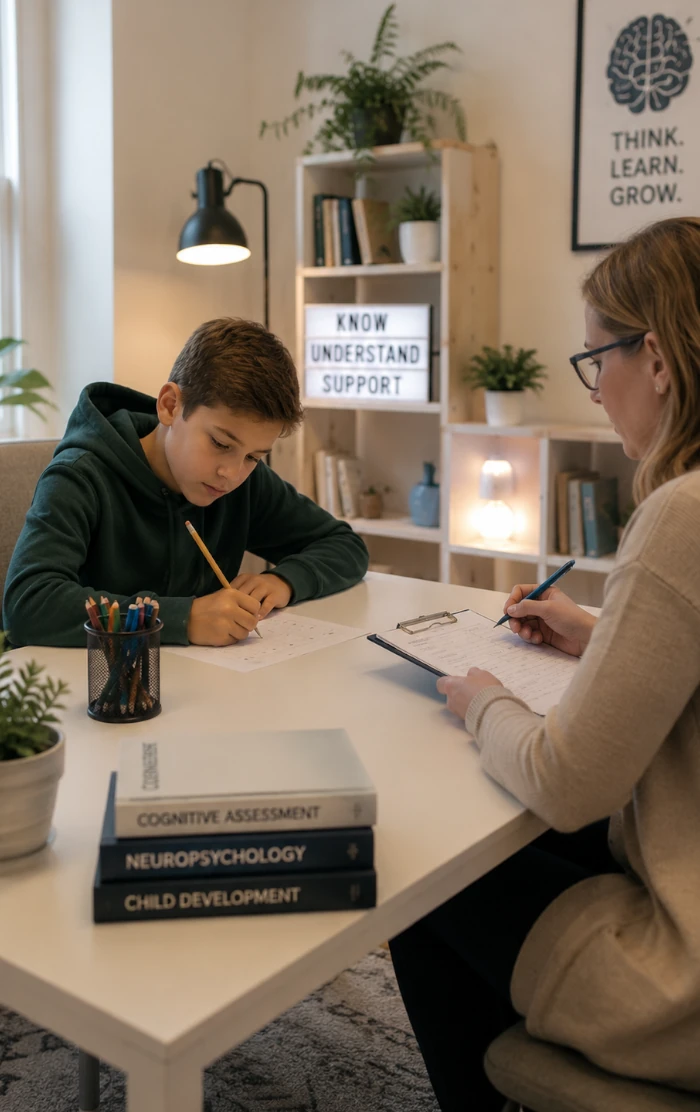
- Testing session (60–90 minutes): The child meets one-on-one with a licensed psychologist in a quiet, comfortable room. The psychologist administers the WISC-V or Stanford-Binet 5, which includes a series of subtests measuring verbal comprehension, visual-spatial reasoning, fluid reasoning, working memory, and processing speed. Breaks are offered as needed.
- Scoring and interpretation (1–2 days): The psychologist scores the test and analyzes the results. They consider the child's age, background, and any relevant medical or educational history.
- Feedback session (45–60 minutes): The psychologist meets with the parents (and the child, if appropriate) to explain the results. They discuss the Full-Scale IQ, index scores, strengths, and areas for growth. They also provide tailored recommendations for home, school, and extracurriculars.
- Comprehensive written report (5–7 days): You receive a detailed report with all scores, normative comparisons, and actionable next steps. This report can be shared with schools, doctors, or other professionals.
The entire process from consultation to report usually takes 1–2 weeks, depending on scheduling. The testing itself is non-invasive and designed to be engaging for children.
What is the WISC-V test?
The WISC-V (Wechsler Intelligence Scale for Children® – Fifth Edition) is the most widely used IQ test for children aged 6:0–16:11. It provides a Full-Scale IQ and five primary index scores: Verbal Comprehension, Visual-Spatial, Fluid Reasoning, Working Memory, and Processing Speed. The test is administered one-on-one by a trained psychologist and takes about 60–90 minutes.
The WISC-V is normed on a large, representative sample of U.S. children and is updated regularly to ensure accuracy. It is the gold standard for gifted identification, learning disability diagnosis, and school placement.
Why test your child's IQ?
IQ testing provides valuable insights into your child's cognitive strengths and weaknesses. It can help:
- Identify giftedness: For admission to gifted programs, private schools, or enrichment opportunities.
- Diagnose learning disabilities: Such as dyslexia, dyscalculia, or ADHD, which can be masked by high intelligence.
- Guide educational planning: Tailor instruction to your child's unique learning profile.
- Provide reassurance: Understand why your child is different from peers and how to support them.
Anaheim Gifted Testing Timeline
- Start with the receiving program: Obtain current written requirements before selecting a psychologist or test.
- AESD referrals: The district publishes specific parent-referral, testing, notification, orientation, and placement windows; dates can extend across school years.
- Private-school admissions: Begin several months before the application deadline to allow records review, testing, report preparation, and follow-up.
- Testing session: WISC-V or Stanford-Binet administration commonly takes about 60–90 minutes, depending on age, test, breaks, and referral question.
- Report turnaround: A focused report may take days to several weeks; comprehensive evaluations often take longer.
- School review: District or school teams may require additional achievement, classroom, language, behavioral, or social-emotional evidence.
- Retesting intervals: Programs may limit how often scores can be submitted, and practice effects can affect interpretation.
- Calendar planning: Avoid testing immediately after illness, major travel, sleep disruption, holiday events, or high-stress school periods when possible.
Anaheim Gifted Programs by Age Group
- Preschool and early childhood: Focus on developmental progress, language exposure, play, social-emotional readiness, and appropriate enrichment rather than premature labeling.
- Kindergarten–grade 2: AESD describes classroom challenge and informal identification through cluster grouping for younger advanced learners.
- Grades 3–6: AESD identifies qualifying students for GATE cluster groups with differentiated depth, complexity, acceleration, creativity, arts, and leadership opportunities.
- Grades 7–8: AUHSD middle-school pathways may include honors or GATE coursework, academic competitions, arts, leadership, and enrichment.
- Grades 9–12: Honors, AP, IB at selected campuses, dual enrollment, career-technical education, arts, athletics, and specialized academies support advanced study.
- College-bound students: Fullerton College, Cypress College, CSUF, Chapman, UCI, and summer programs provide regional academic pathways.
- Gifted youth organizations: California Association for the Gifted, Orange County Council for the Gifted, SENG, and Mensa gifted-youth resources may supplement school services.
- Individual fit: Appropriate pacing, interest, social-emotional readiness, disability support, commute, and family circumstances matter more than age alone.
Anaheim Child ADHD and Learning Disability Assessment
- Comprehensive evaluation: ADHD and learning-disability assessment should include history, interviews, school records, rating scales, achievement data, observations when available, and differential diagnosis.
- IQ testing role: WISC-V or Stanford-Binet can describe cognitive patterns but does not diagnose ADHD, dyslexia, autism, or another disability by itself.
- Language assessment: With a highly multilingual population, examiners must distinguish English-language acquisition from disability and consider testing in the child's strongest language when appropriate.
- Twice exceptionality: High reasoning ability can coexist with ADHD, autism, dyslexia, anxiety, motor difficulties, or slow processing speed.
- School evaluation: Public districts conduct evaluations for educational eligibility under their own procedures; families may request assessment in writing when they suspect a disability.
- Private evaluation: Independent assessment may provide broader diagnosis or recommendations but does not guarantee an IEP, Section 504 plan, GATE placement, or private-school admission.
- Medical coordination: Pediatricians, psychologists, psychiatrists, speech-language pathologists, occupational therapists, neurologists, and educators may address different parts of the child's needs.
- Provider selection: Verify California licensure, bilingual competence when needed, age-group experience, and report acceptance.
Anaheim Summer Programs for Gifted Children
- TGR Learning Lab: Anaheim-based programs connect youth with STEM, career exploration, design, technology, and college-access opportunities; availability varies by season and grade.
- Anaheim Public Library: Summer reading, makerspace, tutoring, digital-learning, arts, and community programs can support advanced interests without requiring gifted identification.
- Discovery Cube Orange County: Nearby science programs and exhibits support engineering, physics, environmental science, and hands-on learning.
- CSUF and community colleges: Youth camps, arts, athletics, STEM, and academic programs may be available through current seasonal schedules.
- Chapman and UCI: Regional universities may offer camps, research exposure, arts, writing, health, business, coding, or precollege opportunities.
- GATE Orchestra and arts: Anaheim-area music and performing-arts programs can support advanced artistic development, subject to current enrollment.
- Parks and nature: Oak Canyon Nature Center, Anaheim Coves, the Santa Ana River Trail, regional parks, and nearby nature preserves support ecology and citizen-science interests.
- Program fit: Compare challenge level, supervision, sensory environment, cost, transportation, language support, disability access, and the child's genuine interests.
Anaheim Child Testing Costs by Provider Type
- School-district evaluation: No charge to families when a public district conducts an assessment under educational procedures, but the scope is limited to school questions and eligibility.
- Focused gifted or placement test: Private fees often fall within the broader $200–$1,200 range, depending on instrument, report detail, consultation, and provider.
- Comprehensive psychoeducational evaluation: Multi-domain evaluations commonly cost substantially more because they include cognitive, academic, behavioral, emotional, executive, and records-review components.
- Medical neuropsychology: Insurance may consider testing when medically necessary and properly authorized; educational gifted testing is usually not covered.
- Bilingual assessment: Qualified bilingual testing, interpreters, translated forms, or additional records review may affect cost and scheduling.
- Private-school requirement: Ask whether the school accepts a focused IQ report or requires achievement testing, developmental history, or a full evaluation.
- Written estimate: Confirm deposit, cancellation policy, testing time, feedback, report length, school consultation, and rush fees before scheduling.
Areas we serve
We support families throughout Anaheim for gifted, WISC-V, Stanford-Binet, ADHD, learning-disability, autism, school-placement, and comprehensive evaluations. The footer intentionally uses citywide wording rather than a keyword-stuffed neighborhood list.
Frequently Asked Questions
Both are excellent tests. WISC-V is more commonly used for school-age children, while Stanford-Binet 5 can be used for ages 2–85. We often recommend WISC-V for gifted identification.
The test itself takes 60–90 minutes. With the consultation, feedback, and report, the entire process is about 1–2 weeks.
No, you can book directly with our psychologists. We serve both self-referred and professionally referred children.
Professional results may be considered by public districts, private schools, and enrichment programs, but each organization sets its own accepted tests, score age, report requirements, and eligibility rules.
Some plans cover cognitive assessments when there is a clinical indication. Check with your provider.
Get a good night's sleep, eat a healthy meal, and arrive relaxed. No specific preparation is needed.
You'll receive a comprehensive report with your child's scores and tailored recommendations.
Interviews and feedback may be available remotely, but many standardized cognitive tests require controlled administration and may need an in-person appointment. Contact us for details.