
WISC Test in Alexandria, VA

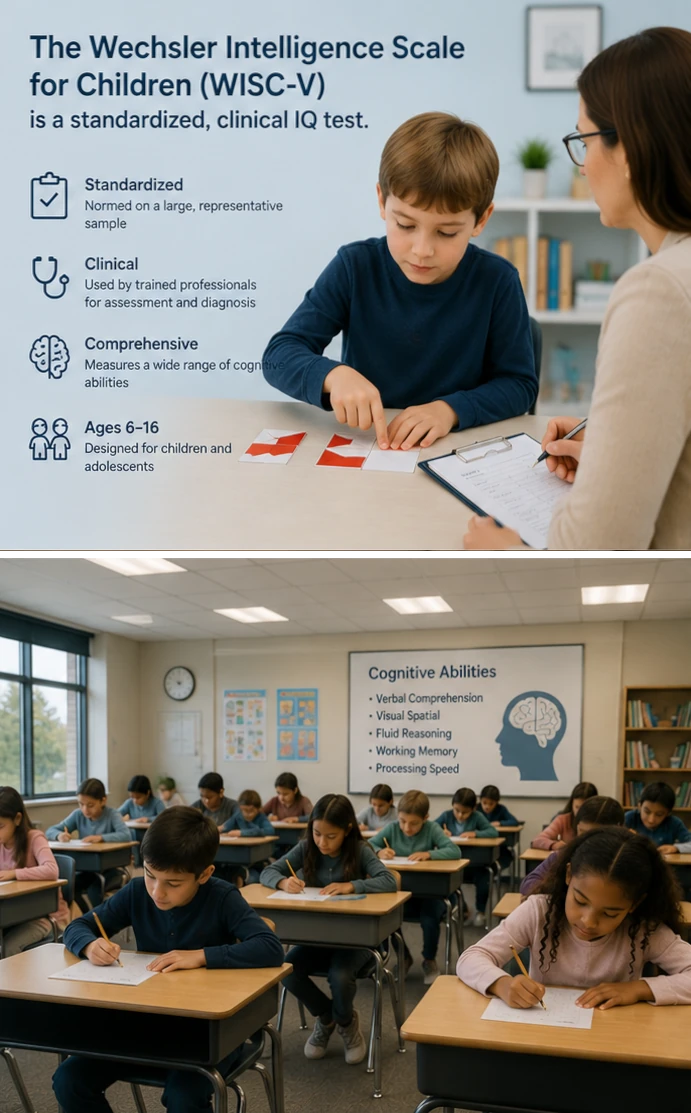
The Wechsler Intelligence Scale for Children (WISC) is the world's most widely used IQ test for children aged 6–16. This comprehensive guide covers the complete history of the WISC, the key differences between WISC-IV and WISC-V, and what you need to know about testing in Alexandria, VA.
Last Updated: September 2026
Complete WISC History
From Wechsler-Bellevue (1939) to WISC-V (2014) – the evolution of child intelligence testing.
WISC-IV vs WISC-V
Detailed comparison of the current and previous versions. What changes, what stays the same.
WISC in Alexandria, VA
How many children take the WISC in Alexandria, VA and what the data tells us about the city.
All WISC Versions
Complete breakdown of subtests and index scores for WISC, WISC-R, WISC-III, WISC-IV, and WISC-V.
Why Use WISC-V?
Understanding the advantages of the newest version and why it's the current gold standard.
Schedule WISC Testing
Book your child's WISC assessment with a licensed psychologist in Alexandria, VA today.
The Complete History of the WISC
The Origins: Wechsler-Bellevue Intelligence Scale (1939)
The story of the WISC begins like the WAIS – with David Wechsler, Chief Psychologist at Bellevue Hospital in New York City. In 1939, Wechsler published the Wechsler-Bellevue Intelligence Scale, which was revolutionary for its time. Wechsler believed that intelligence was not a single, monolithic entity but rather "the global capacity of a person to act purposefully, to think rationally, and to deal effectively with his environment."
Wechsler's test differed from the Stanford-Binet scale in several crucial ways:
- Point scale concept: Items were grouped by content and each item received credit, rather than the age-scale approach of the Binet.
- Non-verbal performance scale: The test included tasks requiring physical action, not just verbal answers, to measure non-verbal intelligence.
- Recognition of non-intellective factors: Wechsler believed that factors like anxiety, confidence, and attitudes influenced test performance.
WISC (1949)
Following the success of the Wechsler-Bellevue for adults, Wechsler published the original WISC in 1949. It was specifically designed for children aged 5–15 and consisted of five verbal subtests and five performance subtests. The test produced Verbal IQ, Performance IQ, and Full Scale IQ scores.
WISC-R (1974)
The WISC-R was released in 1974 and was a significant revision. It updated the norms, improved the test items, and extended the age range to 6–16. The WISC-R also introduced improved administration and scoring procedures.
WISC-III (1991)
The WISC-III brought significant changes in 1991. It introduced four secondary factor indexes: Verbal Comprehension, Perceptual Organization, Freedom from Distractibility, and Processing Speed. New subtests were added, including Symbol Search and Mazes, while some older subtests were revised.
WISC-IV (2003)
The WISC-IV was released in 2003 and represented a major evolution. The verbal/performance IQ scores were removed and replaced by four index scores:
- Verbal Comprehension Index (VCI)
- Perceptual Reasoning Index (PRI)
- Working Memory Index (WMI)
- Processing Speed Index (PSI)
New subtests were added, and some were removed. The test was also updated to better align with current cognitive theory.
WISC-V (2014)
The current version, WISC-V, was released in 2014 and represents the most comprehensive revision to date. It introduced a five-factor model, with the Perceptual Reasoning Index split into two separate indices:
- Verbal Comprehension Index (VCI)
- Visual Spatial Index (VSI)
- Fluid Reasoning Index (FRI)
- Working Memory Index (WMI)
- Processing Speed Index (PSI)
WISC-V also introduced new subtests and updated the normative data to reflect the current population.
WISC-IV vs WISC-V: Key Differences
WISC-IV (2003) – The Previous Standard
- Structure: 10 core subtests and 5 supplemental subtests
- Index Scores: Verbal Comprehension, Perceptual Reasoning, Working Memory, Processing Speed
- Additional Scores: Full Scale IQ, General Ability Index
- Standardization Sample: 2,200 children aged 6-16 in the U.S.
- Administration Time: 65-80 minutes
- Score Descriptors: Very Superior → Superior → High Average → Average → Low Average → Borderline → Extremely Low
WISC-V (2014) – The Current Standard
- Structure: 10 primary subtests, 5 secondary subtests, and 5 tertiary subtests
- Index Scores: Verbal Comprehension, Visual Spatial, Fluid Reasoning, Working Memory, Processing Speed
- Additional Scores: Full Scale IQ, General Ability Index, Cognitive Proficiency Index, Nonverbal Index, Expanded Fluid Reasoning Index
- Standardization Sample: 2,200 children aged 6-16 in the U.S.
- Administration Time: 65-80 minutes (similar to WISC-IV)
- Score Descriptors: Extremely High → Very High → High Average → Average → Low Average → Very Low → Extremely Low
Why Use WISC-V?
WISC-V is the current gold standard for child IQ testing and offers several significant improvements over previous versions.
Advantages of WISC-V
- Five-factor model: Better alignment with the Cattell-Horn-Carroll (CHC) theory of cognitive abilities, providing more detailed information about a child's cognitive profile.
- Improved working memory assessment: Enhanced measures of working memory with new subtests that better capture this important cognitive domain.
- Expanded age range: WISC-V can be used with children aged 6:0–16:11, with new norms and extended content for the full age range.
- Updated norms: Standardized on a representative sample of 2,200 children, reflecting the current population.
- Enhanced clinical utility: Better identification of learning disabilities, giftedness, and other cognitive conditions.
- Digital administration options: Q-interactive platform allows for paperless administration and scoring.
WISC Testing in Alexandria, VA
The WISC-V is commonly used for children ages 6 through 16 when a psychologist needs detailed information about verbal comprehension, visual-spatial reasoning, fluid reasoning, working memory, and processing speed. It may contribute to gifted, learning, attention, developmental, admissions, or broader diagnostic evaluations.
Old Town Psychology, 1221 King Street, Alexandria, VA 22314, can be reached at (571) 478-9499. Its current IQ and gifted-testing information specifically lists the WISC-V for children and describes one-to-one testing by licensed psychologists. Confirm the exact referral, test date, prior-exposure rules, fees, report contents, language services, and whether achievement or other diagnostic measures are also required.
ACPS sets its own Advanced Academic Services, special-education, multilingual, and placement rules. Its current AAS process uses universal screening, automatic referrals for some students, and holistic review of ability, achievement, observations, work samples, and progress information. An outside WISC-V report does not automatically establish program admission or eligibility.
WISC-V interpretation should look beyond Full Scale IQ. Large differences among Verbal Comprehension, Visual Spatial, Fluid Reasoning, Working Memory, and Processing Speed can make one composite less representative. For multilingual Alexandria students, limited English vocabulary or unfamiliar cultural knowledge may suppress some verbal scores without reflecting overall reasoning potential.
All WISC Versions at a Glance
Frequently Asked Questions About the WISC
The WISC was created by David Wechsler, Chief Psychologist at Bellevue Hospital in New York. Its development is a story of innovation that began in 1939 and continues today.
- Wechsler-Bellevue (1939): The original test that inspired both the WAIS and WISC. It introduced the point-scale concept and included a non-verbal performance scale.
- WISC (1949): The first edition specifically designed for children aged 5-15. It produced Verbal IQ, Performance IQ, and Full Scale IQ scores.
- WISC-R (1974): A significant revision with updated norms, improved test items, and an extended age range to 6-16.
- WISC-III (1991): Introduced four secondary factor indexes: Verbal Comprehension, Perceptual Organization, Freedom from Distractibility, and Processing Speed.
- WISC-IV (2003): The verbal/performance IQ scores were removed and replaced by four index scores (Verbal Comprehension, Perceptual Reasoning, Working Memory, and Processing Speed).
- WISC-V (2014): The current standard. It introduces a five-factor model, splitting Perceptual Reasoning into separate Visual Spatial and Fluid Reasoning indices.
Wechsler's original definition of intelligence as "the global capacity of a person to act purposefully, to think rationally, and to deal effectively with his environment" remains influential to this day.
WISC-V is a significant update that brings the test in line with modern cognitive theory and practice. Key differences include:
- Structure: WISC-IV has 4 primary index scores, while WISC-V has 5 primary index scores (Verbal Comprehension, Visual Spatial, Fluid Reasoning, Working Memory, Processing Speed).
- Subtests: WISC-V introduces new subtests including Visual Puzzles, Figure Weights, and Picture Span, while removing some from WISC-IV.
- FSIQ Calculation: WISC-IV uses 10 core subtests to calculate the Full Scale IQ, while WISC-V uses 7 primary subtests.
- Additional Scores: WISC-V introduces new ancillary scores like the Nonverbal Index and Expanded Fluid Reasoning Index.
- Score Descriptors: WISC-V uses descriptors from "Extremely High" to "Extremely Low," replacing "Borderline" with "Very Low" and "Low Average" with "Below Average."
The WISC is not designed to detect ADHD directly. It is an IQ test, and ADHD is a clinical diagnosis based on behavioral symptoms like inattention, hyperactivity, and impulsivity.
However, the WISC can be a valuable tool in the ADHD assessment process. It can reveal cognitive patterns often associated with the disorder:
- Working Memory Deficits: Children with ADHD often score significantly lower on the Working Memory Index (WMI), struggling to hold and manipulate information.
- Processing Speed: Slower processing speeds, measured by the Processing Speed Index (PSI), are another common finding.
- Inconsistent Performance: Children with ADHD may show wide variations in performance across different subtests due to fluctuating attention.
A significant discrepancy between the General Ability Index (GAI) and the Cognitive Proficiency Index (CPI) is also a pattern often seen in ADHD evaluations. Ultimately, the WISC helps clinicians rule out other causes of cognitive difficulties and provides crucial context, but a formal ADHD diagnosis requires a comprehensive clinical evaluation.
The language used to describe IQ scores has evolved significantly, moving away from outdated and potentially stigmatizing terms.
- WISC-R (1974): Used "mentally retarded" for scores below the 2nd percentile.
- WISC-III (1991): Moved to a more modern set of descriptors like "Extremely Low" and "Very Superior."
- WISC-IV (2003): Continued using similar descriptors.
- WISC-V (2014): Introduced new descriptors such as "Extremely High" and "Very High," replacing "Borderline" with "Very Low" and "Low Average" with "Below Average."
These changes reflect a broader effort to ensure that the language used in psychological assessments is respectful, clear, and accurately communicates a child's cognitive profile without causing confusion or stigma.
WISC-V takes approximately 65-80 minutes to administer, depending on the child's age and the number of subtests administered.
WISC-V results may be considered as one part of a gifted evaluation, but acceptance, score criteria, recency, and required supporting evidence vary. Alexandria City Public Schools or the receiving school makes the eligibility decision under its current written policy.
WISC is for children aged 6-16. WAIS is for adults aged 16-90. WISC-V and WAIS-IV have different subtests, norms, and index structures.
Typical fees range from $200 to $1,200. Some insurance plans cover testing when medically necessary.
Some components may be available remotely, but WISC administration depends on publisher rules, clinical appropriateness, Virginia licensure, technology, and the receiving school or program. Many psychologists require in-person testing.