
Mensa Testing in Philadelphia

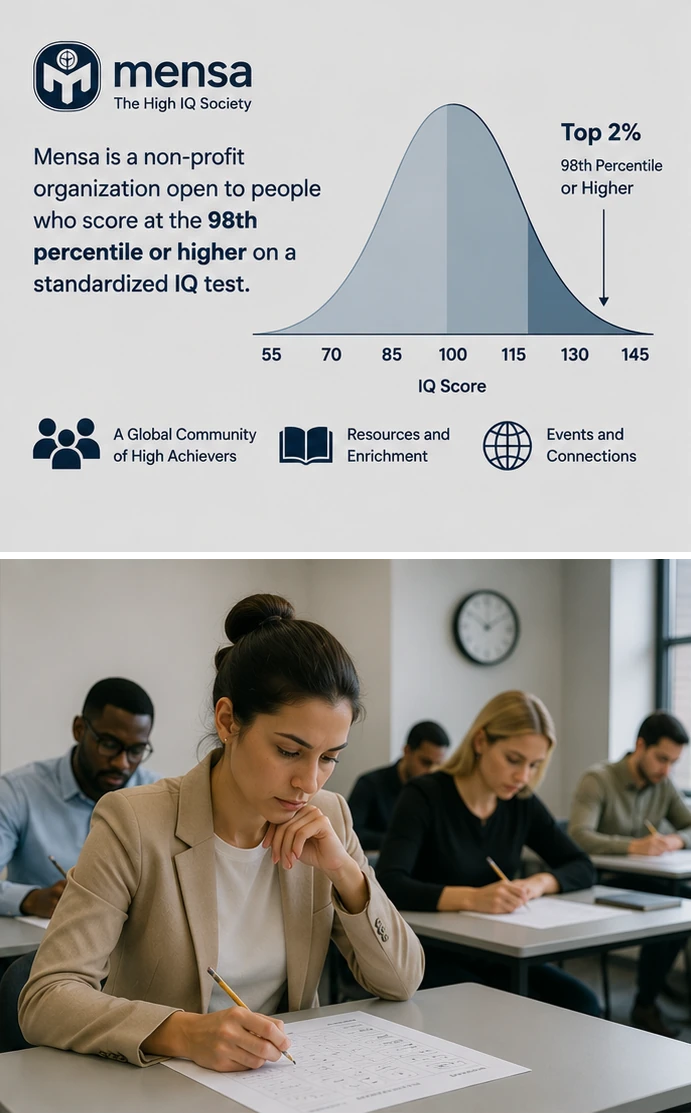
Mensa is the world's oldest and largest high-IQ society, welcoming individuals who score in the top 2% of the population on a standardized intelligence test. This comprehensive guide covers the history of Mensa, membership requirements, Philadelphia's connection to Mensa, and everything you need to know about testing in Philadelphia.
Last Updated: July 2026
Mensa History
From its founding in 1946 to today – the story of the world's premier high-IQ society.
Qualifying Scores
Complete guide to accepted tests and score requirements for Mensa membership.
Mensa in Philadelphia
How many Mensa members are in Philadelphia and what the community looks like.
Accepted Tests
Full list of standardized tests accepted by Mensa for membership qualification.
Testing Process
What to expect during the Mensa Admission Test and how to prepare.
Schedule Mensa Testing
Book your Mensa admission test or IQ assessment with a licensed psychologist in Philadelphia today.
The History of Mensa
The Founding: Oxford, England (1946)
Mensa was founded in 1946 at Oxford University in England by two remarkable individuals: Roland Berrill, an Australian barrister, and Dr. Lancelot Ware, a British scientist and lawyer. The two met by chance on a train journey and discovered they shared a common interest in intelligence testing. They decided to form a society for people with high IQs, and the result was Mensa.
The name "Mensa" comes from the Latin word for "table," symbolizing the organization's goal of creating a round-table society where members meet as equals regardless of background, occupation, race, or any other characteristic. The only qualification for membership is intelligence.
The Early Years
Mensa grew slowly at first but steadily gained recognition. By the 1960s, the organization had established chapters in several countries, including the United States. Today, Mensa has grown to over 150,000 members across more than 100 countries, making it the largest and oldest high-IQ society in the world.
American Mensa, the U.S. chapter, now boasts over 50,000 members, representing one of the largest national groups within Mensa International.
Mensa's Three Purposes
Mensa has three stated purposes:
- To identify and foster human intelligence for the benefit of humanity
- To encourage research into intelligence and its characteristics
- To provide a stimulating intellectual and social environment for its members
Philadelphia's Connection to Mensa
Philadelphia's universities, research institutions, professional communities, and cultural organizations create many opportunities for intellectually curious adults to connect. American Mensa events and local activities vary by organizer and date; prospective members should confirm current Philadelphia-area opportunities directly through official Mensa channels.
Mensa Qualifying Scores
To qualify for Mensa, you must score at or above the 98th percentile on an approved standardized intelligence test. This means performing better than 98 out of every 100 people who take the same test.
Qualifying Scores by Test
Note that different tests use different standard deviations, which is why the qualifying scores vary. The consistent requirement is the 98th percentile.
Mensa in Philadelphia
Philadelphia has a large and diverse adult population, including residents working and studying across higher education, health care, research, the arts, technology, public service, and professional fields. A city population profile does not predict Mensa eligibility; qualification depends on an individual qualifying score at or above the 98th percentile on an accepted test.
Mensa Membership in the Philadelphia Area
American Mensa does not publish a verified city-by-city membership count for Philadelphia. For that reason, this page does not use estimates of local membership. Interested people should use official Mensa resources to check current admission-test sessions, prior-evidence rules, and local event options.
Who Takes the Mensa Test in Philadelphia?
- Academics and researchers: Individuals who enjoy an intellectual community beyond their workplace or university.
- Gifted adults: People who have prior scores or who want a current professionally administered assessment.
- Curious individuals: Adults interested in understanding whether they meet the 98th-percentile qualification standard.
- Parents of gifted children: Adults who decide to explore their own cognitive profile after supporting a child's assessment.
Philadelphia-Area Mensa Events
Event schedules and formats change. Official organizers may offer social gatherings, games, talks, discussion groups, online events, regional gatherings, and member activities; verify the current calendar before making plans.
Accepted Tests for Mensa Qualification
American Mensa accepts scores from approximately 200 different standardized intelligence tests. Tests must be administered by a neutral and qualified third party in a traditional testing environment.
Tests Commonly Administered by Psychologists
- Wechsler Adult Intelligence Scale (WAIS) – FSIQ 130
- Wechsler Intelligence Scale for Children (WISC) – FSIQ 130
- Stanford-Binet Intelligence Scales – IQ 130-132 (depending on version)
- Reynolds Intellectual Assessment Scales – IQ 130
- Differential Ability Scales (DAS) – GCA 130-132
Tests Administered by Schools
- Cognitive Abilities Test (CogAT) – Composite SAS 132
- Otis-Lennon School Ability Test (OLSAT) – Total SAI 132
- Naglieri Nonverbal Ability Test (NNAT) – Nonverbal Ability Index Score 130-132
- Woodcock-Johnson Test of Cognitive Abilities – IQ 131-132
College Preparatory Tests
- SAT (pre-1994) – Combined Verbal & Math 1250+
- GRE (pre-2001) – Combined Verbal & Quantitative 1250+
- ACT (pre-September 1989) – Composite 29+
The Mensa Testing Process
Two Ways to Qualify
There are two primary pathways to Mensa membership:
- Take the Mensa Admission Test: A supervised test administered by Mensa proctors
- Submit prior evidence: If you've already taken an approved test and scored at the 98th percentile, you can submit those scores
The Mensa Admission Test
The Mensa Admission Test is administered in supervised sessions held in cities nationwide, including Philadelphia. Key details:
- Duration: 1-2 hours total
- Format: Two separate timed tests (the Wonderlic and Culture Fair tests)
- Qualifying: You only need to qualify on one of the two tests
- Cost: Approximately $40 for the test
- Retake policy: You can retake the test once every eight weeks
What the Mensa Admission Test Measures
- Pattern recognition – Identifying sequences and relationships
- Logical reasoning – Deductive and inductive thinking
- Spatial visualization – Mental manipulation of objects
- Problem-solving – Complex reasoning under time pressure
Important: The Test is for Admission Only
The Mensa Admission Test is specifically designed for admission to Mensa and does not provide a detailed IQ score or report. You will only be notified whether you qualified for membership. If you want a detailed IQ report with index scores, you should take a professionally administered test like WAIS-IV or SB-5 with a licensed psychologist.
Frequently Asked Questions
Mensa was founded in 1946 in Oxford, England by Roland Berrill and Dr. Lancelot Ware. The name comes from the Latin word for "table," symbolizing a round-table society where all members are equal. Today, Mensa has over 150,000 members in more than 100 countries. American Mensa has over 50,000 members.
The requirement is scoring at or above the 98th percentile on an approved intelligence test. This translates to:
- WAIS-IV or SB-5: IQ 130
- Stanford-Binet (older): IQ 132
- Cattell Culture Fair: IQ 148
- SAT (pre-1994): Combined 1250+
Pennsylvania has approximately 3,500+ Mensa members, with many located in the Philadelphia metropolitan area. The number continues to grow as the region's knowledge-based economy expands.
The Mensa Admission Test takes 1-2 hours total, including check-in and instructions. The two test batteries are timed and typically run between 20-25 minutes each.
The Mensa Admission Test costs approximately $40 in the United States. Annual membership dues after qualification are approximately $99. Professional IQ testing with a licensed psychologist (WAIS or SB-5) typically ranges from $200-$1,200.
Yes. Mensa accepts qualifying scores from tests taken at any point in your life, including childhood. You need to obtain an official report from the testing service or school showing your score. Many members join using SAT scores from decades ago.
No. Mensa does not accept online tests for admission. The test must be administered in person by a qualified proctor in a supervised environment. This includes the Mensa Admission Test and any prior evidence you submit.
Yes. Children can qualify for Mensa by scoring at the 98th percentile on an age-normed test. Parents can submit a psychologist's report directly to American Mensa. There is also a gifted youth program for younger members.
The Mensa Admission Test is designed only to determine if you qualify for membership and does not provide a detailed score report. Professional IQ testing (WAIS-IV, SB-5) provides a comprehensive report with Full Scale IQ, index scores, strengths, and weaknesses. Professional testing is better if you need a detailed analysis for school, career, or clinical purposes.
Mensa is primarily a social organization that provides community for people with high IQs. Activities include social events, discussion groups, lectures, game nights, and special interest groups. Mensa also supports gifted education initiatives, scholarships, and research into intelligence.