
Graduate School Preparation in Oakland

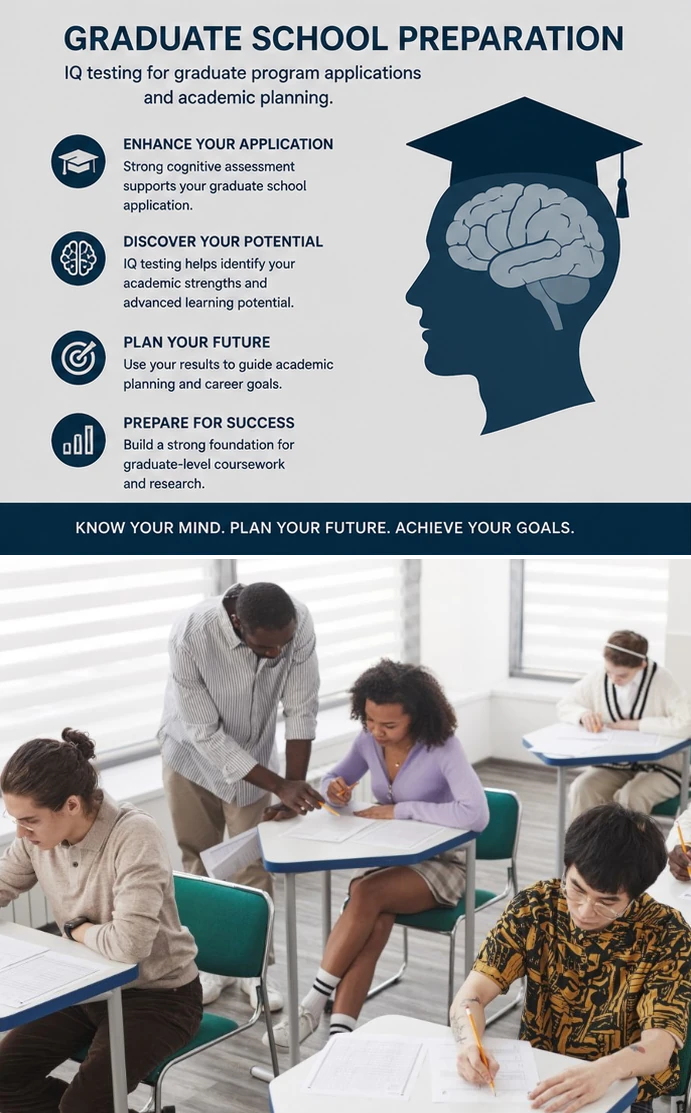
IQ testing can be a valuable tool for graduate school preparation, helping you identify your cognitive strengths, select the right program, and plan for academic success. This comprehensive guide covers how IQ testing supports graduate school applications, which tests are accepted, and how to leverage your results.
Last Updated: July 2026
Adult IQ Testing
WAIS-IV & WAIS-5 available. Comprehensive adult cognitive assessments for graduate school planning.
WAIS-IV & WAIS-5 Tests
Wechsler Adult Intelligence Scale® – Fourth Edition (WAIS-IV) and Fifth Edition (WAIS-5) – the gold standard for adult IQ testing in graduate school applications.
Career Guidance
Use IQ testing to identify career paths and graduate programs that align with your cognitive strengths.
Mensa Testing
Official Mensa testing – another way to demonstrate exceptional cognitive ability for applications. Accepts WAIS-IV, WAIS-5, and Stanford-Binet 5 scores.
Full Evaluation
Comprehensive assessment with detailed report and recommendations for academic planning. Includes WAIS-IV or WAIS-5.
Schedule Graduate School Preparation Testing
Book your graduate school preparation testing with a licensed psychologist in Oakland today.
How IQ Testing Supports Graduate School Preparation
IQ testing provides valuable insights that can help you make informed decisions about graduate school:
- Identify your cognitive strengths: Understand your intellectual profile – verbal comprehension, perceptual reasoning, working memory, and processing speed – and how these align with different graduate programs
- Select the right program: Match your cognitive abilities with program demands – for example, law school requires strong verbal reasoning, while engineering programs demand high perceptual reasoning
- Strengthen your application: Some graduate programs, particularly in clinical psychology, neuropsychology, and education, require or strongly recommend cognitive testing as part of the application process
- Academic planning: Use your cognitive profile to guide your choice of courses, research areas, and career paths
- Identify learning needs: If you have a cognitive weakness in a specific area (e.g., processing speed), you can develop strategies to compensate and succeed in graduate-level work
Graduate Programs That May Require or Recommend IQ Testing
While most graduate programs do not require IQ testing, some fields may request or benefit from cognitive assessment:
- Clinical and Counseling Psychology: Many doctoral programs in psychology require cognitive testing as part of the application or training process
- Neuropsychology: Cognitive assessment is central to the field, and programs often expect familiarity with tests like WAIS-IV and WAIS-5
- School Psychology: Programs require knowledge of cognitive assessment, including the WISC-V and WAIS-IV
- Educational Psychology: Understanding cognitive assessment is essential for careers in educational testing and evaluation
- Gifted Education: Programs in gifted education often require knowledge of IQ testing for identification
- Speech-Language Pathology: Some programs may recommend cognitive testing to understand a client's full profile
- Occupational Therapy: Cognitive assessment can be relevant for some specializations
Oakland Graduate Programs Requiring IQ Testing
Mills College at Northeastern University
- Oakland campus: Offers Northeastern programs, research, professional learning, and innovation opportunities.
- Admissions: Requirements depend on the specific program; clinical IQ testing is not a general graduate-admission requirement.
- Disability services: Students should request current documentation standards directly.
- Planning: Cognitive assessment is useful only when tied to a legitimate clinical or educational question.
Samuel Merritt, Peralta, and Regional Universities
- Samuel Merritt University: Graduate and professional health programs emphasize prerequisites, experience, licensing, and clinical competencies.
- Peralta colleges: Laney and Merritt support transfer and prerequisite completion.
- UC Berkeley: Extensive graduate research and professional programs nearby.
- CSU East Bay: Regional graduate programs in education, psychology, business, health, and sciences.
- UCSF and Stanford: Specialized health, research, and professional programs within the broader Bay Area.
Medical, Psychology, and Professional Programs
- Health sciences: Samuel Merritt, UCSF, and regional universities offer nursing, therapy, medicine, public health, and related training.
- Psychology and education: Programs may require research, statistics, practicum, recommendations, and professional experience rather than an IQ score.
- Law and public policy: Berkeley, San Francisco, and regional programs emphasize academic records, tests where applicable, writing, and service.
- Technology and engineering: Berkeley, Northeastern, CSU East Bay, and Silicon Valley institutions offer technical graduate pathways.
- Business: Bay Area MBA and analytics programs evaluate experience, academics, essays, and interviews.
- Accommodations: Documentation must explain functional limitations and requested support.
Tests Used for Graduate School Preparation
Oakland Research Opportunities
- UC Berkeley: Psychology, neuroscience, education, public health, engineering, data science, social science, and policy research.
- Lawrence Berkeley National Laboratory: Energy, materials, computing, bioscience, climate, and physical-science research.
- Kaiser Permanente Division of Research: Population health, clinical outcomes, epidemiology, and healthcare delivery.
- UCSF Benioff Children’s Oakland: Pediatric clinical and translational research.
- Mills at Northeastern: Oakland campus research and innovation opportunities vary by program.
- Samuel Merritt University: Health-professions research and evidence-based practice.
- Port of Oakland: Environmental, transportation, logistics, climate, and workforce initiatives.
- Community organizations: Public health, education, housing, justice, arts, and nonprofit research projects.
- Bay Area transportation research: BART, AC Transit, the Metropolitan Transportation Commission, and university partners study travel behavior, equity, safety, and infrastructure.
- Climate and environmental research: Port, city, university, and laboratory projects address air quality, sea-level rise, wildfire smoke, energy, and resilience.
- Education research: OUSD, UC Berkeley, nonprofits, and community groups study multilingual learning, college access, school improvement, and youth development.
- Technology research: Berkeley, Northeastern, startups, and regional companies work in artificial intelligence, cybersecurity, data science, and human-computer interaction.
- Clinical research participation: Studies may offer assessments but do not necessarily provide diagnosis, treatment, or a full clinical report.
Oakland Graduate School Scholarships
- Institutional aid: Universities offer program-specific fellowships, assistantships, grants, and scholarships.
- Oakland Promise and local foundations: Some programs support Oakland students through college and may connect graduates to resources.
- Professional associations: Psychology, education, healthcare, engineering, and public-service groups offer awards.
- Employer tuition support: Kaiser, public agencies, schools, transit, and corporations may offer education benefits.
- Public-service programs: Service-based loan repayment or forgiveness may apply to eligible careers.
- Research assistantships: Funding depends on faculty grants and program structure.
- Disability aid: Financial aid and disability accommodations are separate processes.
- Deadlines: Scholarship timelines may precede admission deadlines, so planning should begin early.
Oakland Graduate School Preparation Timeline
- 12–18 months before enrollment: Research programs, prerequisites, costs, faculty, licensure, and outcomes.
- 9–12 months: Complete required tests, request recommendations, draft statements, and identify funding.
- 6–9 months: Submit applications and accommodation requests for entrance exams when applicable.
- 3–6 months: Compare offers, financial aid, commute, housing, internship access, and disability support.
- Before enrollment: Submit final documentation and plan transportation, technology, healthcare, and workload.
- Cognitive evaluation: Begin early only when clinically justified or needed for accommodations.
- Report timing: Allow time for testing, feedback, report revision, and institutional review.
- Reassessment: Do not repeat IQ testing solely to improve an application.
Benefits of IQ Testing for Graduate School Preparation
- Self-awareness: Understand your cognitive strengths and weaknesses and how they relate to different academic and career paths
- Informed decision-making: Choose a graduate program that matches your abilities and interests
- Academic planning: Use your cognitive profile to guide your choice of courses and research areas
- Application enhancement: Some programs may value cognitive testing as evidence of your intellectual abilities
- Career guidance: Identify career paths that align with your cognitive strengths
- Personal growth: Gain insight into your intellectual potential and how to maximize it
Cost of IQ Testing for Graduate School Preparation
The cost of IQ testing for graduate school preparation varies depending on the type of test and the psychologist's experience:
- Single IQ test (WAIS-IV or WAIS-5): $200-$600
- Comprehensive cognitive assessment: $400-$1,200
- Full psychoeducational evaluation: $1,200-$3,000
Some insurance plans may cover testing when it's deemed medically necessary. We recommend checking with your provider for details.
Frequently Asked Questions
Most graduate programs do not require IQ testing. However, some programs in clinical psychology, neuropsychology, school psychology, and gifted education may recommend or require cognitive assessment. Check with your target programs for specific requirements.
WAIS-IV is the most widely used adult IQ test and is appropriate for graduate school preparation. WAIS-5 is also available for those who prefer the newest version. Both provide comprehensive cognitive profiles with index scores for verbal comprehension, perceptual reasoning, working memory, and processing speed.
Understanding your cognitive strengths can help you identify career paths that align with your abilities. For example, high verbal comprehension may indicate strength in law, teaching, or writing, while high perceptual reasoning may indicate strength in engineering, design, or technology.
The test itself takes 60-90 minutes. With the consultation, feedback, and report, the entire process is about 1-2 weeks.
The report includes Full-Scale IQ, index scores, strengths and weaknesses, normative comparisons, and recommendations for graduate school planning and career development.
Some plans cover cognitive assessments when there is a clinical indication. Graduate school preparation is often considered an educational rather than medical service, so coverage varies. Check with your provider.
Some interview and feedback components may be completed remotely, but standardized WAIS administration depends on publisher rules, clinical appropriateness, technology, California licensure, and the receiving organization. Many evaluations require in-person testing.
Get a good night's sleep, eat a healthy meal, and arrive relaxed. No specific preparation is needed. The test measures innate cognitive abilities, so studying is not necessary.
Typical fees range from $200 to $1,200 for a single IQ test, with full evaluations costing up to $3,000. Some insurance plans cover testing when medically necessary.
Mensa membership demonstrates high cognitive ability and may be a positive addition to your graduate school application. We offer official Mensa testing and documentation.