
Child IQ Testing in Nashville

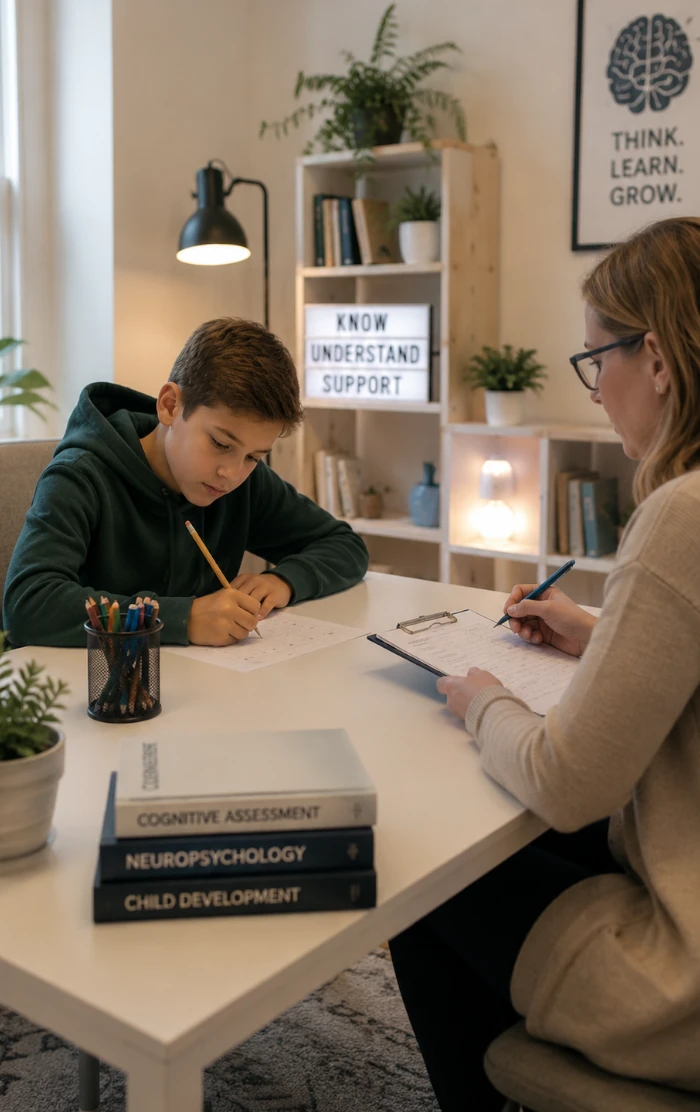
Professional child IQ testing in Nashville – whether you need an assessment for school placement, gifted program eligibility, or to understand your child's learning profile, we connect you with licensed psychologists in the Nashville area.
Last Updated: July 2026
Gifted Testing
Identify giftedness for school placement, enrichment, and talent programs using WISC-V or Stanford-Binet 5.
WISC-V Test
Wechsler Intelligence Scale for Children® Fifth Edition – the gold standard for child IQ testing.
Stanford-Binet 5
Stanford-Binet Intelligence Scales Fifth Edition – comprehensive cognitive assessment for all ages.
Full Evaluation
Combined assessment with detailed report and recommendations. Includes WISC-V or Stanford-Binet 5.
School Placement Testing
Testing for private school admission and gifted program eligibility using WISC-V or Stanford-Binet 5.
Schedule Child IQ Testing
Book your WISC-V & Stanford-Binet 5 for ages 6–16. Gifted identification, learning profiles, etc. with a licensed psychologist in Nashville today.
Child IQ Testing in Nashville: city context
Nashville serves families throughout Davidson County and surrounding Middle Tennessee communities. The U.S. Census Bureau estimated the Nashville-Davidson metropolitan government balance population at 721,074 in 2025, and approximately 20.7% of residents are under age 18.
Families may seek child testing for gifted-program planning, school placement, learning concerns, disability documentation, or a clearer understanding of cognitive strengths. Local resources include Metro Nashville Public Schools (MNPS), private and independent schools, Vanderbilt pediatric services, university programs, and licensed private psychologists.
IQ, gender, and demographic context (child population)
Clinical tests such as the WISC-V and Stanford-Binet 5 use age-based national norms rather than separate Nashville norms for boys and girls. Results should be interpreted individually because language, educational opportunity, attention, disability, health, anxiety, rapport, and testing conditions can influence performance.
Nashville's current citywide demographics are approximately 54.6% White alone, 24.9% Black alone, 3.5% Asian alone, 11.2% two or more races, and 14.1% Hispanic or Latino. Child-specific percentages can differ from the citywide figures, and Hispanic origin may overlap with race categories.
There is no authoritative Nashville dataset establishing average child IQ by gender, race, or ethnicity. Group identity should never be used to predict a child's ability. The useful information comes from the child's individual cognitive profile, observed behavior, history, and educational needs.
Nashville School Districts and Gifted Programs
Metro Nashville Public Schools (MNPS) Gifted and Talented Education
- Grade range: MNPS provides GATE classes for academically gifted and talented students in grades K-8.
- Identification: Eligibility uses a multiple-measures matrix that includes district benchmarks and a cognitive aptitude test.
- Testing windows: Districtwide consideration generally occurs in spring, with an additional fall window for eligible students who missed spring testing.
- Service model: Qualified students receive differentiated, problem-based instruction, with a GATE teacher at each K-8 MNPS school.
- Current rules: Families should confirm transfer, charter-school, retesting, and outside-evaluation policies directly with MNPS.
MNPS Academic Magnet and Advanced High-School Pathways
- Hume-Fogg High School and Martin Luther King Jr. Magnet School have academic admissions requirements.
- MNPS high schools also offer AP, Cambridge, International Baccalaureate, dual-enrollment, early-college, and career-academy pathways.
- GATE services are structured for K-8; high-school acceleration is generally delivered through advanced courses and specialized programs.
Williamson County Schools Advanced Academics
- Williamson County families should review the district's current gifted, advanced-academic, and special-education identification procedures.
- Private testing may provide useful clinical information, but district teams determine eligibility under current Tennessee rules.
Sumner County Schools Gifted Services
- Sumner County provides services under Tennessee's gifted and special-education framework.
- Referral, assessment, eligibility, and service decisions are made through district procedures and may use multiple data sources.
Rutherford, Wilson, and Other Middle Tennessee Districts
- Nearby districts maintain their own advanced-learning and intellectually gifted procedures.
- Families should verify testing calendars, accepted measures, transfer rules, and whether an outside report will be reviewed by the school team.
Nashville Private Schools and Testing Requirements
Nashville-area independent schools include Montgomery Bell Academy, Harpeth Hall, University School of Nashville, Ensworth, Harding Academy, Lipscomb Academy, and others. Admissions requirements vary by school and grade and may include school records, interviews, teacher recommendations, achievement testing, or other assessments.
Do not assume that a WISC-V, Stanford-Binet, or private IQ report is required or accepted. Contact each admissions office before scheduling testing and ask which instruments, testing dates, evaluator credentials, and report formats are permitted.
Nashville Gifted Identification Statistics
MNPS provides GATE services across K-8 schools and uses broad district screening and multiple measures to support equitable access. The district does not present a simple public citywide count that can be used to estimate how many Nashville children are “gifted” based on IQ alone.
Academically gifted GATE eligibility and Tennessee's “Intellectually Gifted” special-education eligibility are related but distinct. Neither should be reduced to a single universal IQ cutoff without reviewing current district and state criteria.
The child IQ testing process: step by step
Understanding the testing process can help parents prepare their child and reduce anxiety. Here's what to expect:
- Initial consultation (15–20 minutes): A brief phone or video call with the psychologist to discuss your child's background, concerns, and goals. This helps determine the right test and approach.
- Testing session (60–90 minutes): The child meets one-on-one with a licensed psychologist in a quiet, comfortable room. The psychologist administers the WISC-V or Stanford-Binet 5, which includes a series of subtests measuring verbal comprehension, visual-spatial reasoning, fluid reasoning, working memory, and processing speed. Breaks are offered as needed.
- Scoring and interpretation (1–2 days): The psychologist scores the test and analyzes the results. They consider the child's age, background, and any relevant medical or educational history.
- Feedback session (45–60 minutes): The psychologist meets with the parents (and the child, if appropriate) to explain the results. They discuss the Full-Scale IQ, index scores, strengths, and areas for growth. They also provide tailored recommendations for home, school, and extracurriculars.
- Comprehensive written report (5–7 days): You receive a detailed report with all scores, normative comparisons, and actionable next steps. This report can be shared with schools, doctors, or other professionals.
The entire process from consultation to report usually takes 1–2 weeks, depending on scheduling. The testing itself is non-invasive and designed to be engaging for children.
What is the WISC-V test?
The WISC-V (Wechsler Intelligence Scale for Children® – Fifth Edition) is the most widely used IQ test for children aged 6:0–16:11. It provides a Full-Scale IQ and five primary index scores: Verbal Comprehension, Visual-Spatial, Fluid Reasoning, Working Memory, and Processing Speed. The test is administered one-on-one by a trained psychologist and takes about 60–90 minutes.
The WISC-V is normed on a large, representative sample of U.S. children and is updated regularly to ensure accuracy. It is the gold standard for gifted identification, learning disability diagnosis, and school placement.
Why test your child's IQ?
IQ testing provides valuable insights into your child's cognitive strengths and weaknesses. It can help:
- Identify giftedness: For admission to gifted programs, private schools, or enrichment opportunities.
- Diagnose learning disabilities: Such as dyslexia, dyscalculia, or ADHD, which can be masked by high intelligence.
- Guide educational planning: Tailor instruction to your child's unique learning profile.
- Provide reassurance: Understand why your child is different from peers and how to support them.
Nashville Gifted Testing Timeline
- MNPS spring testing: Districtwide consideration and administration generally occur during the spring semester for kindergarten through grade 7.
- MNPS fall window: An additional window is available for eligible students who did not participate in spring testing.
- Private evaluations: Scheduling and report turnaround vary by clinician; start early when a school deadline applies.
- One test per school year: MNPS states that students may be tested once per school year for its GATE process.
Nashville Gifted Programs by Age Group
- Pre-K: MNPS offers limited pre-K GATE classes at Robertson Academy under current program criteria.
- Kindergarten-grade 8: MNPS GATE provides small-group, differentiated instruction for eligible students.
- Grades 7-12: Academic magnet options include Martin Luther King Jr. Magnet School; high-school options include Hume-Fogg and other advanced pathways.
- High school: AP, Cambridge, IB, dual enrollment, early college, and career academies offer additional acceleration.
- Outside school: Vanderbilt Programs for Talented Youth and other regional organizations provide enrichment subject to eligibility and current schedules.
Nashville Child ADHD and Learning Disability Assessment
A comprehensive child evaluation may include cognitive testing, academic achievement testing, attention and executive-function measures, behavior rating scales, developmental history, interviews, and school records. IQ testing by itself cannot diagnose ADHD, dyslexia, autism, or another learning or developmental condition.
Nashville families may seek school-based evaluation through MNPS or clinical services through Vanderbilt pediatric specialists and licensed private psychologists. The best route depends on whether the goal is special-education eligibility, medical diagnosis, treatment planning, or independent documentation.
Nashville Summer and Enrichment Programs for Advanced Learners
Advanced learners may benefit from Vanderbilt Programs for Talented Youth, Nashville Public Library programs, museum and science activities, university camps, arts programs, coding and robotics opportunities, and school-based summer offerings.
Eligibility, dates, costs, and age ranges change. Review current program information directly and distinguish enrichment admission from clinical gifted identification or school special-education eligibility.
Nashville Child Testing Costs and School Evaluations
Private child-testing fees depend on the battery, clinician, records review, report detail, and whether the service is a brief gifted assessment or a full psychoeducational or neuropsychological evaluation. Ask for a written estimate and the expected report timeline.
When a disability is suspected, families may request an evaluation through the public-school system. School evaluations and private clinical evaluations serve overlapping but different purposes, and the school team makes educational eligibility decisions under applicable law.
Areas we serve
Child-testing resources may serve Nashville and Davidson County, including Downtown, Midtown, Green Hills, Belle Meade, East Nashville, Donelson, Hermitage, Madison, Antioch, Bellevue, and surrounding Middle Tennessee communities.
Frequently Asked Questions
Both are excellent tests. WISC-V is more commonly used for school-age children, while Stanford-Binet 5 can be used for ages 2–85. We often recommend WISC-V for gifted identification.
The test itself takes 60–90 minutes. With the consultation, feedback, and report, the entire process is about 1–2 weeks.
No, you can book directly with our psychologists. We serve both self-referred and professionally referred children.
Yes, our reports are accepted by Metro Nashville Public Schools, private schools, and other gifted programs.
Some plans cover cognitive assessments when there is a clinical indication. Check with your provider.
Get a good night's sleep, eat a healthy meal, and arrive relaxed. No specific preparation is needed.
You'll receive a comprehensive report with your child's scores and tailored recommendations.
Remote administration may be possible only in limited circumstances. The evaluator must confirm publisher guidance, test validity, state licensing, technology requirements, and acceptance by the receiving school or organization.