
Child IQ Testing in Mesa

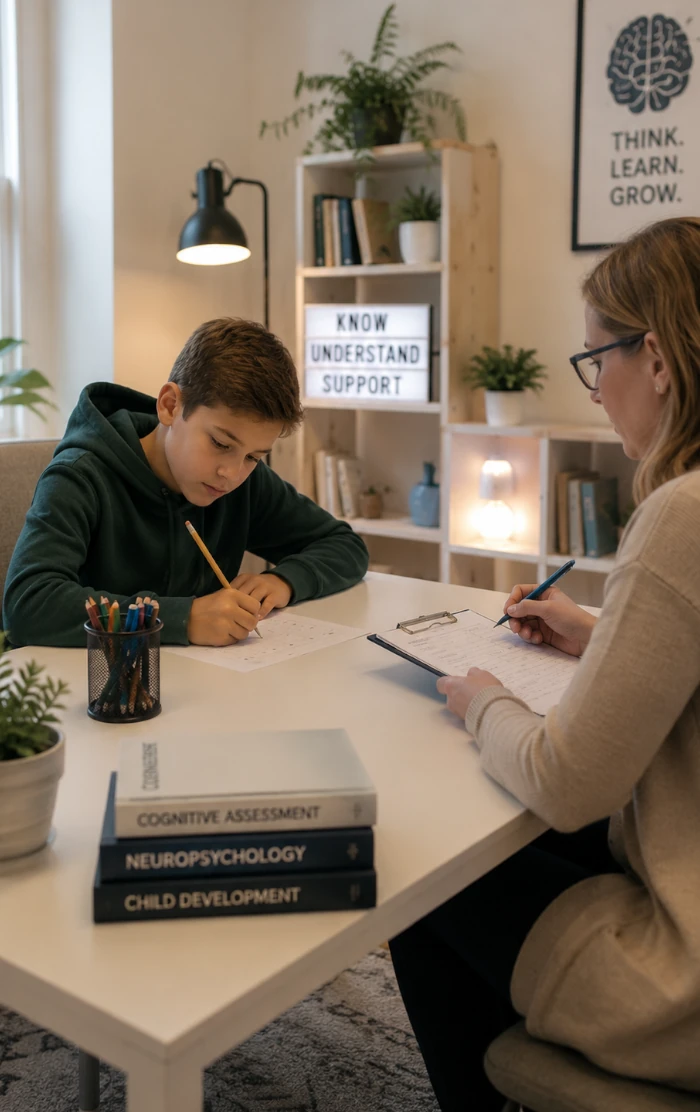
Professional child IQ testing in Mesa – whether you need an assessment for school placement, gifted program eligibility, or to understand your child's learning profile, we connect you with licensed psychologists in the Mesa area.
Last Updated: July 2026
Gifted Testing
Identify giftedness for school placement, enrichment, and talent programs using WISC-V or Stanford-Binet 5.
WISC-V Test
Wechsler Intelligence Scale for Children® Fifth Edition – the gold standard for child IQ testing.
Stanford-Binet 5
Stanford-Binet Intelligence Scales Fifth Edition – comprehensive cognitive assessment for all ages.
Full Evaluation
Combined assessment with detailed report and recommendations. Includes WISC-V or Stanford-Binet 5.
School Placement Testing
Testing for private school admission and gifted program eligibility using WISC-V or Stanford-Binet 5.
Schedule Child IQ Testing
Book your WISC-V & Stanford-Binet 5 for ages 6–16. Gifted identification, learning profiles, etc. with a licensed psychologist in Mesa today.
Child IQ Testing in Mesa: city context
Mesa families have access to one of Arizona's largest public school systems, charter and private options, community-college early pathways, ASU-connected programs and regional pediatric services. Child IQ testing may support gifted identification, learning-disability assessment, twice-exceptional planning, school placement or a broader neuropsychological evaluation.
IQ by gender & ethnicity (child population)
Children under age 18 represent 22.5% of Mesa's population. The city is diverse, with 26.9% of residents identifying as Hispanic or Latino and 19.8% of residents age five and older speaking a language other than English at home.
- Boys and girls: Overall IQ distributions overlap substantially; individual index scores and learning histories are more useful than group averages.
- Language: English learners and bilingual children require careful consideration of language exposure, schooling and test validity.
- Culture and opportunity: Educational access, health, sleep, nutrition, stress and familiarity with testing can affect performance.
- Age norms: WISC-V and Stanford-Binet scores compare the child with same-age national peers.
- No Mesa subgroup IQ averages: There is no authoritative city dataset assigning average IQ scores to Mesa boys, girls, neighborhoods or racial and ethnic groups.
- Responsible reports: Examiners should explain limitations and avoid inferring innate ability from demographic categories.
Mesa School Districts and Gifted Programs
Mesa Public Schools Gifted Program
- Grade span: Mesa Public Schools describes gifted programming at elementary, junior-high and high-school levels.
- Program purpose: Services are intended for students needing differentiated instruction beyond the regular program, including depth, acceleration and affective support.
- Identification: District procedures use state-approved cognitive measures and school evidence; families should review the current MPS scope and sequence and referral calendar.
- Arizona benchmark: A 97th-percentile score in verbal, quantitative or nonverbal reasoning is a common qualifying route under state definitions.
- School assignment: Service models and available placements vary by grade and school.
- Independent testing: Confirm in writing whether privately administered WISC-V or Stanford-Binet results will be considered and which score report is required.
Gilbert Public Schools Gifted Program
- Service area: Gilbert schools serve communities adjacent to southeast Mesa and may be relevant for families near district boundaries.
- State framework: The district must identify and serve gifted K–12 learners under Arizona law.
- Evidence: Group cognitive testing, achievement and other district criteria may be used.
- Placement: Options depend on grade, school and current district programming.
- Boundary verification: Mesa mailing addresses do not always determine school-district assignment; check the official boundary map.
Chandler Unified School District Gifted Program
- Nearby access: Chandler Unified serves areas south and southwest of Mesa and operates specialized gifted options.
- Testing: Current approved instruments, test windows and placement procedures should be obtained directly from the district.
- Specialized programs: Some options may require additional criteria beyond a single cognitive score.
- Transfers: Open-enrollment and transportation rules can affect practical access.
- Outside reports: Families should confirm whether private testing is accepted before scheduling.
Queen Creek Unified School District Gifted Program
- Growth area: Queen Creek Unified serves rapidly developing communities southeast of Mesa.
- K–12 requirement: Gifted identification and differentiated services follow Arizona requirements.
- Referral: Parent, teacher and school data may contribute to evaluation.
- Programming: Models may include cluster grouping, enrichment, acceleration and advanced coursework.
- Current criteria: Families should verify the district's latest testing and placement rules.
Higley Unified School District Gifted Program
- East Valley access: Higley Unified is near southeast Mesa and serves several growing communities.
- Identification: Uses district procedures within Arizona's gifted framework.
- Advanced pathways: Gifted services may connect with honors, Advanced Placement, dual enrollment and accelerated mathematics.
- Documentation: Independent reports should include standard scores, percentiles, behavioral observations and test dates.
- Annual changes: Program sites, transportation and grade-level options should be confirmed each school year.
Mesa Private Schools and Programs Using Testing Information
Private and charter admission practices vary. Many schools do not require a clinical IQ test, and a school should never be described as requiring one without current written confirmation.
- BASIS Mesa: College-preparatory charter school with accelerated academics; charter admission is governed by its current enrollment policy rather than a general IQ requirement.
- ASU Preparatory Academy Polytechnic: K–12 public charter programs on the ASU Polytechnic campus with project-based and college-credit pathways.
- Redeemer Christian School: Private-school option in Mesa; families should request current admission and learning-support requirements.
- East Valley private schools: Independent, Montessori, religious and specialized schools may request educational records, achievement testing or psychoeducational reports in particular cases.
- Learning-support placement: Schools may review cognitive, achievement, attention and social-emotional data when determining accommodations or support.
- Confirm before testing: Obtain the exact accepted test, recency limit, examiner credentials and report format from the receiving school.
Mesa Gifted Identification Statistics
- City child population: 22.5% of Mesa residents are under age 18.
- State threshold context: Arizona commonly defines gifted eligibility through a 97th-percentile score in one or more approved reasoning areas.
- Expected prevalence: A strict 97th-percentile threshold represents roughly the top 3% in a single measured domain, but district identification totals can be higher because students may qualify in different areas and through local procedures.
- No verified city total: A current, authoritative Mesa-wide count of all gifted children across district, charter, private and homeschool settings is not publicly consolidated.
- Equity: Universal screening, local norms, multiple measures and outreach can improve identification of multilingual, low-income, disabled and twice-exceptional students.
- Interpretation: Giftedness can appear in verbal, mathematical, visual-spatial, creative, leadership or domain-specific performance; one score does not describe the whole child.
The child IQ testing process: step by step
Understanding the testing process can help parents prepare their child and reduce anxiety. Here's what to expect:
- Initial consultation (15–20 minutes): A brief phone or video call with the psychologist to discuss your child's background, concerns, and goals. This helps determine the right test and approach.
- Testing session (60–90 minutes): The child meets one-on-one with a licensed psychologist in a quiet, comfortable room. The psychologist administers the WISC-V or Stanford-Binet 5, which includes a series of subtests measuring verbal comprehension, visual-spatial reasoning, fluid reasoning, working memory, and processing speed. Breaks are offered as needed.
- Scoring and interpretation (1–2 days): The psychologist scores the test and analyzes the results. They consider the child's age, background, and any relevant medical or educational history.
- Feedback session (45–60 minutes): The psychologist meets with the parents (and the child, if appropriate) to explain the results. They discuss the Full-Scale IQ, index scores, strengths, and areas for growth. They also provide tailored recommendations for home, school, and extracurriculars.
- Comprehensive written report (5–7 days): You receive a detailed report with all scores, normative comparisons, and actionable next steps. This report can be shared with schools, doctors, or other professionals.
The entire process from consultation to report usually takes 1–2 weeks, depending on scheduling. The testing itself is non-invasive and designed to be engaging for children.
What is the WISC-V test?
The WISC-V (Wechsler Intelligence Scale for Children® – Fifth Edition) is the most widely used IQ test for children aged 6:0–16:11. It provides a Full-Scale IQ and five primary index scores: Verbal Comprehension, Visual-Spatial, Fluid Reasoning, Working Memory, and Processing Speed. The test is administered one-on-one by a trained psychologist and takes about 60–90 minutes.
The WISC-V is normed on a large, representative sample of U.S. children and is updated regularly to ensure accuracy. It is the gold standard for gifted identification, learning disability diagnosis, and school placement.
Why test your child's IQ?
IQ testing provides valuable insights into your child's cognitive strengths and weaknesses. It can help:
- Identify giftedness: For admission to gifted programs, private schools, or enrichment opportunities.
- Diagnose learning disabilities: Such as dyslexia, dyscalculia, or ADHD, which can be masked by high intelligence.
- Guide educational planning: Tailor instruction to your child's unique learning profile.
- Provide reassurance: Understand why your child is different from peers and how to support them.
Mesa Gifted Testing Timeline
- August–September: Review district rules, prior records and school deadlines after enrollment.
- Fall: Many schools begin referrals, group screening or parent information sessions.
- Winter: Additional assessment, score review and placement discussions may occur.
- Spring: Districts often finalize services or placements for the next school year.
- Private testing: Schedule early enough for administration, scoring, feedback and report delivery before a school deadline.
- Retesting: Follow instrument practice-effect guidance and receiving-program rules; unnecessary repeat testing can reduce validity.
- Transfers: Families moving between Mesa, Gilbert, Chandler, Queen Creek or charter systems should request written score-transfer policies.
- Urgent deadlines: Ask whether preliminary score letters are accepted while the full report is completed.
Mesa Gifted Programs by Age Group
- Preschool: Developmental assessment may address advanced milestones, but formal gifted labels and services are less consistent before school age.
- Kindergarten–grade 2: Early identification should consider developmental variability, classroom evidence, language and opportunities to learn.
- Grades 3–6: Common period for group screening, pull-out enrichment, cluster grouping, subject acceleration and specialized placements.
- Junior high: Advanced mathematics, honors coursework, accelerated science and project-based enrichment become more prominent.
- High school: Honors, Advanced Placement, International Baccalaureate where available, dual enrollment, career-technical education and early-college options.
- Twice-exceptional students: May need both advanced instruction and disability-related accommodations.
- Homeschool and charter students: Access to district services and testing varies; families should verify eligibility and enrollment rules.
- College connection: MCC early-college and ASU Prep pathways can support advanced secondary students.
Mesa Child ADHD and Learning Disability Assessment
- Comprehensive approach: IQ testing should be combined with achievement tests, behavior ratings, interviews and school records when ADHD or learning disability is suspected.
- Dyslexia and reading: Evaluate phonological processing, decoding, fluency, comprehension and written language rather than relying on IQ-achievement discrepancy alone.
- Mathematics: Assessment may examine calculation, problem solving, number sense, working memory and instructional history.
- Attention: Consider symptoms across home and school and rule out sleep, anxiety, hearing, vision, language and medical factors.
- Autism and social communication: IQ testing may be one part of a broader developmental evaluation.
- School evaluation rights: Families may request evaluation through the public school when a disability is suspected; private evaluation does not replace district procedures.
- Banner pediatric neuropsychology: Mesa-based specialists assess children with complex medical, neurological and developmental concerns when clinically appropriate.
- Actionable report: Recommendations should connect findings to instruction, accommodations, intervention and progress monitoring.
Mesa Summer Programs for Gifted Children
- ASU summer programs: University and college units offer changing STEM, engineering, technology, arts and academic opportunities across the metro area.
- Mesa Community College: Youth, dual-enrollment and enrichment options vary by year and campus.
- Mesa Arts Center: Visual arts, performance and creative classes support advanced artistic interests.
- Arizona Museum of Natural History: Science, paleontology, archaeology and natural-history programming for curious learners.
- i.d.e.a. Museum: Design, creativity and hands-on exploration for younger children.
- Mesa Public Library: Reading, maker, coding and educational programs at multiple branches.
- East Valley camps: Robotics, coding, aviation, music, debate and sports programs are available through schools, nonprofits and private providers.
- Heat planning: Choose indoor or early-morning activities during extreme temperatures and verify hydration and transportation plans.
Mesa Child Testing Costs by Provider Type
- Public-school evaluation: No direct fee to eligible enrolled students when the district evaluates suspected educational needs under applicable law.
- Independent gifted IQ testing: Often several hundred dollars depending on instrument, report length and feedback.
- Psychoeducational evaluation: Higher cost because it includes cognitive, academic and behavioral measures.
- Neuropsychological evaluation: Typically the most expensive and may involve insurance when medically necessary.
- Insurance limits: Gifted or private-school admission testing is usually educational rather than medically necessary.
- School acceptance: Confirm accepted instruments and examiner credentials before paying.
- Financial assistance: Ask providers about payment plans, university training clinics, sliding scales or nonprofit resources.
- Report update: Schools and testing agencies may require recent documentation, so ask about recency rules.
Areas we serve
We support families throughout Mesa for gifted, WISC-V, Stanford-Binet, ADHD, learning-disability and comprehensive evaluations. The footer intentionally uses city-wide wording rather than a keyword-stuffed neighborhood list.
Frequently Asked Questions
Both are excellent tests. WISC-V is more commonly used for school-age children, while Stanford-Binet 5 can be used for ages 2–85. We often recommend WISC-V for gifted identification.
The test itself takes 60–90 minutes. With the consultation, feedback, and report, the entire process is about 1–2 weeks.
No, you can book directly with our psychologists. We serve both self-referred and professionally referred children.
Yes, our reports are accepted by Mesa Public Schools, private schools, and other gifted programs.
Some plans cover cognitive assessments when there is a clinical indication. Check with your provider.
Get a good night's sleep, eat a healthy meal, and arrive relaxed. No specific preparation is needed.
You'll receive a comprehensive report with your child's scores and tailored recommendations.
Interviews and feedback may be available remotely, but many standardized cognitive tests require controlled administration and may need an in-person appointment. Contact us for details.