
Child IQ Testing in Memphis

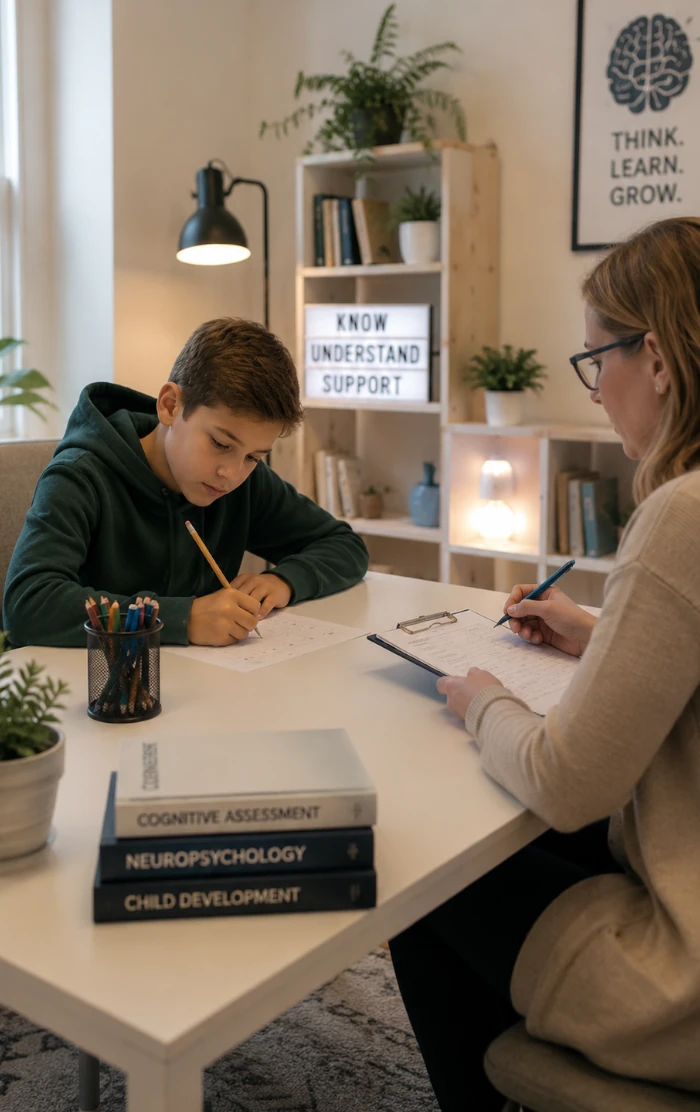
Families may request a child cognitive assessment for school placement, gifted identification, learning concerns, or a clearer understanding of a child's strengths and needs. Submitted requests can be shared with participating licensed providers serving the Memphis area.
Last Updated: July 2026
Gifted Testing
Identify giftedness for school placement, enrichment, and talent programs using WISC-V or Stanford-Binet 5.
WISC-V Test
Wechsler Intelligence Scale for Children® Fifth Edition – the gold standard for child IQ testing.
Stanford-Binet 5
Stanford-Binet Intelligence Scales Fifth Edition – comprehensive cognitive assessment for all ages.
Full Evaluation
Combined assessment with detailed report and recommendations. Includes WISC-V or Stanford-Binet 5.
School Placement Testing
Testing for private school admission and gifted program eligibility using WISC-V or Stanford-Binet 5.
Schedule Child IQ Testing
Book your WISC-V & Stanford-Binet 5 for ages 6–16. Gifted identification, learning profiles, etc. with a licensed psychologist in Memphis today.
Local context for child assessment
Memphis serves a large and diverse child population across MSCS, municipal districts, charter schools, private schools, university-affiliated programs, homeschool communities, and clinical systems. The Census Bureau estimated 609,647 residents in 2025, with 25.2% under age 18.
Families seek testing for CLUE or gifted questions, Optional School planning, private-school admission, acceleration, learning disabilities, ADHD, autism, intellectual disability, twice-exceptionality, or a clearer profile of strengths and needs.
IQ, gender, language, and demographic context
Child IQ tests such as the WISC-V and Stanford-Binet 5 use national age-based norms. They do not use separate Memphis norms for boys and girls, and overall IQ distributions overlap substantially by sex. Individual children may nevertheless show meaningful differences among verbal, visual-spatial, fluid-reasoning, working-memory, quantitative, and processing-speed abilities.
- Residents under age 18: 25.2% of Memphis's population.
- Female residents: 52.6% of the total city population.
- Black or African American alone: 62.9%.
- White alone: 23.8%.
- Hispanic or Latino: 10.4%.
- Asian alone: 1.7%.
- Two or more races: 5.5%.
- Language other than English spoken at home: 11.5% of residents age 5 and older.
No valid local source supports assigning IQ averages to Memphis children by gender, race, ethnicity, district, school, or neighborhood. Equitable evaluation considers language exposure, cultural context, educational opportunity, disability, health, sensory and motor needs, trauma, test familiarity, and whether the selected instrument is appropriate for the referral question.
School districts and gifted programs
Memphis-Shelby County Schools CLUE Services
- Universal screening: MSCS uses districtwide benchmark and screening data to identify students who may need CLUE enrichment or gifted evaluation, reducing dependence on referrals alone.
- Multiple pathways: Students may enter consideration through screening, parent or teacher referral, achievement data, cognitive data, creativity or characteristics information, and other evidence under current procedures.
- CLUE Enrichment and CLUE Gifted: Families should distinguish enrichment access from Tennessee special-education eligibility for intellectually gifted services.
- Educational planning: Gifted eligibility does not automatically determine a specific school, Optional Program, acceleration, or private-school placement.
Tennessee Intellectually Gifted Eligibility
- State category: Tennessee recognizes intellectually gifted as a special-education category when outstanding abilities and potential create educational needs beyond differentiated general education.
- Evaluation: Teams consider cognition, educational performance, creativity or gifted characteristics, and the need for specially designed instruction; no private score alone guarantees eligibility.
- IEP: Eligible students receive services through an individualized education program.
Optional Schools and Advanced Programs
- Program network: MSCS lists 45 competitive, theme-based Optional programs at elementary, middle, and high-school levels.
- Program types: Options include STEM, International Baccalaureate, enriched academics, college preparation, creative and performing arts, language, and specialized themes.
- Admissions: Academic, conduct, attendance, testing, audition, prerequisite, and space requirements vary by program and year.
Municipal and Suburban Districts
Bartlett, Collierville, Germantown, Lakeland, Arlington, and Millington operate separate district procedures. Families should confirm each district's referral process, accepted measures, transfer rules, reevaluation timeline, and service model.
School-team evidence: Parents should bring report cards, benchmark results, work samples, intervention records, teacher observations, prior evaluations, language history, and information about attendance or school changes. These materials help distinguish advanced ability from achievement opportunity and identify twice-exceptional patterns.
CLUE versus Optional Schools: CLUE eligibility and Optional School admission are not interchangeable. A child may qualify for enrichment or gifted services without receiving an Optional School seat, and an Optional program may use criteria unrelated to a private IQ score. Families should read the current handbook for the exact year of application.
Cross-district moves: A student moving between MSCS, Bartlett, Collierville, Germantown, Lakeland, Arlington, Millington, DeSoto County, or an Arkansas district may be reviewed under a different plan. Transfer records do not always produce automatic continuation of the same placement or service level.
Language and cultural fairness: Memphis children may speak Spanish, Arabic, Vietnamese, or other languages at home. The examiner should determine whether an English-language cognitive test validly answers the question, whether an interpreter is appropriate, and how language exposure and educational history affect interpretation.
Private schools and testing requirements
Memphis University School
Independent boys' college-preparatory school. Confirm grade-specific testing, records, interviews, recommendations, and deadlines directly with admissions.
Hutchison School
Independent girls' school. Admissions requirements vary by division and may include school-selected assessments and records.
St. Mary's Episcopal School
Independent girls' school with division-specific application procedures; verify whether outside cognitive testing is requested or accepted.
Lausanne Collegiate School
Independent coeducational school with International Baccalaureate programming. Confirm current admissions and placement measures.
St. Agnes Academy–St. Dominic School
Catholic school serving girls and boys in separate divisions. Requirements vary by grade and entry point.
Christian Brothers, Harding, ECS, and Other Schools
Private-school requirements differ. Never assume a WISC-V or Stanford-Binet report substitutes for the school's own entrance examination.
Obtain written confirmation of the accepted instrument, score type, test-date window, examiner credentials, report format, and submission deadline before scheduling.
Some schools use group achievement or aptitude testing, some conduct their own admissions assessment, and others rely primarily on records, interviews, recommendations, classroom visits, or readiness observations. A private clinical WISC-V should not be ordered merely because a family assumes every independent school wants one.
For early-childhood applicants, schools may focus on developmental readiness and classroom fit rather than a full-scale IQ. For older students, course placement may require subject achievement data even when a cognitive report is available.
Gifted-identification context
Publicly available data do not support a reliable citywide estimate of how many Memphis children are gifted or an IQ average by school, race, sex, ZIP code, or income. Counts depend on definitions, screening opportunities, referral practices, eligibility standards, parent access, language, disability, and program capacity.
- Population context: 25.2% of Memphis residents are under age 18.
- District screening: MSCS uses universal-screening data and multiple eligibility pathways, which can identify students who might otherwise be missed.
- State framework: Tennessee intellectually gifted eligibility requires both evaluation criteria and an educational need for specially designed instruction.
- Equity: Children from every racial, cultural, linguistic, disability, and income group can be gifted. Screening and interpretation should account for access and opportunity.
The child IQ testing process: step by step
Understanding the testing process can help parents prepare their child and reduce anxiety. Here's what to expect:
- Initial consultation (15–20 minutes): A brief phone or video call with the psychologist to discuss your child's background, concerns, and goals. This helps determine the right test and approach.
- Testing session (60–90 minutes): The child meets one-on-one with a licensed psychologist in a quiet, comfortable room. The psychologist administers the WISC-V or Stanford-Binet 5, which includes a series of subtests measuring verbal comprehension, visual-spatial reasoning, fluid reasoning, working memory, and processing speed. Breaks are offered as needed.
- Scoring and interpretation (1–2 days): The psychologist scores the test and analyzes the results. They consider the child's age, background, and any relevant medical or educational history.
- Feedback session (45–60 minutes): The psychologist meets with the parents (and the child, if appropriate) to explain the results. They discuss the Full-Scale IQ, index scores, strengths, and areas for growth. They also provide tailored recommendations for home, school, and extracurriculars.
- Comprehensive written report (5–7 days): You receive a detailed report with all scores, normative comparisons, and actionable next steps. This report can be shared with schools, doctors, or other professionals.
The entire process from consultation to report usually takes 1–2 weeks, depending on scheduling. The testing itself is non-invasive and designed to be engaging for children.
What is the WISC-V test?
The WISC-V (Wechsler Intelligence Scale for Children® – Fifth Edition) is the most widely used IQ test for children aged 6:0–16:11. It provides a Full-Scale IQ and five primary index scores: Verbal Comprehension, Visual-Spatial, Fluid Reasoning, Working Memory, and Processing Speed. The test is administered one-on-one by a trained psychologist and takes about 60–90 minutes.
The WISC-V is normed on a large, representative sample of U.S. children and is updated regularly to ensure accuracy. It is the gold standard for gifted identification, learning disability diagnosis, and school placement.
Why test your child's IQ?
IQ testing provides valuable insights into your child's cognitive strengths and weaknesses. It can help:
- Identify giftedness: For admission to gifted programs, private schools, or enrichment opportunities.
- Diagnose learning disabilities: Such as dyslexia, dyscalculia, or ADHD, which can be masked by high intelligence.
- Guide educational planning: Tailor instruction to your child's unique learning profile.
- Provide reassurance: Understand why your child is different from peers and how to support them.
Gifted-assessment timeline
- Before testing: Ask MSCS, the municipal district, Optional School, or private school what assessment is required and whether outside testing is accepted.
- District referral: School timelines are governed by Tennessee special-education procedures and district calendars; request written notice of the next steps.
- Private testing: Scheduling may take several weeks, testing usually takes one to two hours for a stand-alone cognitive measure, and written reports may require additional time.
- Application deadlines: Optional and private-school deadlines may occur months before enrollment, so do not wait until the final week.
- Retesting: Repeating a similar test too soon may create practice effects and may not be accepted by the receiving organization.
Gifted programs by age group
Early Childhood and Kindergarten
Focus on developmental history, language, play, learning rate, readiness, and the receiving program's age rules. The Stanford-Binet 5 may be considered for younger children, but school readiness is broader than IQ.
Elementary School
MSCS screening, CLUE services, Optional programs, municipal-district gifted procedures, enrichment, acceleration, and private-school planning are common questions. WISC-V and Stanford-Binet 5 are frequent individual measures.
Middle School
Planning may involve CLUE or IEP services, honors and advanced courses, STEM and IB programs, Optional Schools, subject acceleration, social-emotional needs, and twice-exceptionality.
High School
Families often focus on honors, AP, IB, dual enrollment, University High pathways, specialized programs, accommodations, course balance, college readiness, and career exploration rather than IQ alone.
ADHD and learning-disability assessment
A WISC-V score alone does not diagnose ADHD, dyslexia, dyscalculia, dysgraphia, autism, or an emotional disorder. A full evaluation may include achievement testing, attention and executive-function measures, behavior scales, interviews, records, observations, language assessment, adaptive functioning, and medical or developmental information.
- School evaluation: Families may request evaluation through the public school when a disability is suspected.
- Clinical evaluation: Le Bonheur, UTHSC-affiliated services, St. Jude for eligible patients, hospital systems, developmental specialists, and private psychologists may address clinical referral questions.
- Twice-exceptionality: High reasoning ability can coexist with ADHD, autism, language disorder, learning disability, anxiety, trauma, or motor and sensory needs.
- Documentation: Obtain the receiving school's current requirements before testing for accommodations or placement.
Summer and enrichment programs for advanced learners
Memphis-area options change annually and may be offered by the University of Memphis, Rhodes, CBU, UTHSC partners, Memphis Public Libraries, the Memphis Museum of Science & History, Memphis Zoo, Memphis Botanic Garden, Stax Music Academy, arts organizations, coding and robotics providers, schools, and community nonprofits.
- Academic enrichment: STEM, writing, debate, language, mathematics, research, and college-readiness programs.
- Creative development: Music, theater, visual arts, design, filmmaking, and performance opportunities.
- Leadership and service: Civic, museum, environmental, entrepreneurship, and volunteer programs.
- Selection: Match the child's interest, developmental readiness, sensory needs, schedule, and social-emotional profile rather than selecting solely by IQ.
Costs and school evaluations
Fees vary by clinician, test battery, records review, report length, feedback, travel, and whether the evaluation includes academic, attention, autism, language, behavioral, or adaptive measures. A stand-alone cognitive test usually costs less than a full psychoeducational or neuropsychological evaluation.
- Public-school evaluation: May be provided without charge when the district suspects a qualifying disability or gifted educational need.
- Private-school testing: Usually paid by the family unless the school states otherwise.
- Insurance: Coverage is more likely for medically necessary diagnostic evaluation than for curiosity, Optional School admission, private-school placement, or Mensa.
- Written estimate: Request a fee statement covering consultation, testing, scoring, report, feedback, forms, record review, and expedited deadlines.
Service area and licensing
Providers may serve Memphis and nearby Shelby County communities, including Bartlett, Germantown, Collierville, Lakeland, Arlington, and Millington. Availability varies by practice, age group, assessment type, and state license. Arkansas and Mississippi residents should confirm cross-state authorization and report acceptance.
Frequently Asked Questions
Both are excellent tests. WISC-V is more commonly used for school-age children, while Stanford-Binet 5 can be used for ages 2–85. The appropriate instrument depends on the referral question, age, school requirements, and the evaluator’s professional judgment.
The test itself takes 60–90 minutes. With the consultation, feedback, and report, the entire process is about 1–2 weeks.
A referral is not always required. A parent or guardian may request contact from a participating licensed provider, although each practice may have its own intake and referral requirements.
A report may be considered, but acceptance is never automatic. Confirm MSCS, charter, private-school or program requirements before testing.
Some plans cover cognitive assessments when there is a clinical indication. Check with your provider.
Get a good night's sleep, eat a healthy meal, and arrive relaxed. No specific preparation is needed.
You'll receive a comprehensive report with your child's scores and tailored recommendations.
Remote administration may be possible only in limited circumstances. The evaluator must confirm publisher guidance, test validity, state licensing, technology requirements, and acceptance by the receiving school or organization.