
Child IQ Testing in Kansas City

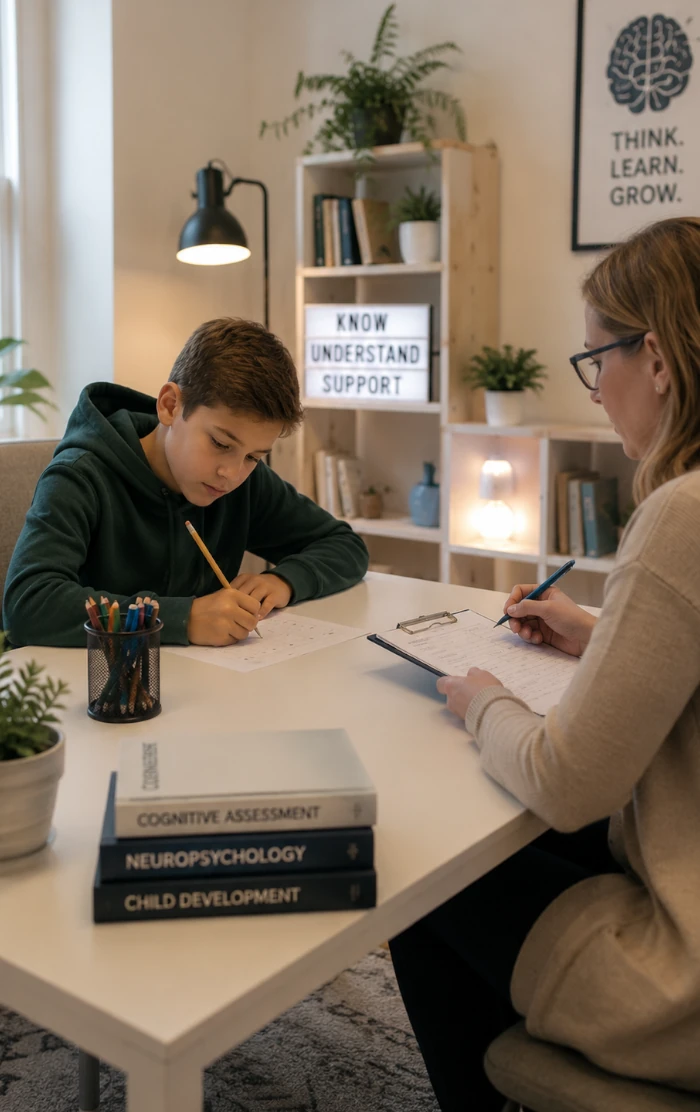
Professional child IQ testing in Kansas City – whether you need an assessment for school placement, gifted program eligibility, or to understand your child's learning profile, we connect you with licensed psychologists in the Kansas City area.
Last Updated: July 2026
Gifted Testing
Identify giftedness for school placement, enrichment, and talent programs using WISC-V or Stanford-Binet 5.
WISC-V Test
Wechsler Intelligence Scale for Children® Fifth Edition – the gold standard for child IQ testing.
Stanford-Binet 5
Stanford-Binet Intelligence Scales Fifth Edition – comprehensive cognitive assessment for all ages.
Full Evaluation
Combined assessment with detailed report and recommendations. Includes WISC-V or Stanford-Binet 5.
School Placement Testing
Testing for private school admission and gifted program eligibility using WISC-V or Stanford-Binet 5.
Schedule Child IQ Testing
Book your WISC-V & Stanford-Binet 5 for ages 6–16. Gifted identification, learning profiles, etc. with a licensed psychologist in Kansas City today.
Child IQ Testing in Kansas City: city context
Kansas City, Missouri is the principal city of a major bi-state metropolitan region spanning western Missouri and eastern Kansas. The city had an estimated 521,220 residents in 2025, up 2.6% from the 2020 estimates base, and covers approximately 314.7 square miles. The wider Kansas City region includes communities on both sides of the state line and supports a large healthcare, engineering, logistics, education, finance, technology, and government workforce.
The city’s educational profile is substantial: 91.9% of adults age 25 and older are high-school graduates or higher, and 38.4% hold a bachelor’s degree or higher. These figures describe educational attainment—not intelligence—and no authoritative source publishes a valid citywide “average IQ” for Kansas City.
IQ by gender & ethnicity (child population)
Kansas City’s population is 51.7% female. Children under age 18 account for 22.5% of Kansas City’s population. Standardized child IQ tests do not use different scoring systems for boys and girls; scores are interpreted against age-based norms, and individual development, education, language, health, and testing conditions matter far more than gender.
Current Census demographic context for Kansas City includes:
- White alone: 56.5% of residents.
- Black or African American alone: 25.5%.
- Asian alone: 2.9%.
- American Indian and Alaska Native alone: 0.4%.
- Native Hawaiian and Other Pacific Islander alone: 0.2%.
- Two or more races: 9.9%.
- Hispanic or Latino: 12.5% of residents; Hispanic origin may overlap with racial categories.
- White alone, not Hispanic or Latino: 54.0%.
- Foreign-born residents: 8.6%.
- Language other than English spoken at home: 13.1% of people age 5 and older.
These statistics describe the community served. They should never be used to infer an individual’s intellectual ability. Professional IQ testing interprets each person’s results using standardized age-based norms, behavioral observations, background information, and the referral question.
Kansas City School Districts and Gifted Programs
Kansas City Public Schools Gifted and Advanced Learning
- District options: KCPS provides magnet, college-preparatory, career, arts, language, and advanced-learning opportunities across its schools.
- Referral: Families should ask the district for the current gifted-referral, screening, eligibility, and service procedures because criteria and testing windows may change.
- School records: Classroom achievement, teacher observations, district assessment data, and other evidence may be considered alongside cognitive measures.
- Outside testing: A private WISC-V or Stanford-Binet report may provide useful information, but the district determines whether and how outside data are used.
North Kansas City Schools SAGE and PEGS
- SAGE: Students in Academically Gifted Education serves kindergarten through grade 8 at the Northland Innovation Center.
- Participation: The district reports serving nearly 700 students each week; most attend one day per week.
- PEGS: The Program for Exceptionally Gifted Students provides a full-time option for qualifying learners.
- High school: Gifted Resource Specialists support identified students in grades 9–12 at district high schools.
- Curriculum: Programming emphasizes real-world problem solving, critical thinking, independent study, collaboration, affective learning, technology, and enrichment.
Park Hill School District Bridges Program
- Elementary model: Bridges is a gifted pull-out program for identified students.
- Schedule: Second- through fifth-grade Bridges students attend one day per week.
- Skills: Instruction emphasizes critical thinking, logic, creativity, problem solving, academic challenge, and affective needs.
- Parent support: The district has developed parent information and support resources related to gifted education.
Lee's Summit, Blue Springs, Liberty, and Independence
- Lee’s Summit R-7: Provides challenging opportunities for elementary gifted students and advanced secondary options.
- Blue Springs: Offers gifted services, advanced coursework, dual-credit pathways, and specialized academic opportunities.
- Liberty: Provides gifted and advanced-learning services in the Northland.
- Independence: Offers gifted services, advanced coursework, career pathways, and early-college opportunities.
- Local criteria: Each Missouri district maintains its own state-aligned identification plan, timelines, instruments, and service model.
Kansas-Side Gifted Programs
- Blue Valley: Gifted education is part of special education; eligible students receive an IEP based on demonstrated educational need.
- Shawnee Mission: Provides gifted education, advanced academics, and specialized services across a large Johnson County district.
- Olathe: Offers gifted education, advanced courses, career academies, and college-credit options.
- Kansas City, Kansas: Provides district academic and specialized programs; families should request current gifted-evaluation procedures.
- State difference: Kansas treats giftedness within special education, so evaluation and eligibility procedures differ from Missouri’s state-approved gifted programs.
Kansas City Private Schools Requiring IQ Testing
Private-school requirements vary by school, grade, and admission year. Families should obtain written instructions directly from the admissions office before paying for testing.
- Pembroke Hill School: A pre-K–12 independent college-preparatory school; current admission testing requirements should be confirmed by grade.
- Barstow School: An independent school serving students from early childhood through grade 12; admissions documentation varies by division.
- Notre Dame de Sion: An independent Catholic school with separate grade-level admission processes.
- Rockhurst High School: A Jesuit college-preparatory school for boys; entrance and placement procedures should be confirmed directly.
- St. Teresa’s Academy: A Catholic college-preparatory school for girls with its own admission and placement process.
- Hyman Brand Hebrew Academy: A Jewish community day school serving multiple grades; families should ask about current evaluation requirements.
- Whitefield Academy and other faith-based schools: Requirements may involve records, interviews, placement tests, achievement data, or psychological testing depending on the student.
- Montessori and specialized schools: Some programs use developmental observations or school-specific assessments rather than a conventional IQ test.
- Important: Do not assume a WISC-V, Stanford-Binet, or private evaluation will be accepted without written confirmation from the school.
Kansas City Gifted Identification Statistics
- No single metro total: Kansas City spans many districts and two states, so there is no authoritative combined count of all gifted students.
- North Kansas City Schools: Reports nearly 700 K–8 students participating weekly in SAGE, with PEGS serving exceptionally gifted learners full time.
- Missouri identification: Districts use state guidance and locally approved criteria across multiple areas of evidence.
- Kansas identification: Giftedness is evaluated through special-education procedures and documented through an IEP for eligible students.
- Equity: Universal screening, local norms, multiple measures, language access, and careful interpretation can reduce under-identification.
- Private testing: Independent results may add detail but do not automatically establish public-school eligibility.
- Score interpretation: A 98th-percentile score is often associated with giftedness, but district eligibility may require additional evidence and educational need.
The child IQ testing process: step by step
Understanding the testing process can help parents prepare their child and reduce anxiety. Here's what to expect:
- Initial consultation (15–20 minutes): A brief phone or video call with the psychologist to discuss your child's background, concerns, and goals. This helps determine the right test and approach.
- Testing session (60–90 minutes): The child meets one-on-one with a licensed psychologist in a quiet, comfortable room. The psychologist administers the WISC-V or Stanford-Binet 5, which includes a series of subtests measuring verbal comprehension, visual-spatial reasoning, fluid reasoning, working memory, and processing speed. Breaks are offered as needed.
- Scoring and interpretation (1–2 days): The psychologist scores the test and analyzes the results. They consider the child's age, background, and any relevant medical or educational history.
- Feedback session (45–60 minutes): The psychologist meets with the parents (and the child, if appropriate) to explain the results. They discuss the Full-Scale IQ, index scores, strengths, and areas for growth. They also provide tailored recommendations for home, school, and extracurriculars.
- Comprehensive written report (5–7 days): You receive a detailed report with all scores, normative comparisons, and actionable next steps. This report can be shared with schools, doctors, or other professionals.
The entire process from consultation to report usually takes 1–2 weeks, depending on scheduling. The testing itself is non-invasive and designed to be engaging for children.
What is the WISC-V test?
The WISC-V (Wechsler Intelligence Scale for Children® – Fifth Edition) is the most widely used IQ test for children aged 6:0–16:11. It provides a Full-Scale IQ and five primary index scores: Verbal Comprehension, Visual-Spatial, Fluid Reasoning, Working Memory, and Processing Speed. The test is administered one-on-one by a trained psychologist and takes about 60–90 minutes.
The WISC-V is normed on a large, representative sample of U.S. children and is updated regularly to ensure accuracy. It is the gold standard for gifted identification, learning disability diagnosis, and school placement.
Why test your child's IQ?
IQ testing provides valuable insights into your child's cognitive strengths and weaknesses. It can help:
- Identify giftedness: For admission to gifted programs, private schools, or enrichment opportunities.
- Diagnose learning disabilities: Such as dyslexia, dyscalculia, or ADHD, which can be masked by high intelligence.
- Guide educational planning: Tailor instruction to your child's unique learning profile.
- Provide reassurance: Understand why your child is different from peers and how to support them.
Kansas City Gifted Testing Timeline
- August–September: Families review district procedures, prior records, teacher observations, and application deadlines.
- Fall: Many schools collect achievement data and accept referrals after teachers observe classroom performance.
- Winter: District or private evaluations may occur for spring eligibility, placement, or planning decisions.
- Spring: Schools communicate decisions, develop service plans, and prepare for the following school year.
- Private-school cycle: Admission deadlines often occur from fall through early spring and vary widely.
- Summer: Private testing may be easier to schedule, but verify that results will still meet the receiving program’s date requirements.
- Retesting: Repeating the same or similar test too soon can invalidate interpretation; disclose all prior testing dates and instruments.
Kansas City Gifted Programs by Age Group
- Preschool: Developmental consultation may be more useful than formal IQ classification unless there is a specific referral need.
- Kindergarten–grade 2: Schools may use screening, enrichment, classroom differentiation, and early referral procedures.
- Grades 2–5: Common services include pull-out programs, cluster grouping, accelerated content, enrichment, and independent projects.
- Grades 6–8: Students may receive advanced courses, gifted seminars, competitions, project-based learning, or specialized centers.
- Grades 9–12: Honors, AP, IB, dual credit, early college, mentorship, research, and individualized gifted-resource support may be available.
- Exceptionally gifted students: North Kansas City’s PEGS is a regional example of a full-time model for highly advanced learners.
- Outside school: Libraries, museums, Science City, universities, coding programs, arts organizations, debate, robotics, and academic competitions provide enrichment.
Kansas City Child ADHD and Learning Disability Assessment
- IQ testing alone is insufficient: ADHD and learning-disorder evaluations require history, symptom and achievement measures, records, observations, and differential diagnosis.
- Public-school evaluation: Families may request an educational evaluation when a suspected disability affects school performance.
- Private evaluation: Independent psychologists may provide broader cognitive, academic, behavioral, emotional, and diagnostic assessment.
- Children’s Mercy: Provides pediatric neuropsychology and related developmental and behavioral services for medically and developmentally complex referrals.
- Twice exceptionality: Gifted children can also have ADHD, autism, dyslexia, anxiety, or other conditions; strengths may mask impairment and impairment may suppress scores.
- Records: Bring report cards, work samples, intervention data, prior testing, medical history, and teacher feedback.
- School plans: Eligibility for an IEP, Section 504 plan, or gifted services is decided under separate legal and educational criteria.
Kansas City Summer Programs for Gifted Children
- Science City: STEM exhibits, camps, demonstrations, and hands-on learning at Union Station.
- Kansas City Zoo & Aquarium: Science, animal, conservation, and youth-learning opportunities.
- Nelson-Atkins Museum of Art: Studio, museum, cultural, and family programs.
- Kansas City Public Library and Mid-Continent Public Library: Reading programs, maker activities, technology, research, and youth events.
- UMKC and area colleges: Seasonal camps and workshops may include music, arts, debate, STEM, athletics, writing, and academic enrichment.
- Johnson County Community College and community programs: Offer youth classes in technology, arts, science, and career exploration.
- Robotics, coding, debate, chess, music, and theater: Private and nonprofit programs operate throughout the metro.
- Selection: Match program intensity to the child’s interests, stamina, social needs, and desire for challenge rather than using IQ alone.
Kansas City Child Testing Costs by District
- Public-school evaluation: Eligible educational evaluations are provided without charge when conducted under special-education or district gifted procedures.
- Private IQ test: Fees vary by provider, test, report depth, records review, and feedback time.
- Psychoeducational evaluation: Costs are higher because achievement, attention, emotional, behavioral, and diagnostic measures may be included.
- Medical neuropsychology: Insurance coverage depends on medical necessity, network status, authorization, deductible, and the referral question.
- School-admission testing: Often self-pay because it is educational rather than medically necessary.
- University clinics: Training clinics may offer lower-cost services, but availability, waitlists, age ranges, and evaluation types vary.
- Cross-state insurance: Missouri and Kansas provider networks and licensing rules may affect coverage and appointment location.
- Written estimate: Ask what is included—testing time, scoring, report, feedback, school consultation, forms, and expedited service—before scheduling.
Areas we serve
We support all areas of Kansas City. School district, provider location, telehealth, and report acceptance should be confirmed for the child’s specific address and purpose.
Frequently Asked Questions
Both are excellent tests. WISC-V is more commonly used for school-age children, while Stanford-Binet 5 can be used for ages 2–85. We often recommend WISC-V for gifted identification.
The test itself takes 60–90 minutes. With the consultation, feedback, and report, the entire process is about 1–2 weeks.
No, you can book directly with our psychologists. We serve both self-referred and professionally referred children.
Yes, our reports are accepted by Kansas City Public Schools, private schools, and other gifted programs.
Some plans cover cognitive assessments when there is a clinical indication. Check with your provider.
Get a good night's sleep, eat a healthy meal, and arrive relaxed. No specific preparation is needed.
You'll receive a comprehensive report with your child's scores and tailored recommendations.
Some components may be available remotely, but test publisher rules, state licensure, age, referral purpose, and receiving-organization requirements determine whether remote administration is appropriate and accepted.