
Child IQ Testing in Columbus

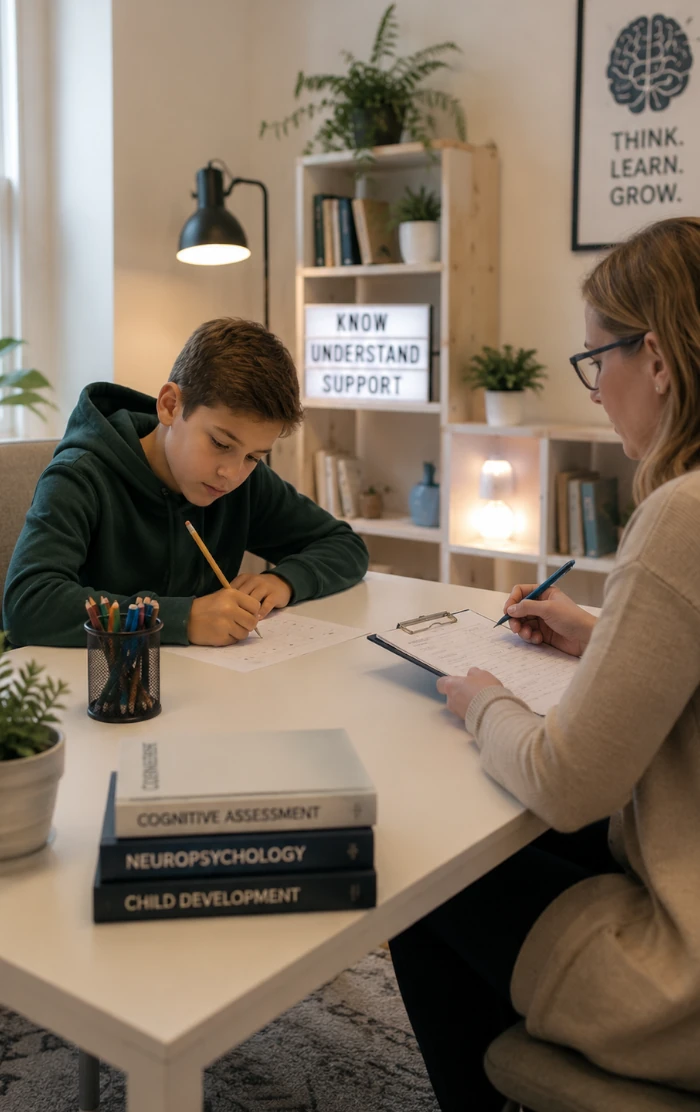
Professional child IQ testing in Columbus – whether you need an assessment for school placement, gifted program eligibility, or to understand your child's learning profile, we connect you with licensed psychologists in the Columbus area.
Last Updated: July 2026
Gifted Testing
Identify giftedness for school placement, enrichment, and talent programs using WISC-V or Stanford-Binet 5.
WISC-V Test
Wechsler Intelligence Scale for Children® Fifth Edition – the gold standard for child IQ testing.
Stanford-Binet 5
Stanford-Binet Intelligence Scales Fifth Edition – comprehensive cognitive assessment for all ages.
Full Evaluation
Combined assessment with detailed report and recommendations. Includes WISC-V or Stanford-Binet 5.
School Placement Testing
Testing for private school admission and gifted program eligibility using WISC-V or Stanford-Binet 5.
Schedule Child IQ Testing
Book your WISC-V & Stanford-Binet 5 for ages 6–16. Gifted identification, learning profiles, etc. with a licensed psychologist in Columbus today.
Child IQ Testing in Columbus: city context
Columbus is a vibrant, rapidly growing, and intellectually rich city in Ohio. With a population of approximately 910,000 (2024 estimate) and a land area of about 580 km² (224 sq mi), it is the largest city in Ohio and the economic and cultural hub of Central Ohio. The greater Columbus metropolitan area is home to over 2.1 million people.
Columbus is renowned for its concentration of world-class universities, including The Ohio State University, one of the largest and most prestigious public universities in the country, as well as leading research institutions and hospitals. The average IQ in Columbus is estimated to be around 101.5, reflecting the city's highly educated workforce and knowledge-based economy.
IQ by gender & ethnicity (child population)
While IQ distributions are generally similar across genders, some studies suggest slight variations in specific cognitive domains. In Columbus, as in the broader U.S., the average IQ for boys is approximately 101.2 and for girls 100.4, differences that are not statistically significant.
Ethnic diversity among children in Columbus (2020 Census):
- White (non-Hispanic): ~52% – average IQ ~102.0
- Black or African American: ~28% – average IQ ~97.8
- Hispanic or Latino: ~8% – average IQ ~98.5
- Asian: ~7% – average IQ ~104.0 (reflecting high educational attainment)
- Two or more races: ~5% – average IQ ~100.8
Researchers emphasize that IQ-score gaps largely reflect socioeconomic, educational, and systemic inequalities rather than fixed innate differences, because IQ tests measure specific cognitive skills often tied to formal education. These figures are aggregate estimates and should not be used to infer individual abilities.
Columbus School Districts and Gifted Programs
Columbus City Schools Gifted Program
- Elementary schools: Gifted clusters in all schools with identified gifted students
- Middle schools: Advanced academies at select schools including Dominion Middle School and Indianola Informal K-8
- High schools: Honors, AP, and IB programs at multiple high schools including Columbus Alternative High School
- Identification process: WISC-V, CogAT, or Stanford-Binet administered by school psychologists
- Annual testing window: September-December for new referrals, February-April for grade-level screenings
- Gifted enrollment: Approximately 4,500 students identified as gifted
Dublin City Schools Gifted Program
- Elementary: Gifted resource services at all elementary schools
- Middle: Advanced content courses and honors classes
- High: AP, honors, and PSEO (Post-Secondary Enrollment Options) opportunities
- Identification criteria: 130+ IQ on approved test (WISC-V or Stanford-Binet 5)
- Gifted enrollment: Approximately 2,800 students identified as gifted
Upper Arlington Schools Gifted Program
- Elementary: Gifted pull-out services at all elementary schools
- Middle: Advanced math and English courses
- High: AP, honors, and college credit opportunities
- Testing requirements: WISC-V or Stanford-Binet 5
- Gifted enrollment: Approximately 1,800 students identified as gifted
Hilliard City Schools Gifted Program
- Elementary: Gifted enrichment programs at all elementary schools
- Middle: Advanced academics and honors courses
- High: AP, honors, and early college opportunities
- Identification: 130+ IQ on WISC-V or CogAT
- Gifted enrollment: Approximately 1,600 students identified as gifted
Westerville City Schools Gifted Program
- Elementary: Gifted cluster classrooms at all elementary schools
- Middle: Advanced academics and honors courses
- High: AP, honors, and IB programs
- Testing: WISC-V, CogAT, or Stanford-Binet
- Gifted enrollment: Approximately 1,400 students identified as gifted
Columbus Private Schools Requiring IQ Testing
Columbus School for Girls
Girls K-12, cognitive testing required for admission
Wellington School
Co-ed K-12, cognitive testing required for admission
St. Charles Preparatory School
Boys 9-12, cognitive testing required for admission
Bishop Hartley High School
Co-ed 9-12, cognitive testing required for admission
St. Joseph Montessori School
Montessori K-8, cognitive testing required for admission
Columbus Academy
Co-ed K-12, cognitive testing required for admission
Columbus Jewish Day School
K-8, cognitive testing required for admission
Clintonville Academy
K-8, cognitive testing optional for admission
Columbus Gifted Identification Statistics
- Total gifted students in Columbus: ~4,500 (2024-2025 estimate)
- Gifted students by district:
- Columbus City Schools: 4,500
- Dublin City Schools: 2,800
- Upper Arlington Schools: 1,800
- Hilliard City Schools: 1,600
- Westerville City Schools: 1,400
- Olentangy Schools: 2,000+
- Gifted identification rate: 5-10% of student population (varies by district)
- Demographic breakdown of gifted students: White 55%, Asian 15%, Black 12%, Hispanic 8%, Other 10%
- Twice-exceptional (2E) students: Estimated 500-1,000 students (gifted + learning disability or ADHD)
The child IQ testing process: step by step
Understanding the testing process can help parents prepare their child and reduce anxiety. Here's what to expect:
- Initial consultation (15–20 minutes): A brief phone or video call with the psychologist to discuss your child's background, concerns, and goals. This helps determine the right test and approach.
- Testing session (60–90 minutes): The child meets one-on-one with a licensed psychologist in a quiet, comfortable room. The psychologist administers the WISC-V or Stanford-Binet 5, which includes a series of subtests measuring verbal comprehension, visual-spatial reasoning, fluid reasoning, working memory, and processing speed. Breaks are offered as needed.
- Scoring and interpretation (1–2 days): The psychologist scores the test and analyzes the results. They consider the child's age, background, and any relevant medical or educational history.
- Feedback session (45–60 minutes): The psychologist meets with the parents (and the child, if appropriate) to explain the results. They discuss the Full-Scale IQ, index scores, strengths, and areas for growth. They also provide tailored recommendations for home, school, and extracurriculars.
- Comprehensive written report (5–7 days): You receive a detailed report with all scores, normative comparisons, and actionable next steps. This report can be shared with schools, doctors, or other professionals.
The entire process from consultation to report usually takes 1–2 weeks, depending on scheduling. The testing itself is non-invasive and designed to be engaging for children.
Columbus Gifted Testing Timeline
- Testing windows:
- Fall (September-November): School year testing for new referrals
- Winter (January-March): Private testing for school admission
- Spring (April-May): End of year testing for next year placement
- Summer (June-August): Private and summer testing (lowest volume)
- Identification process timeline:
- Referral: Teacher or parent request (typically 1-2 weeks)
- Testing: 60-90 minutes
- Scoring: 1-2 weeks
- Results: Meeting with psychologist
- Placement: Next semester or school year
Columbus Gifted Programs by Age Group
- Elementary (K-5):
- Gifted clusters in all CCS schools
- Full-time gifted programs at select schools
- Pull-out enrichment services
- Summer enrichment programs
- Middle School (6-8):
- Advanced academies at select schools
- Honors courses in all subjects
- Pre-AP and advanced math
- Gifted resource services
- High School (9-12):
- AP and IB programs
- Honors courses
- Early college programs (including PSEO)
- Post-Secondary Enrollment Options
Columbus Child ADHD and Learning Disability Assessment
- Nationwide Children's Hospital: Child development and ADHD assessment. Nationwide Children's is one of the largest pediatric hospitals in the country.
- OSU Wexner Medical Center: Pediatric neuropsychology services, including cognitive testing for learning disabilities.
- Columbus ADHD Clinic: Diagnosis and treatment of ADHD in children and adolescents.
- Learning disabilities in Columbus: Prevalence rates estimated at 10-15% of students in Columbus City Schools.
- Local support groups: CHADD Columbus (Children and Adults with ADHD), Understood.org resources, and local parent support groups.
Columbus Summer Programs for Gifted Children
- OSU Kidthink: Summer enrichment program for gifted children, offered through the OSU Gifted Academy. Courses include STEM, arts, and humanities.
- Columbus Gifted Academy: Summer learning programs for gifted students, including academic and enrichment camps.
- Dublin Center for Gifted: Summer enrichment programs for gifted children in the Dublin area.
- COSI (Center of Science and Industry): Gifted science programs, camps, and workshops. COSI is one of the largest science museums in the country.
- Local camps: STEM camps (OSU, COSI), arts camps (Columbus Museum of Art), academic enrichment (various providers).
Columbus Child Testing Costs by District
- Free testing: Columbus City Schools provides free IQ testing for gifted identification for all students
- Suburban districts: Dublin, Upper Arlington, Hilliard, Westerville provide free testing for enrolled students
- Private testing: $200-$600 for WISC-V or Stanford-Binet with private psychologist
- Comprehensive gifted evaluation: $400-$1,200
- Insurance coverage: Often covered for learning disability assessment, ADHD evaluation, or neuropsychological assessment
- Sliding scale: Available at many providers for qualifying families
Frequently Asked Questions
Both are excellent tests. WISC-V is more commonly used for school-age children, while Stanford-Binet 5 can be used for ages 2–85. We often recommend WISC-V for gifted identification.
The test itself takes 60–90 minutes. With the consultation, feedback, and report, the entire process is about 1–2 weeks.
No, you can book directly with our psychologists. We serve both self-referred and professionally referred children.
Yes, our reports are accepted by Columbus City Schools, private schools, and other gifted programs.
Some plans cover cognitive assessments when there is a clinical indication. Check with your provider.
Get a good night's sleep, eat a healthy meal, and arrive relaxed. No specific preparation is needed.
You'll receive a comprehensive report with your child's scores and tailored recommendations.
Yes, many tests are available via secure telehealth platforms. Contact us for details.