
Child IQ Testing in Boston

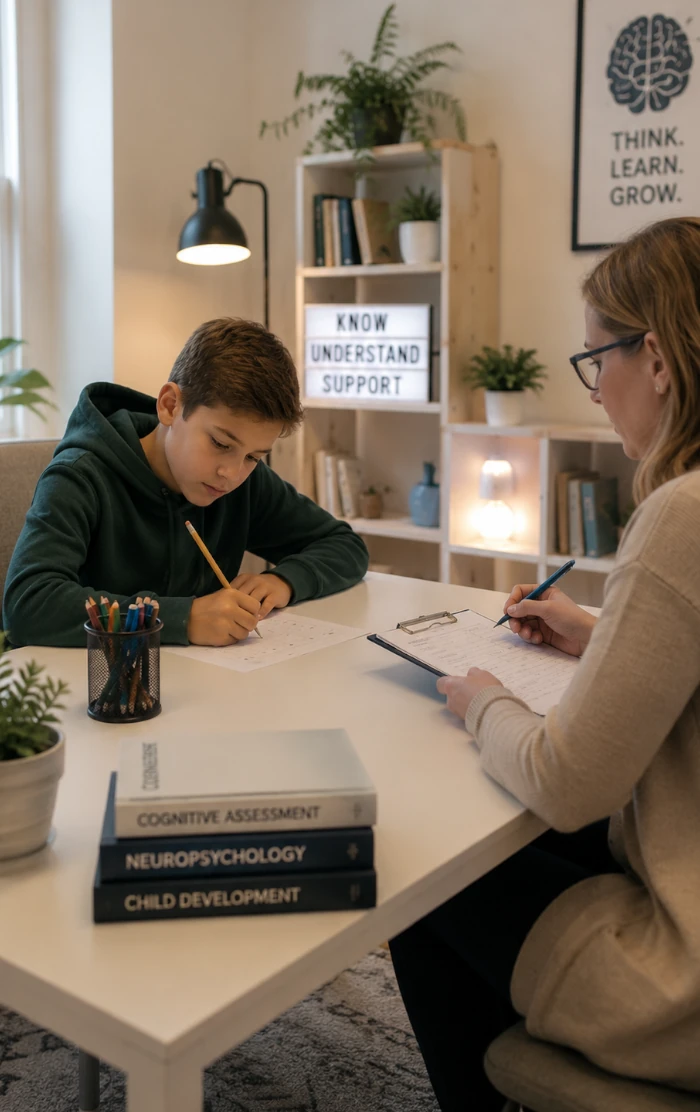
Professional child IQ testing in Boston – whether you need an assessment for school placement, gifted program eligibility, or to understand your child's learning profile, we connect you with licensed psychologists in the Boston area.
Last Updated: August 2026
Gifted Testing
Identify giftedness for school placement, enrichment, and talent programs using WISC-V or Stanford-Binet 5.
WISC-V Test
Wechsler Intelligence Scale for Children® Fifth Edition – the gold standard for child IQ testing.
Stanford-Binet 5
Stanford-Binet Intelligence Scales Fifth Edition – comprehensive cognitive assessment for all ages.
Full Evaluation
Combined assessment with detailed report and recommendations. Includes WISC-V or Stanford-Binet 5.
School Placement Testing
Testing for private school admission and gifted program eligibility using WISC-V or Stanford-Binet 5.
Schedule Child IQ Testing
Book your WISC-V & Stanford-Binet 5 for ages 6–16. Gifted identification, learning profiles, etc. with a licensed psychologist in Boston today.
Child IQ Testing in Boston: city context
Boston is a historic, vibrant, and intellectually rich city in Massachusetts. With a population of approximately 675,000 (2024 estimate) and a land area of about 125 km² (48.4 sq mi), it is the 24th most populous city in the United States and the economic and cultural hub of New England. The greater Boston metropolitan area is home to over 4.9 million people.
Boston is world-renowned for its concentration of universities, research institutions, and hospitals. The average IQ in Boston is estimated to be around 101.2, above the national average of 100, reflecting the city's highly educated population and knowledge-based economy.
IQ by gender & ethnicity (child population)
While IQ distributions are generally similar across genders, some studies suggest slight variations in specific cognitive domains. In Boston, as in the broader U.S., the average IQ for boys is approximately 100.3 and for girls 100.0, differences that are not statistically significant.
Ethnic diversity among children in Boston (2020 Census):
- White (non-Hispanic): ~44% – average IQ ~101.8
- Black or African American: ~22% – average IQ ~96.8
- Hispanic or Latino: ~19% – average IQ ~97.5
- Asian: ~10% – average IQ ~103.5 (reflecting high educational attainment)
- Two or more races: ~5% – average IQ ~100.2
Researchers emphasize that IQ-score gaps largely reflect socioeconomic, educational, and systemic inequalities rather than fixed innate differences, because IQ tests measure specific cognitive skills often tied to formal education. These figures are aggregate estimates and should not be used to infer individual abilities.
The child IQ testing process: step by step
Understanding the testing process can help parents prepare their child and reduce anxiety. Here's what to expect:
- Initial consultation (15–20 minutes): A brief phone or video call with the psychologist to discuss your child's background, concerns, and goals. This helps determine the right test and approach.
- Testing session (60–90 minutes): The child meets one-on-one with a licensed psychologist in a quiet, comfortable room. The psychologist administers the WISC-V or Stanford-Binet 5, which includes a series of subtests measuring verbal comprehension, visual-spatial reasoning, fluid reasoning, working memory, and processing speed. Breaks are offered as needed.
- Scoring and interpretation (1–2 days): The psychologist scores the test and analyzes the results. They consider the child's age, background, and any relevant medical or educational history.
- Feedback session (45–60 minutes): The psychologist meets with the parents (and the child, if appropriate) to explain the results. They discuss the Full-Scale IQ, index scores, strengths, and areas for growth. They also provide tailored recommendations for home, school, and extracurriculars.
- Comprehensive written report (5–7 days): You receive a detailed report with all scores, normative comparisons, and actionable next steps. This report can be shared with schools, doctors, or other professionals.
The entire process from consultation to report usually takes 1–2 weeks, depending on scheduling. The testing itself is non-invasive and designed to be engaging for children.
What is the WISC-V test?
The WISC-V (Wechsler Intelligence Scale for Children® – Fifth Edition) is the most widely used IQ test for children aged 6:0–16:11. It provides a Full-Scale IQ and five primary index scores: Verbal Comprehension, Visual-Spatial, Fluid Reasoning, Working Memory, and Processing Speed. The test is administered one-on-one by a trained psychologist and takes about 60–90 minutes.
The WISC-V is normed on a large, representative sample of U.S. children and is updated regularly to ensure accuracy. It is the gold standard for gifted identification, learning disability diagnosis, and school placement.
Why test your child's IQ?
IQ testing provides valuable insights into your child's cognitive strengths and weaknesses. It can help:
- Identify giftedness: For admission to gifted programs, private schools, or enrichment opportunities.
- Diagnose learning disabilities: Such as dyslexia, dyscalculia, or ADHD, which can be masked by high intelligence.
- Guide educational planning: Tailor instruction to your child's unique learning profile.
- Provide reassurance: Understand why your child is different from peers and how to support them.
Areas we serve
We provide child IQ testing services throughout the Boston metropolitan area, including Back Bay, Beacon Hill, Cambridge, Brookline, Somerville, Newton, Wellesley, and surrounding communities. Our psychologists also offer virtual testing options for Massachusetts residents who cannot attend in person.
Frequently Asked Questions
Both are excellent tests. WISC-V is more commonly used for school-age children, while Stanford-Binet 5 can be used for ages 2–85. We often recommend WISC-V for gifted identification.
The test itself takes 60–90 minutes. With the consultation, feedback, and report, the entire process is about 1–2 weeks.
No, you can book directly with our psychologists. We serve both self-referred and professionally referred children.
Yes, our reports are accepted by Boston Public Schools, private schools, and other gifted programs.
Some plans cover cognitive assessments when there is a clinical indication. Check with your provider.
Get a good night's sleep, eat a healthy meal, and arrive relaxed. No specific preparation is needed.
You'll receive a comprehensive report with your child's scores and tailored recommendations.
Yes, many tests are available via secure telehealth platforms. Contact us for details.